Ashtanga Ayurveda – The 8 Branches of Healing

Ayurveda, the ancient “Science of Life” originating in India over 5,000 years ago, presents a holistic and profoundly intricate system of medicine. Unlike modern allopathic medicine, which often focuses on specialized organs or systems, Ayurveda views the human being as an inseparable microcosm of the universe, governed by the same fundamental energies (Doshas: Vata, Pitta, Kapha).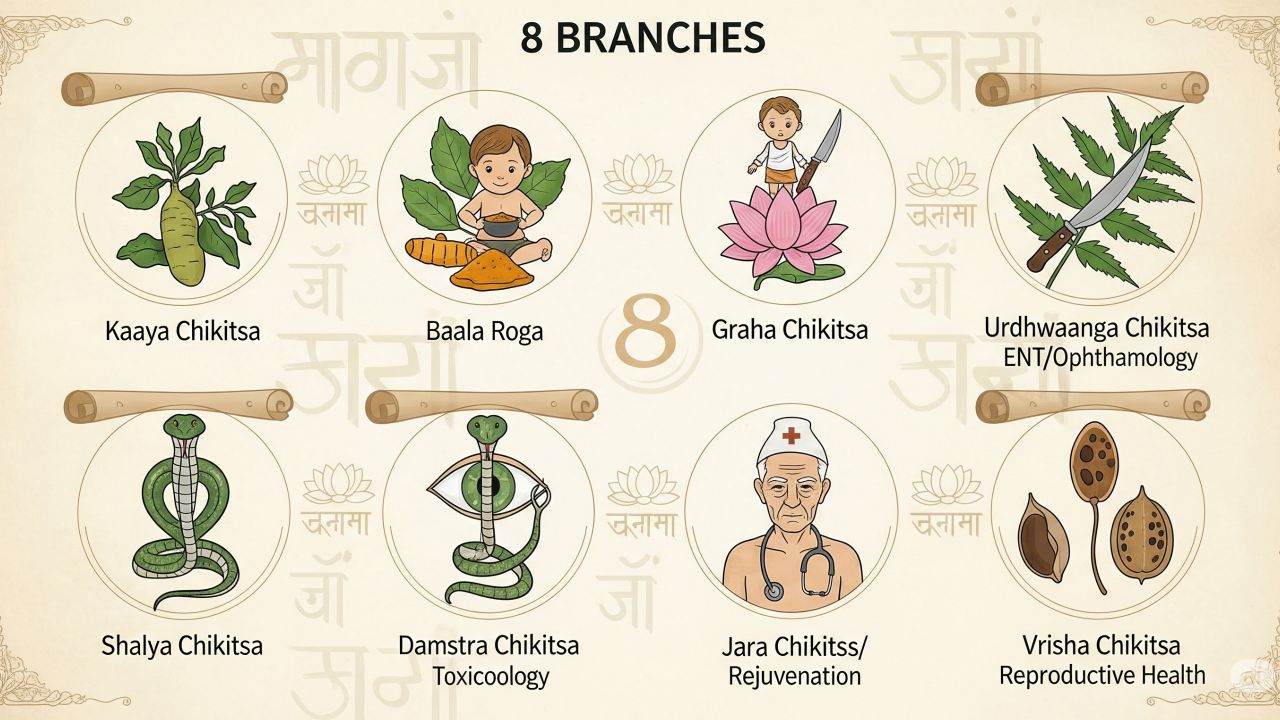 Its comprehensiveness is perhaps best encapsulated in its foundational structure: Ashtanga Ayurveda, the Eight Branches of Ayurveda. These branches represent a complete medical system, covering every conceivable aspect of human health, disease, treatment, and well-being, from conception to death and beyond, encompassing the physical, mental, and spiritual dimensions.
This article delves deep into each of these eight pillars, exploring their historical roots, core philosophies, diagnostic approaches, treatment modalities, and enduring relevance in the modern world.
Ashtanga Ayurveda: The Core Branches of Ayurvedic Medicine
Ayurveda’s foundational texts, primarily the Charaka Samhita (Internal Medicine), the Sushruta Samhita (Surgery), and the Ashtanga Hridaya/Sangraha (Compendium of Eight Branches), establish the framework of Ashtanga.
This structure wasn’t arbitrary; it arose from the profound understanding that health manifests through harmony on multiple interconnected levels.
Treating a skin disease (potentially under Kayachikitsa or Shalya) without considering digestive health (Kayachikitsa) or mental state (Bhuta Vidya) would be incomplete.
Similarly, promoting longevity (Rasayana) requires attention to childhood health (Kaumarbhritya) and reproductive vitality (Vajikarana). The eight branches are:
- Kayachikitsa (Internal Medicine)
- Shalya Tantra (Surgery)
- Shalakya Tantra (ENT, Ophthalmology & Diseases above Clavicles)
- Kaumarbhritya (Pediatrics, Obstetrics & Gynecology)
- Agada Tantra (Toxicology)
- Bhuta Vidya (Psychiatry, Psychology & Spiritual Healing)
- Rasayana Tantra (Rejuvenation & Geriatrics)
- Vajikarana Tantra (Aphrodisiacs, Reproductive Health & Virilification)
This structure ensured Ayurveda developed sophisticated expertise in specialized areas while maintaining its core holistic principle: treating the individual, not just the disease.
Deep Dive into the Eight Branches
1. Kayachikitsa (Internal Medicine): The Foundation of Balance
Core Philosophy: Kayachikitsa forms the bedrock of Ayurvedic practice. It focuses on diagnosing and treating systemic diseases affecting the entire body or multiple systems, primarily arising from imbalances in the three Doshas (Vata, Pitta, Kapha).
The seven Dhatus (tissues: plasma, blood, muscle, fat, bone, marrow/nervous, reproductive), the Malas (wastes), and Agni (digestive/metabolic fire). Health is seen as a state of dynamic equilibrium (Swasthya), and disease (Vikara) as its disturbance.
Scope: Encompasses a vast array of conditions: fever (Jwara), digestive disorders (Grahani, Ajirna), respiratory diseases (Kasa, Swasa, Rajayakshma/TB), metabolic disorders (Prameha/Diabetes, Medoroga/Obesity).
Besides this, musculoskeletal disorders (Amavata/Rheumatoid Arthritis, Sandhigata Vata/Osteoarthritis), neurological conditions (Pakshaghata/Paralysis), skin diseases (Kushtha), anemia (Pandu), urinary disorders (Mutrakrichhra), and general debility (Daurbalya).
Diagnostic Approach: Employs the sophisticated “Ashtavidha Pariksha” (Eightfold Examination): Nadi (pulse diagnosis), Mootra (urine), Mala (stool), Jihva (tongue), Shabda (voice/speech), Sparsha (touch/skin), Druk (eyes/vision), and Aakriti (general appearance/build).
Detailed patient history (Prashna Pariksha) focusing on diet, lifestyle, habits, and mental state is paramount.
Treatment Modalities: Aims to restore balance through:
- Nidana Parivarjana: Eliminating causative factors (dietary, lifestyle, environmental).
- Shodhana Chikitsa (Purification): Primarily Panchakarma – Vamana (emesis), Virechana (purgation), Basti (medicated enema), Nasya (nasal administration), Raktamokshana (bloodletting). Removes accumulated toxins (Ama) and excess Doshas.
- Shamana Chikitsa (Palliation): Using herbs, diet (Ahara Chikitsa), lifestyle routines (Dinacharya, Ritucharya), and mild cleansing procedures to pacify aggravated Doshas without radical elimination.
- Rasayana & Vajikarana: Used adjunctively for rejuvenation and strengthening.
- Pathya Vyavastha: Prescribing specific dietary and lifestyle regimens tailored to the individual and disease.
Modern Relevance: Kayachikitsa’s emphasis on prevention, root-cause analysis, personalized treatment, diet, and lifestyle management resonates deeply with modern functional and integrative medicine approaches.
Its strategies for managing chronic lifestyle disorders like diabetes, arthritis, and digestive issues are increasingly sought after.
2. Shalya Tantra (Surgery): The Art of Precision
Core Philosophy: This branch focuses on diseases requiring physical intervention for removal or correction. Ancient Ayurvedic surgeons recognized that certain pathologies (like abscesses, tumors, stones, or severe trauma) could not be resolved solely by internal medicine and required skillful manual intervention.
Sushruta, the father of surgery, emphasized the surgeon’s need for profound anatomical knowledge, steady hands, keen observation, and compassion.
Scope: Extensive and surprisingly advanced for its time:
- General Surgery: Abscess drainage, wound management (Vrana Chikitsa – highly detailed), hernia repair, anal fistulas/hemorrhoids (Arsha), hydrocele.
- Oncological Surgery: Removal of tumors (Arbuda, Granthi) – benign and malignant.
- Orthopedic Surgery: Fracture management (Bhagna), dislocation reduction, amputation techniques.
- Laparotomy: Abdominal surgery for conditions like intestinal obstruction or perforation.
- Lithotomy: Removal of bladder stones (Ashmari).
- Plastic & Reconstructive Surgery: Pioneered techniques like skin grafting (especially forehead flap rhinoplasty – rebuilding noses, often lost due to punishment or war).
Diagnostic Approach: Relied heavily on inspection (Darshana), palpation (Sparshana), and patient history. Understanding the stage and nature of wounds (Vrana) was particularly sophisticated.
Treatment Modalities:
- Instruments (Yantra & Shastra): Described over 120 sharp (shastra – knives, scalpels, lancets) and 300 blunt (yantra – forceps, probes, specula, cauteries) instruments, many resembling modern counterparts.
- Surgical Techniques: Detailed procedures for incision (Chhedana), excision (Bhedana), scarification (Lekhana), puncture (Vedhana), probing (Eshana), extraction (Aharana), drainage (Visravana), and suturing (Sevana). Used natural sutures (ant heads, horsehair, fibers).
- Pre & Post-Operative Care: Emphasized purification (Panchakarma) before major surgery, dietary regimens, wound dressings (using honey, ghee, herbs like Turmeric), and physiotherapy.
- Anesthesia: Used herbal decoctions (e.g., wine infused with herbs like Cannabis, Datura, Aconite) and medicated oils for local and general anesthesia.
Modern Relevance: While modern surgery has advanced technologically, Sushruta’s anatomical descriptions, principles of asepsis (though not microbial theory), meticulous wound management techniques, and emphasis on surgical ethics remain foundational.
Ayurvedic hospitals still practice Shalya Tantra, particularly for piles, fistulas, wound care, and certain orthopedic conditions, often integrating with modern diagnostics.
3. Shalakya Tantra (ENT, Ophthalmology & Supraclavicular Diseases): Guardians of the Senses
Core Philosophy: Focuses on diseases affecting the organs “above the clavicles” – the head and neck region. This branch acknowledges the vital importance of the senses (Indriyas) in experiencing life and interacting with the world. It developed specialized diagnostic and therapeutic approaches for these delicate organs.
Scope:
- Ophthalmology (Netra Chikitsa): Conjunctivitis (Abhishyanda), cataracts (Kacha, Linganasha), glaucoma (Adhimantha), corneal ulcers (Savrana Shukra), refractive errors, pterygium (Arma), trachoma, dry eyes. Detailed descriptions of eye anatomy and layers.
- Otorhinolaryngology (ENT – Karna-Nasa-Mukha-Roga Chikitsa): Ear infections (Karna Shula), hearing loss (Badhirya), tinnitus (Karna Nada), vertigo (Bhrama); nasal disorders (Nasagata Roga) like rhinitis (Pinas), sinusitis (Dushta Pratishyaya), nosebleeds (Urdhva Raktapitta); throat conditions (Mukha Roga) like tonsillitis (Tundikeri), hoarseness (Swara Bheda), oral ulcers (Mukhapaka).
- Dentistry (Danta Chikitsa): Toothache (Danta Shula), gum disease (Danta Moolagata Roga), dental caries, tooth mobility.
- Cephalic Disorders: Headaches (Shirashoola), migraines (Ardhavabhedaka), facial paralysis (Ardita).
Diagnostic Approach: Detailed inspection of eyes, ears, nose, mouth, and throat; assessment of secretions; functional testing (vision, hearing, smell, taste); palpation of head and neck regions; pulse diagnosis relevant to the head.
Treatment Modalities:
- Specialized Instruments (Shalakas): Probes, applicators, droppers, specula, and mirrors designed specifically for each orifice.
- Local Therapies: Extensive use of medicated oils (Taila), ghees (Ghrita), powders (Churna), pastes (Kalka), decoctions (Kashaya), and fumes (Dhuma) administered as:
- Netra Kriyakalpa: Eye treatments like Tarpana (pooling medicated ghee over the eye), Putapaka (poultices), Seka (irrigation), Aschyotana (eye drops), Anjana (collyrium/eye salve).
- Nasya: Nasal administration of medicated oils/powders/decoctions – crucial for head/neck disorders and systemic effects.
- Karna Purna: Filling ears with medicated oils.
- Gandoosha/Kavala: Oil pulling/gargling for oral health.
- Internal Medications: Herbs to support specific organs and balance Doshas internally.
- Surgical Interventions: For conditions like cataracts (couching technique), nasal polyps, severe tonsillitis.
Modern Relevance: Shalakya Tantra offers valuable, non-invasive, and preventive approaches for common ENT and eye issues (dry eyes, sinusitis, oral hygiene, headaches). Nasya therapy is particularly recognized for its benefits in neurological and respiratory conditions. Its emphasis on local drug delivery systems is sophisticated.
4. Kaumarbhritya (Pediatrics, Obstetrics & Gynecology): Nurturing the Future
Core Philosophy: Dedicated to the care of women during pregnancy and childbirth, and the health of children from conception through adolescence.
It recognizes the profound vulnerability and unique physiological needs of both mother and child, viewing them as intrinsically linked. “Kaumarabhritya” literally translates to “the care of the child.”
Scope:
- Obstetrics (Garbhini Paricharya): Comprehensive prenatal care (month-by-month regimens), management of pregnancy disorders (hyperemesis, edema, bleeding), normal and complicated labor protocols, postpartum care (Sutika Paricharya) for mother and newborn, lactation support.
- Neonatology & Pediatrics (Balaroga Chikitsa): Newborn care (Navajata Shishu Paricharya), breastfeeding guidance, childhood nutrition (Phalaprashana/solid food introduction), management of common childhood diseases (fever, diarrhea, respiratory infections, worms/Krimi), developmental disorders, teething problems, epilepsy (Apasmara).
- Gynecology (Stri Roga): Management of menstrual disorders (Artava Dushti), leucorrhea (Shveta Pradara), infertility (Vandhyatva), pelvic inflammatory disease, uterine fibroids, menopausal syndrome (Rajonivritti Janya Vikara).
Diagnostic Approach: Specific examination techniques for infants and children (e.g., examining the umbilical cord, cry, fontanelles). Detailed menstrual history for women.
Emphasis on observing the mother’s health as an indicator of the child’s well-being and vice versa.
Treatment Modalities:
- Preventive & Promotive: Emphasis on preconception care (Garbhadhana Sanskar), meticulous prenatal routines (diet, lifestyle, mental well-being, therapies like Snehana/Abhyanga), postnatal rejuvenation and bonding protocols, childhood immunization concepts (through processed smallpox scabs – an early form of variolation), and establishing healthy routines (Dinacharya for children).
- Gentle Therapeutics: Use of mild herbs, medicated ghees (e.g., Brahmi Ghrita for intellect), specific milk decoctions (Ksira Kashaya), nutritional supplements (like Chyawanprash for children), gentle massage (Balabhyanga), and lifestyle modifications tailored for mothers and children.
- Samskaras: Prescribed rituals at key life stages (like Simantonayana – parting of hair during pregnancy, Annaprashana – first solid food) promoting psychological and spiritual well-being.
Modern Relevance: Kaumarbhritya’s holistic approach to maternal health (preventing complications, promoting natural birth, postpartum recovery) and pediatrics (preventive care, boosting immunity, managing common ailments gently) aligns perfectly with contemporary midwifery, naturopathic pediatrics, and integrative women’s health. Its focus on nutrition and lifestyle for mothers and children is timeless.
5. Agada Tantra (Toxicology): The Science of Poisons
Core Philosophy: Dedicated to understanding, preventing, and treating conditions arising from exposure to poisons (Visha), whether animate (animal venoms) or inanimate (plant, mineral, artificial).
It recognizes poisons as potent disruptors of Dosha balance and vital functions. Expertise in Agada Tantra was historically crucial for kings and communities.
Scope:
- Sthavara Visha (Plant/Inanimate Poisons): Poisonous plants, mushrooms, minerals (like arsenic, lead), contaminated food/water, artificial poisons.
- Jangama Visha (Animal Poisons): Venomous snake bites (Sarpavisha), scorpion stings (Vrishchika Damsha), spider bites, insect bites/stings, rabid animal bites.
- Gara Visha (Combined/Artificial Poisons): Complex poisons created by combining substances; slow-acting poisons.
- Dushi Visha (Chronic Toxicity): Effects of long-term, low-dose exposure to toxins (e.g., environmental pollutants, heavy metals, improper medication use – concepts remarkably modern).
- Food Poisoning (Aharaja Visha).
Diagnostic Approach: Detailed history of exposure; examination of bite/sting marks; identifying symptoms based on toxin type (e.g., neurotoxic vs. hemotoxic snake venom); assessing vital signs; observing characteristic changes in body fluids (like urine/sputum color).
Treatment Modalities:
- Prevention: Identification of poisonous substances, safe food/water practices, and protective measures against venomous creatures.
- Immediate First Aid: Techniques like suction, tourniquets (with cautions), local incisions for venom extraction, and application of specific herbs to the bite site.
- Antidotes (Vishaghna Dravya): A vast pharmacopeia of herbal, mineral, and animal-derived antidotes administered orally, nasally, or topically. Famous formulations include combinations like Tribhuvana Kirti Rasa.
- Shodhana (Detoxification): Aggressive use of Panchakarma (especially Vamana, Virechana, Basti) to eliminate absorbed toxins.
- Shamana (Symptom Management): Herbs to support vital functions, reduce pain, inflammation, and counteract specific toxic effects.
Modern Relevance: While modern anti-venoms are life-saving for snake bites, Agada Tantra’s principles for managing poisoning symptoms, supporting organ function, and detoxification.
It helps treating chronic low-grade toxicity (highly relevant today) remain valuable. Its herbal antidotes are studied for potential applications. The concept of Dushi Visha foreshadowed modern environmental medicine.
6. Bhuta Vidya (Psychiatry, Psychology & Spiritual Healing): Healing the Mind-Spirit
Core Philosophy: Addresses disorders of the mind (Manas), intellect (Buddhi), consciousness (Chitta), and ego (Ahamkara), often attributed to imbalances in subtle energies or affliction by negative external influences (Bhutas – encompassing microbial, psychological, and spiritual entities in the classical context). It integrates mental, emotional, and spiritual well-being.
Scope:
- Mental Disorders: Psychosis (Unmada), depression (Vishada), anxiety disorders (Chittodvega), phobias (Bhaya), hysteria (Apasmara – overlapping with epilepsy), dementia, and personality disorders.
- Spiritual/Subtle Afflictions: Conditions where behavior or illness was traditionally attributed to affliction by negative energies or planetary influences (Graha Badha). This includes concepts of possession.
- Stress-related Disorders: Somatization of mental distress.
- Epilepsy (Apasmara): Often addressed within this branch due to its behavioral manifestations.
Diagnostic Approach: Detailed observation of behavior, speech, thought patterns, sleep, dreams, physical signs, and pulse diagnosis. Assessment of Sattva (purity/clarity of mind), Rajas (activity/agitation), and Tamas (inertia/delusion) qualities. History focuses on life events, traumas, and family background.
Treatment Modalities: A truly integrated approach:
Daivavyapashraya Chikitsa (Spiritual Therapy): Mantras (sacred chants), Yantras (sacred diagrams), wearing gemstones (Mani), specific rituals (Homa), prayers, and pilgrimage. Aims to harmonize subtle energies and provide psychological comfort.
Yuktivyapashraya Chikitsa (Rational Therapy):
- Medhya Rasayanas: Herbs specifically for intellect and mental clarity (Brahmi, Shankhapushpi, Mandukaparni, Jyotishmati).
- Panchakarma: Crucial for clearing mental toxins (Manasa Ama).
- Diet & Lifestyle: Sattvic diet (pure, light), calming routines, yoga (especially Pranayama), meditation (Dhyana).
- Counseling (Satvavajaya): Literally “winning back the mind.” Involves psychotherapy techniques like cognitive reorientation, moral guidance, cultivating positive emotions, reducing attachment/aversion, building willpower.
Sattvavajaya Chikitsa (Psychotherapy): As mentioned above, a sophisticated system for managing the mind.
Modern Relevance: Bhuta Vidya’s holistic view of mental health, combining spiritual support, psychotherapy, herbal medicine, lifestyle changes, and purification, is highly congruent with integrative psychiatry and trauma-informed care.
Its focus on Sattvavajaya is a profound ancient psychotherapeutic model. Medhya Rasayanas are widely studied for cognitive support and neuroprotection.
7. Rasayana Tantra (Rejuvenation & Geriatrics): The Elixir of Life
Core Philosophy: Focuses on promoting longevity (Ayus), enhancing vitality (Bala), preventing aging (Jara) and disease (Vyadhi), improving mental and physical resilience, and achieving optimal health and radiance (Prabha). It’s not merely anti-aging but pro-vitality at any age. Rasayana means “the path (Ayana) of essence (Rasa).”
Scope:
- Enhancing overall health, immunity (Vyadhikshamatva), and lifespan.
- Slowing the aging process and reversing age-related degeneration.
- Boosting specific systems: intellect, memory, sensory acuity, skin health, sexual vitality, musculoskeletal strength.
- Preventing and managing degenerative diseases associated with aging.
- Promoting tissue nourishment (Dhatu Poshan).
Prerequisites (Rasayana Paricharya): Rasayana is never administered casually. It requires thorough preparation:
- Shodhana: Complete Panchakarma to eliminate toxins (Ama) and Dosha imbalances.
- Deepana/Pachana: Optimizing digestive fire (Agni).
- Samsarjana Krama: Gradual dietary normalization after Shodhana.
Treatment Modalities:
- Kutipravesika Rasayana: Intensive, secluded retreat-like treatment involving specific diet, herbs, and practices within a specially constructed hut.
- Vatatapika Rasayana: Less intensive, practiced while continuing normal daily duties.
- Aushadha Rasayana: Herbal, mineral, and animal-derived rejuvenatives (e.g., Amalaki, Ashwagandha, Shatavari, Guduchi, Bala, Gold preparations (Swarna Bhasma), Chyawanprash).
- Ahara Rasayana: Rejuvenative dietary protocols (e.g., milk, ghee, honey, specific fruits/vegetables).
- Achara Rasayana: Rejuvenative lifestyle & ethical conduct (truthfulness, non-violence, charity, self-control, meditation, yoga).
Modern Relevance: The global anti-aging and wellness industries echo Rasayana’s goals. Scientific research increasingly validates the adaptogenic, immunomodulatory, antioxidant, and neuroprotective properties of many Rasayana herbs.
Its emphasis on detoxification, gut health, stress management, and ethical living as foundations for vitality is profoundly relevant. Geriatric care benefits immensely from its holistic approach.
8. Vajikarana Tantra (Aphrodisiacs, Reproductive Health & Virilification): The Seed of Life
Core Philosophy: Focuses on enhancing sexual health, potency (Virya), and pleasure (Sukha); treating sexual dysfunctions; improving the quality and quantity of reproductive tissues (Shukra Dhatu – semen/ovum); and promoting the conception of healthy, virtuous offspring. “Vaji” means horse (symbolizing strength/stamina), “karana” means making. It aims to create vitality like a horse.
Scope:
- Male Sexual Health: Erectile dysfunction (Klaibya), premature ejaculation, low libido (Naraharsha), oligospermia (low sperm count), poor sperm motility/morphology.
- Female Sexual Health: Low libido, anorgasmia, and infertility related to reproductive tissue quality.
- General Reproductive Health: Enhancing Shukra Dhatu quality in both partners, supporting fertility, promoting conception of healthy children (Prajnaprada).
- Genitourinary Disorders: Related to sexual function.
Prerequisites: Similar to Rasayana, Vajikarana requires preparatory Shodhana (especially Basti) and optimization of digestion (Agni). It’s often undertaken after Rasayana to build upon the foundation of vitality.
Treatment Modalities:
- Vajikarana Dravyas: Specific aphrodisiac herbs (e.g., Ashwagandha, Shatavari, Kapikacchu, Safed Musli, Gokshura, Vidari Kanda, Shilajit) are often processed with milk, ghee, or honey into formulations (Lehyams, Avalehas, Vatis).
- Diet (Ahara): Nourishing foods like milk, ghee, nuts, dates, eggs, and meat broths (traditionally, when indicated and ethically sourced).
- Lifestyle (Vihara): Stress management, adequate sleep, specific exercises (to strengthen pelvic region), moderation in sexual activity, cultivating healthy relationships.
- Psychological Counseling: Addressing performance anxiety, relationship issues affecting intimacy.
- Rasayana Support: Often used synergistically.
Modern Relevance: Vajikarana addresses widespread concerns about sexual health and fertility. Many of its herbs have been clinically studied for improving libido, erectile function, sperm parameters, and hormonal balance.
Its holistic approach, combining physical, nutritional, and psychological support, is crucial for effective management of sexual dysfunctions and infertility.
Ashtanga Yoga for Whole-Body Health
The true genius of Ashtanga Ayurveda lies in its integrated nature. A practitioner doesn’t rigidly confine themselves to one branch.
Treating infertility (Vajikarana) might require addressing digestive issues (Kayachikitsa) and stress (Bhuta Vidya). Managing a chronic eye disease (Shalakya) necessitates understanding systemic health (Kayachikitsa) and detoxification (Agada/Shodhana).
Rejuvenation (Rasayana) builds upon a foundation created through internal medicine and purification. This interconnectedness reflects the Ayurvedic view of the human being as a complex, dynamic whole.
Ashtanga Ayurveda in the Modern World
Despite millennia passing, the relevance of the eight branches is undeniable:
- Personalized Medicine: Ayurveda’s core principle of individual constitution (Prakriti) and personalized treatment is the epitome of modern precision medicine goals.
- Preventive Focus: Its unparalleled emphasis on prevention through Dinacharya, Ritucharya, Sadvritta (ethical conduct), and Ahara is crucial in an era of chronic lifestyle diseases.
- Integrative Potential: Ashtanga Ayurveda offers a vast repository of knowledge and therapies (diet, herbs, yoga, meditation, detoxification) that can powerfully complement modern allopathic medicine, particularly in managing chronic conditions, promoting wellness, and reducing side effects.
- Holistic Healing: Addressing the mind-body-spirit connection, long neglected in conventional medicine, is increasingly recognized as essential for true health, making Bhuta Vidya and the holistic ethos central.
- Scientific Validation: Ongoing research continues to validate the efficacy of Ayurvedic herbs, principles of dietetics, and therapeutic modalities across various branches.
The Eight Branches of Ayurveda – Kayachikitsa, Shalya, Shalakya, Kaumarbhritya, Agada, Bhuta Vidya, Rasayana, and Vajikarana – represent not just a historical classification, but a living, breathing testament to the depth, breadth, and foresight of ancient Vedic wisdom.