Yoga Nidra: Ancient Yogic Sleep for Modern Stress Relief

In an age where “burnout” has become a cultural norm and the quest for quality sleep feels like an elusive dream, an ancient practice offers a profound solution: Yoga Nidra. Often translated as “yogic sleep,” this transformative technique is neither conventional sleep nor ordinary meditation.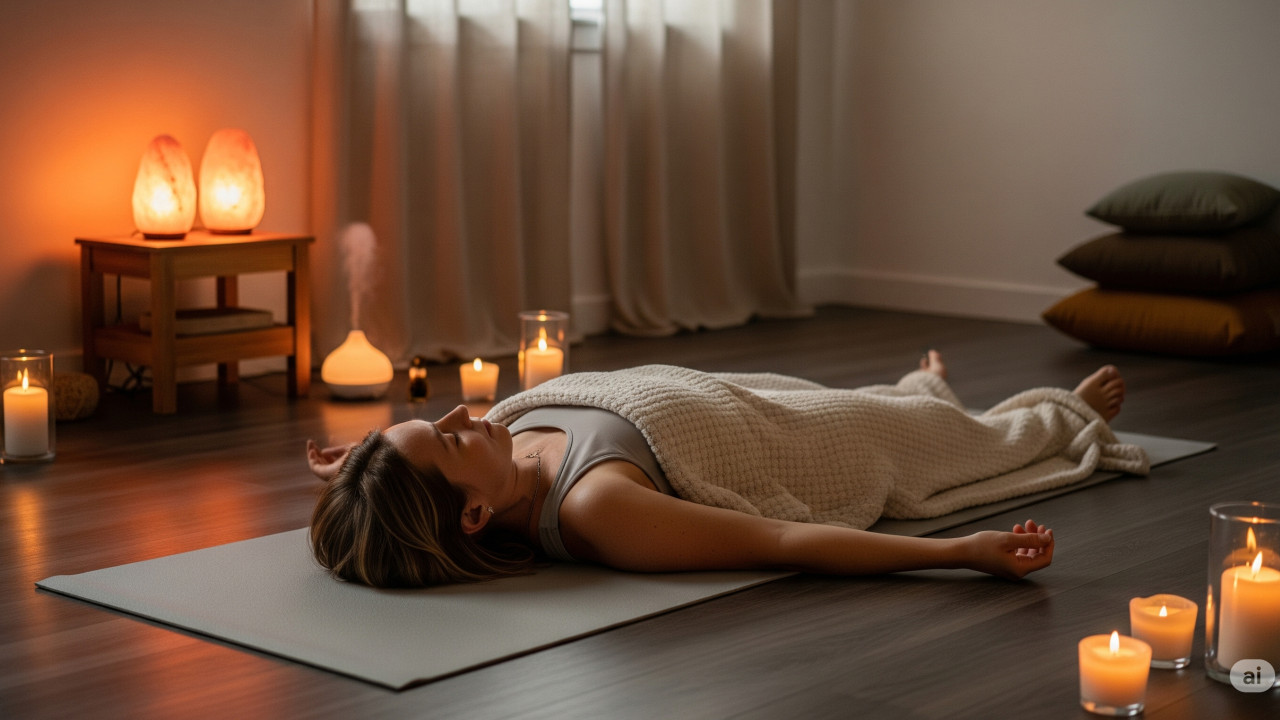 It is a state of conscious deep relaxation, a guided journey into the liminal space between waking and sleeping, where profound physiological rest meets heightened awareness.
We explore the essence, science, practice, benefits, and transformative potential of Yoga Nidra, revealing why it is increasingly recognized as a vital tool for holistic well-being in the modern world.
Yoga Nidra: Beyond Sleep, Beyond Meditation
Yoga Nidra is more than just relaxation—it’s a powerful practice that brings deep rest to the body and mind, while keeping a quiet thread of awareness alive.
Imagine getting the restorative benefits of deep sleep without actually falling asleep. That’s the beauty of Yoga Nidra. It goes beyond typical relaxation or meditation by guiding you into the deeper layers of consciousness, where real change can begin.
What’s the Purpose?
At its heart, Yoga Nidra works on multiple levels:
- Deep Rest: It provides rest that can feel even more rejuvenating than hours of regular sleep, helping to reset and calm the nervous system.
- Subconscious Exploration: It gently opens the door to the subconscious—where old patterns, beliefs, and emotional imprints (known as Samskaras) are stored.
- Sankalpa (Intention Setting): During the practice, a clear, heartfelt intention (Sankalpa) is planted into this receptive state of mind. It’s like planting a seed of change in the most fertile soil—helping align your life with your deeper truth or purpose.
- Awareness & Integration: Yoga Nidra trains you to witness thoughts, emotions, and physical sensations without getting swept away. Over time, this builds emotional balance, clarity, and resilience.
What Does It Feel Like?
People often describe Yoga Nidra as an experience of deep peace, warmth, and spaciousness. You might feel like you’re floating, or like your body is asleep, but your mind is quietly awake.
Even if you drift near sleep, there’s usually a soft, steady awareness of the guide’s voice and your inner experience. Ultimately, Yoga Nidra isn’t about doing—it’s about being. And in that stillness, real healing and transformation can begin.
Roots and Evolution: From Tantra to Modern Science
The roots of Yoga Nidra stretch deep into the soil of ancient Tantric traditions. One key influence is Nyasa—a practice where mantras or visualizations of deities are mentally placed onto specific parts of the body to awaken energy and awareness.
These early techniques were more than symbolic rituals; they were powerful tools for shifting consciousness.
We also find echoes of Yoga Nidra in the Upanishads, where there’s mention of Prajna—a state of deep, conscious sleep that hints at the kind of awareness Yoga Nidra cultivates.
The Modern Architect: Swami Satyananda Saraswati
While the practice has ancient roots, Yoga Nidra as we know it today was shaped and systematized in the mid-20th century by Swami Satyananda Saraswati, founder of the Bihar School of Yoga.
He drew from Tantra (like Nyasa), Advaita Vedanta (the philosophy of non-duality), and Western psychology to create a clear, step-by-step approach to conscious relaxation.
His eight-stage model remains the most widely taught and practiced version of Yoga Nidra today, offering a bridge between the ancient and the modern.
Integration and Adaptation
Yoga Nidra hasn’t stayed frozen in tradition—it continues to grow and evolve:
- Therapeutic Insights: Many modern teachers highlight its effectiveness for stress relief, trauma healing (including PTSD), and emotional well-being. It’s increasingly seen as a gentle yet powerful tool in the field of mental health.
- iRest (Integrative Restoration): Developed by clinical psychologist Dr. Richard Miller, iRest is a trauma-informed, research-supported adaptation of Yoga Nidra. It’s used widely among veterans, people living with chronic pain, and those navigating anxiety or depression. iRest focuses on grounding, welcoming all sensations and emotions, and working skillfully with core beliefs.
- Secular Use: Today, Yoga Nidra is finding a home in places far beyond traditional yoga studios. You’ll find it in schools, hospitals, corporate wellness programs, and even athletic training—often taught without any spiritual language, focusing simply on its practical benefits: rest, clarity, and resilience.
How Yoga Nidra Rewires the Body and Mind
Yoga Nidra isn’t just about feeling relaxed in the moment—it’s doing real, measurable work beneath the surface. By understanding the physiological and neurological changes that happen during practice, we begin to see why it’s such a powerful tool for healing, growth, and transformation.
1. The Brainwave Symphony
EEG studies show that Yoga Nidra gently guides the brain through a unique and beneficial sequence of brainwave states:
- Beta Waves (13–30 Hz): These dominate during normal waking life—when we’re thinking, planning, solving problems. During Yoga Nidra, beta activity drops significantly as we shift out of the “doing” mode.
- Alpha Waves (8–13 Hz): These are linked to calm, relaxed alertness—like daydreaming or light meditation. Alpha waves rise as we settle into the early stages of the practice.
- Theta Waves (4–8 Hz): This is the hallmark of deep Yoga Nidra. Theta is the brainwave of deep meditation, intuitive insight, and the dreamlike space between sleep and wakefulness. What’s unique about Yoga Nidra is that even in this deeply relaxed state, a thread of awareness remains active.
- Delta Waves (0.5–4 Hz): These are seen in deep, dreamless sleep. While Yoga Nidra may bring you close to this depth, delta activity tends to remain low—this is what sets it apart from unconscious sleep.
2. Taming the Stress Response
Yoga Nidra activates the parasympathetic nervous system (PNS)—our natural “rest and digest” mode. This is the antidote to the constant low-grade stress many of us live with in modern life.
Some of the physiological effects include:
- Lower cortisol levels: Helping reduce inflammation and stress.
- Slower heart rate and blood pressure: Supporting heart health and relaxation.
- Calmer breathing: Promoting inner stillness.
- Improved digestion and immune function: As the body shifts out of survival mode, it returns to healing and maintenance.
3. Rewiring Through Neuroplasticity
The brain is always changing—and Yoga Nidra gives it a gentle but powerful nudge in the right direction. Through regular practice, we strengthen neural pathways linked to calm, clarity, and emotional resilience, while weakening those tied to chronic stress, anxiety, or negative thought loops.
The consistent exposure to theta states and the practice of non-reactive awareness is key here—this is where real, lasting change begins.
4. Accessing the Subconscious
Theta waves also open a direct gateway to the subconscious mind—the realm that stores our core beliefs, emotional patterns, and behavioral habits.
That’s why the Sankalpa (a heartfelt intention or affirmation) is repeated during Yoga Nidra: it bypasses the critical, analytical mind and embeds itself deep into the subconscious, where it can begin to take root and create lasting transformation. Similarly, visualization practices become especially potent in this state.
5. Shifting Pain Perception
Emerging research suggests that Yoga Nidra can actually change how the brain processes pain. By relaxing the nervous system and shifting attention away from pain signals, the practice reduces the emotional intensity and perceived discomfort of chronic pain—making it a promising complementary approach for pain management.
The Stages of a Yoga Nidra Practice (Satyananda Tradition)
A typical Yoga Nidra session lasts anywhere from 20 to 45 minutes, moving through a carefully structured sequence designed to withdraw the senses (Pratyahara) and guide your awareness deep within.
Here’s a breakdown of the journey:
1. Preparation: Setting the Stage & Intention (Sankalpa)
Before you begin, create the right environment:
- Find a quiet, comfortable space where you won’t be disturbed. Silence or turn off devices.
- Lie on your back in Savasana (Corpse Pose). Use props like a bolster under the knees or a blanket under the head for full comfort. Cover yourself with a light blanket if you tend to get cold.
- The goal is complete stillness and zero physical effort.
Set Your Sankalpa (Intention): This is a short, positive, and present-tense affirmation like “I am at peace,” or “I live with purpose.” You’ll repeat this silently at the beginning and again at the deepest point of the practice, when the mind is most receptive.
2. Rotation of Consciousness (Chidakasha Dharana / Body Scan)
You’ll be guided to mentally move your awareness through different parts of the body in a specific sequence (e.g., right thumb → fingers → palm → wrist, and so on).
- This is purely mental—no physical movement.
- It helps focus the mind, releases tension, and starts to withdraw the senses from the outside world.
3. Awareness of Breath (Pranayama Dharana)
Now, bring your attention to the natural rhythm of your breath.
- Observe the inhalation and exhalation without trying to control it.
- Notice sensations at the nostrils, the rise and fall of the chest or abdomen.
This simple focus anchors the mind, deepens relaxation, and settles the nervous system even further.
4. Experiencing Opposites (Bhava-Spanda Dharana – Sensations & Feelings)
This stage invites you to explore contrasting sensations, which may include:
- Heaviness and lightness
- Warmth and coolness
- Discomfort and ease
You’ll fully experience one sensation, then its opposite, often moving quickly between the two.
This helps:
- Build interoceptive awareness (the ability to sense what’s happening inside the body),
- Cultivate emotional resilience, and
- Loosen deeply held tensions.
It also trains the mind to witness sensations without reacting, which is key to emotional healing.
5. Visualization (Chidakasha Dharana – Mental Imagery)
Now, the subconscious is gently activated through imagery.
- This might involve peaceful natural scenes (a forest, a beach),
- Symbolic images (a flame, a mountain, a lotus),
- Or more abstract journeys through colors, shapes, or inner landscapes.
The images are usually presented in a flowing, intuitive way. Visualization works directly with the right brain and subconscious, helping to:
- Process emotions and past experiences,
- Tap into creativity and intuition, and
- Reinforce your Sankalpa on a deep level.
6. Repetition of Sankalpa
At the point of deepest stillness and inner awareness—often associated with the theta brainwave state—you’ll silently repeat your Sankalpa once more.
This is the most potent moment to plant your intention. The conscious mind is quiet, and the subconscious is wide open, ready to absorb the seed of transformation.
7. Externalization (Bahiranga Dharana – Coming Back)
Finally, the practice ends with a slow, gentle return to waking life:
- Bring awareness back to the breath,
- Then to the body and the points of contact with the floor,
- Begin to notice sounds in the room,
- Gently move fingers and toes, maybe stretch a little,
- Keep the eyes closed for a few extra moments to absorb the experience.
This stage ensures you transition smoothly, feeling grounded, rested, and integrated.
The Multidimensional Benefits of Yoga Nidra
With consistent practice, Yoga Nidra offers profound healing and transformation—touching every layer of our being, from the physical body to the deeper currents of the mind and spirit.
1. Physical Restoration
At the physiological level, Yoga Nidra delivers deep rest and recovery:
- Stress and Anxiety Relief: It calms the nervous system, lowers cortisol levels, and helps the body shift out of chronic fight-or-flight mode.
- Better Sleep: While it doesn’t replace sleep, Yoga Nidra helps regulate sleep cycles, reduce insomnia, and improve sleep depth and quality.
- Boosts Immunity: The deep rest supports cellular repair and enhances immune function.
- Pain Relief: Regular practice has been shown to reduce the perception of chronic pain and improve coping mechanisms.
- Heart Health: By slowing the heart rate and reducing blood pressure, it supports cardiovascular wellness.
- Nervous System Regulation: It builds resilience and helps bring the body back to balance after stress or emotional overload.
2. Mental and Emotional Resilience
Yoga Nidra also works deeply on the mind and emotions, offering clarity and calm:
- Quiets the Mental Noise: It helps reduce overthinking, mental chatter, and the tendency to ruminate.
- Improves Focus and Concentration: The structured nature of the practice trains your ability to sustain attention.
- Emotional Balance: You learn to observe emotions without being overwhelmed by them, which reduces reactivity and builds inner stability.
- Reduces Anxiety and Depression: It offers a grounded, calming space that helps interrupt negative thought cycles.
- Trauma Release: Held tension and subconscious patterns (samskaras) can gently surface and be processed safely over time.
- Self-Awareness and Mindfulness: The practice deepens your connection to your inner world, helping you stay more present in daily life.
3. Cognitive and Creative Expansion
Beyond relaxation, Yoga Nidra opens the door to higher brain function and creative insight:
- Enhances Creativity and Intuition: The theta brainwave state accessed during the practice allows for new ideas, deeper insights, and intuitive clarity to emerge.
- Supports Memory and Learning: These same brain states are linked to memory consolidation and deeper learning.
- Improves Problem-Solving: A calm and spacious mind tends to see solutions more clearly and handle challenges more effectively.
4. Personal Growth and Inner Exploration
Perhaps most profoundly, Yoga Nidra can become a space for personal transformation and spiritual growth:
- Sankalpa (Intention) Activation: By planting your intention during the deepest phase of relaxation, you align your subconscious with your conscious goals.
- Builds Confidence and Self-Compassion: The nurturing quality of the practice helps soften harsh inner voices and builds a more supportive inner dialogue.
- Deep Inner Peace: Over time, Yoga Nidra cultivates a stable sense of contentment that isn’t dependent on external circumstances.
- Sense of Connection: Many practitioners report a deepened connection to themselves, to others, to nature—or to something greater.
- Exploring Consciousness: At its most subtle levels, Yoga Nidra can offer glimpses beyond the personal self—touching moments of pure awareness or “Turiya,” the fourth state of consciousness described in yogic philosophy.
Yoga Nidra in the Modern World: Variations & Real-Life Applications
What makes Yoga Nidra so powerful today is its versatility. While rooted in tradition, the practice easily adapts to modern lifestyles, diverse populations, and a wide range of goals—from daily self-care to deep healing.
1. Flexible Duration for Every Schedule
Yoga Nidra can be as brief or as immersive as you need:
- Quick Resets (10–15 minutes): Great for busy days when you need a mental break or emotional reset.
- Standard Sessions (20–45 minutes): Ideal for regular personal practice or guided group classes.
- Deep Dives (60–90 minutes): Perfect for workshops, retreats, or when exploring deeper layers of healing and transformation.
2. Themed Practices for Specific Needs
Yoga Nidra can be customized to support just about any area of life. Common themes include:
- Better Sleep
- Stress and Anxiety Relief
- Chronic Pain Support
- Confidence & Self-Esteem
- Self-Compassion & Forgiveness
- Creative Flow & Inspiration
- Performance Prep (sports, artistic expression, public speaking)
- Grief & Emotional Processing
Each variation uses intention, breath, and visualization in a way that speaks directly to the need at hand.
3. iRest Yoga Nidra: A Trauma-Informed, Evidence-Based Approach
iRest® (Integrative Restoration) is a modern form of Yoga Nidra developed by psychologist Dr. Richard Miller. It’s backed by research and designed to be accessible, especially for people dealing with trauma, anxiety, or chronic pain.
Key elements include:
- A trauma-sensitive framework that emphasizes safety and choice.
- Encouragement to welcome all experiences—pleasant or difficult—without judgment.
- Guided self-inquiry into beliefs, emotions, and identity, fostering deep insight and healing.
iRest is widely used in clinical settings, with military veterans, and in community programs focused on resilience and recovery.
4. Where Yoga Nidra Is Being Used Today
More and more, Yoga Nidra is showing up in spaces far beyond the yoga studio:
- Mental Health Care: Supporting therapy for PTSD, depression, anxiety, and addiction recovery.
- Medical Settings: Used in pain management, cancer support, chronic illness treatment, and pre/post-surgery recovery.
- Schools & Universities: Helping students reduce stress, sharpen focus, and regulate emotions.
- Workplaces: Offering a practical tool for burnout prevention, creativity, and emotional resilience.
- Correctional Facilities: Assisting with emotional processing, behavioral regulation, and personal growth.
5. A Simple Yet Powerful Personal Practice
At its core, Yoga Nidra is a deeply restorative and empowering daily ritual. Whether you’re seeking better sleep, emotional balance, or a deeper connection to yourself, this practice is:
- Accessible to almost anyone
- Easy to do at home
- Incredibly effective, even in small doses
Even just 15 minutes a day can make a noticeable difference in how you feel, think, and move through life.
Important Considerations for Practicing Yoga Nidra
Yoga Nidra is a deeply nourishing and healing practice—but like any inner work, it requires mindfulness and care. As you explore its depths, here are some key things to keep in mind:
1. It’s Not a Substitute for Sleep
While Yoga Nidra offers rest that can feel as restorative as hours of sleep, it doesn’t replace the essential biological processes of actual sleep.
Think of it as a powerful complement, not a replacement. Practicing regularly can actually improve the quality of your nightly sleep.
2. Not a Standalone Treatment
Yoga Nidra supports healing, but it’s not a substitute for medical or mental health care. If you’re navigating physical illness, trauma, depression, or other clinical concerns, continue working with qualified healthcare providers—and consider Yoga Nidra as a supportive tool alongside professional care.
3. Emotional Releases Can Happen
As the body and mind unwind, buried emotions or memories (known as samskaras in yogic philosophy) may naturally rise to the surface. This is a sign that your system is releasing old tension—but it can sometimes feel intense.
Practice with compassion:
- Let sensations or emotions arise without judgment.
- Stay grounded in your body or breath if you feel overwhelmed.
- Remind yourself: You are safe in the present moment.
- If needed, take breaks—or seek support from a trauma-informed teacher or mental health professional.
4. Choose the Right Guidance
- If you’re new to Yoga Nidra, start with guided recordings, apps, or online classes. These provide structure and help you stay present.
Live sessions or workshops can offer deeper insight, community, and personalized support. - If you have a history of trauma, it’s important to practice with someone who understands how to hold a safe space.
Look for teachers trained in trauma-sensitive Yoga Nidra or protocols like iRest. Don’t hesitate to let them know your needs ahead of time if you feel comfortable.
5. Listen to Your Body
- While stillness is part of the practice, comfort is more important. If lying in one position causes pain or restlessness, gently adjust.
- If any physical or emotional distress becomes too much, pause or end the practice. Trust your inner wisdom—there’s no “right” way to do it.
6. Timing Matters
To get the most from your practice, consider when and how you approach it:
Avoid practicing right after a heavy meal or when you’re already very sleepy (you might just drift off).
Ideal times include:
- Before bed (to wind down)
- Upon waking (to start the day centered)
- Midday (as a reset or energy boost)
Ultimately, any time you feel the need to rest, reset, or reconnect is a good time to practice.
How to Begin: A Guide to Starting Your Yoga Nidra Journey
Feeling called to try Yoga Nidra? Beautiful. The practice is simple, deeply restorative, and accessible to everyone—no flexibility, spiritual background, or prior meditation experience required. Here’s a gentle step-by-step guide to help you get started:
1. Find the Right Resources
There are many great options to guide your first sessions, from apps to online teachers and books. Here’s where to look:
Apps:
- Insight Timer (huge free library of Yoga Nidra sessions)
- Calm, Headspace (some shorter Nidra-inspired practices)
- iRest App (trauma-sensitive, structured guidance)
- Synctuition (more abstract and sound-based)
YouTube & Websites:
- Yoga Nidra Network
- Ally Boothroyd – Saraswati River Yoga
- Jennifer Piercy
- Roger Gabriel
- iRest Institute and Bihar School of Yoga websites
Teachers & Studios:
- Search for certified Yoga Nidra or iRest teachers (many offer classes online or in person).
- Local yoga studios often offer live or recorded classes.
Books (for deeper understanding):
- Yoga Nidra by Swami Satyananda Saraswati (a foundational classic)
- The iRest Program for Healing PTSD by Dr. Richard Miller
- The Art of Deep Relaxation by Anne Douglas
- Radiant Rest by Tracee Stanley (beautiful, accessible, and soulful)
2. Set Up Your Space
Creating a nurturing environment makes a big difference in your experience. Here’s how:
- Quiet: Turn off notifications, silence your phone, and minimize disruptions. Earplugs or noise-canceling headphones can help.
- Comfort: Lie down on a yoga mat or bed. Use a blanket for warmth, a pillow or bolster under your knees, and something soft under your head.
- Low Light: Dim the room or use an eye pillow to signal rest to your nervous system.
- Create a Mini Sanctuary: Even a corner of your home can feel sacred with intention—add a candle, crystal, or item that soothes you.
3. Create Your Sankalpa (Intention Statement)
Your Sankalpa is a short, powerful phrase that you plant deep into your subconscious during the practice. Here’s how to create one:
- Say what you want, not what you don’t: Focus on the positive (e.g., “I am calm” instead of “I’m not anxious”).
- Use the present tense: Phrase it as though it’s already true: “I am…”, “I trust…”, “I feel…”
- Keep it clear and meaningful: Make it short but resonant.
- Feel it emotionally: The more heart connection, the more powerful.
Examples:
- “I am whole and complete.”
- “I trust my inner wisdom.”
- “I am peaceful amidst change.”
- “I welcome rest and renewal.”
- “I live with clarity and purpose.”
4. Let Go – The Art of Surrender
The most important part? You don’t have to “do” anything.
- There’s no effort, no goal to achieve, no way to get it “right.”
- Let yourself be guided.
- If your mind wanders (it will), simply return to the voice or the breath.
- If you fall asleep, that’s okay too—it means your body needed deep rest.
- Be patient. Like any practice, Yoga Nidra deepens over time.
Even 2–3 sessions a week can bring noticeable shifts in how you sleep, feel, and show up in daily life.
Yoga Nidra is more than just relaxation—it’s a gateway to deep inner healing. In a world of constant stress and speed, this practice offers a radical act of self-care: conscious, restorative rest. By guiding the body into a deeply relaxed theta state, Yoga Nidra helps reset the nervous system, heal the subconscious, and reconnect us to our natural sense of peace and wholeness.