Lepa Kalpana: Ayurvedic Herbal Paste Formulation for External Use

Ayurveda, the ancient Indian system of medicine, is renowned for its holistic approach to health and disease. It emphasizes the balance of the mind, body, and spirit, achieved through a harmonious blend of diet, lifestyle, and therapeutic interventions.  A cornerstone of Ayurvedic treatment (Chikitsa) is the sophisticated use of medicinal substances, formulated into specific dosage forms known as Kalpanas. These formulations are meticulously designed to maximize the therapeutic potential of herbs and minerals, ensuring optimal delivery and efficacy.
Among these diverse Kalpanas, a significant category is dedicated to external applications. The skin, being the largest organ of the body, is not merely a protective barrier but a complex organ of absorption and excretion. Ayurveda recognized this principle millennia ago, developing a sophisticated system of topical medicines.
This article delves deep into the principal external dosage forms: Kalka (paste), Lepa (medicated plaster), and Malahara (ointment), exploring their preparation methods, classifications, therapeutic applications, and the profound scientific rationale underlying their use.
Kalka Kalpana – What is it?
The term Kalka is derived from the Sanskrit root ‘kalp’, which means ‘to prepare’ or ‘to formulate’. In its most fundamental sense, Kalka refers to a soft, uniform paste or bolus created by grinding fresh or dried herbal substances with a liquid. It is the most basic and ancient form of herbal preparation in Ayurveda. Acharya Charaka, in his seminal text Charaka Samhita, provides a concise definition:
“Ya: Pindo rasa-pishtanam sa kalka: parikeertita:” (Charaka Samhita Sutrasthana 4/7)
This translates to: “The bolus formed by pounding substances along with their juices (or a liquid) is known as Kalka.”
This “bolus form” is crucial as it indicates the ideal consistency—neither too dry and crumbly nor too liquid and runny. It should be cohesive enough to be rolled into a small ball (pinda), ensuring the active principles are properly extracted and the paste is easy to administer.
How is Kalka prepared?
The preparation of Kalka, while seemingly simple, requires attention to detail to preserve the therapeutic properties of the herbs.
1. Selection of Herbs: The process begins with the selection of high-quality, authentic herbs. These can be used in their fresh (Aardra) or dried (Shushka) form.
2. Preparation of Dravyas (Substances):
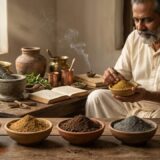
- Fresh Herbs: Soft, fresh leaves, roots, or fruits can be directly pounded in a mortar and pestle (Khalva Yantra). The traditional stone mortar and pestle are preferred because they do not generate heat during grinding, which can degrade volatile active compounds.
- Dry Herbs: Hard, dry substances like barks (e.g., Twak – Cinnamon), roots (e.g., Ashwagandha), or seeds must first be softened. They are typically soaked in a small amount of water or another appropriate liquid (like milk or decoction) for several hours. This soaking rehydrates the fibers, making them soft and easier to grind into a smooth paste.
3. Grinding Process: The moistened herbs are ground meticulously until a smooth, lump-free paste is achieved. Any fibrous or coarse particles should be removed to attain the desired bolus consistency. The choice of liquid medium (Bhavana Dravya) is critical and is selected based on the desired therapeutic action and the predominant Dosha involved in the disease.
The Shelf Life and Dosage Lepa Kalpana
A defining characteristic of Kalka is its perishability. As a fresh preparation without preservatives, it has a very short shelf life—typically it must be used immediately after preparation, or within 24 hours if stored in a cool place. This underscores the importance of freshness and potency in Ayurvedic medicines.
The standard internal dosage for Kalka is 1 Karsha, which is approximately 12 grams. For external application, the quantity is Yathabhuyasam (as required), depending on the size and nature of the affected area.
The Adjuvants (Prakshepaka Dravyas) and Their Significance
To enhance the efficacy, palatability, and targeted delivery of Kalka for internal use, specific adjuvants (Anupana) are mixed with it. Acharya Sharangadhara provides clear guidelines on their proportions:
Kalke madhu ghritam tailam deyam dwigunamatraya |
Sita gudam samam dadyat drava deyah chaturgunah ||” (Sharangdhara Samhita Madhyama Khanda 5/2)
This translates to:
- Madhu (Honey), Ghrita (Ghee), Taila (Oil): These are added in double the quantity of the Kalka.
- Sita (Sugar Candy), Guda (Jaggery): These are added in equal quantity to the Kalka.
- Drava (Liquids) such as water, milk, or herbal decoctions (Kashaya): These are added in four times the quantity of the Kalka.
The choice of adjuvant is strategic:
- Honey is a natural preservative and a Yogavahi (catalyst) that carries the properties of the herb deep into the tissues. It is also beneficial for Kapha and Pitta conditions.
- Ghee is a supreme medium for pacifying Pitta and Vata, and it enhances the absorption of fat-soluble compounds.
- Oils are primarily used for Vata disorders and to nourish dry tissues.
Therapeutic Uses and Applications of Kalka
The versatility of Kalka is illustrated by the example of Nimba (Neem) Patra Kalka:
“Lepat nimba-dalaih kalko vrana-shodhana-ropanah | Bhakshanat chhardi kushthani pitt-shleshma kriminjayet ||” (Sharangdhara Samhita Madhyama Khanda 5/7)
- Preparation: Fresh leaves of Neem (Azadirachta indica) are crushed into a paste.
- External Use: Applied on wounds (Vrana), this Kalka acts as a Shodhana (cleanser) and Ropana (healer), leveraging Neem’s potent antibacterial and anti-inflammatory properties.
- Internal Use: Consumed with sesame oil, it treats vomiting (Chhardi), skin diseases (Kushtha), worms (Krimi), and imbalances of Pitta and Kapha.
This dual usage highlights how Kalka serves as a fundamental base for both internal and external therapies in classical Ayurveda.
Lepa Kalpana – (Types of Lepa & How to Apply)
While the term Kalka was used generically in early texts like Charaka and Sushruta Samhita for any paste, later compendiums like the Sharangadhara Samhita and Bhavaprakasha began to distinguish Lepa as a preparation exclusively intended for external application on the body. The word Lepa comes from the root ‘lip’, meaning ‘to smear’ or ‘to anoint’. It is defined as:
“Dravyamardram shila-pishtam shushkam va sadravam tanu | Dehe pralepanartham tal lepa ityucyate budhaih ||“
This means: “A substance—whether fresh and pounded on a stone, or dry and mixed with a liquid—applied thinly on the body for the purpose of smearing is known as Lepa by the wise.”
1. The Classification of Lepa
Lepa is classified based on various criteria, including its physical nature, pharmacological action, and therapeutic goal.
A. Based on Potency and Physical Nature (Guna):
1. Pralepa:
- Properties: Prepared from herbs with Sheeta Veerya (cooling potency). The paste itself is cool to the touch.
- Indications: Primarily used to pacify aggravated Pitta Dosha. Conditions include inflammation, burning sensations, sunburn, skin rashes, and bleeding disorders.
- Examples: Lepa of Chandana (Sandalwood), Usheera (Vetiver), or Gulab Jal (Rose water).
2. Pradeha:
- Properties: Prepared from herbs with Ushna Veerya (heating potency). The paste is slightly warm when applied.
- Indications: Used to combat aggravated Kapha and Vata Dosha. It helps in reducing stiffness, cold swellings, pain, and congestion by improving blood circulation.
- Examples: Lepa of Shunti (Ginger), Pippali (Long Pepper), Chitraka (Leadwort), or mustard paste.
3. Alepa: This is a balanced Lepa, often a mixture of cooling and heating herbs, used when the Doshic imbalance is complex or when a neutral action is required.
B. Based on Therapeutic Action (Karma):
- Shothahara Lepa (Anti-inflammatory): Used to reduce swelling (Shotha). E.g., Punarnavadi Lepa.
- Vishagna Lepa (Antitoxic): Used to neutralize poisons from insect bites, scorpion stings, or allergic contact. E.g., Dashanga Lepa (Paste of ten ingredients).
- Varnya Lepa (Complexion Enhancing): Aimed at improving skin complexion, reducing pigmentation, acne, and dark spots. E.g., Raktachandanadi Lepa.
- Kandughna Lepa (Anti-pruritic): Used to relieve itching (Kandu) in conditions like eczema and urticaria.
- Vranaropana Lepa (Wound Healing): Promotes granulation tissue formation and healing of chronic ulcers.
The Science of Lepa Thickness
Ayurveda prescribes specific thicknesses for different types of Lepa, measured in Angula (approximately the width of a finger, or 2 cm). This is not arbitrary but based on the desired depth of action and the nature of the condition.
- Doshagna Lepa (for balancing Doshas): 1/4 Angula (approx. 0.5 cm). A thinner layer allows for better evaporation and a cooling, penetrating effect.
- Vishagna Lepa (for toxins): 1/3 Angula (approx. 0.66 cm). A slightly thicker layer is used to draw out toxins from the skin.
- Varnya Lepa (for complexion): 1/2 Angula (approx. 1 cm). A thicker layer is intended for a more sustained, nourishing, and moisturizing effect on the superficial layers of the skin.
This precise guidance ensures the Lepa remains effective during its intended period of action—typically while it is still moist. Once it dries, its ability to release active principles diminishes.
Rules and Regulations for Application (Lepa Vidhi)
The application of Lepa is governed by a set of strict rules to maximize benefits and prevent complications:
- Fresh Preparation: Lepa should always be prepared fresh for each application to ensure maximum potency.
- Direction of Application: It should be applied Pratiloma (against the direction of hair follicles). This facilitates deeper penetration of the active ingredients by entering the hair follicles and sebaceous glands.
- Timing: Lepa is generally applied during the day. Night application is discouraged (except in emergencies like poisonous bites) as it may block skin pores and impede the natural exchange of body heat.
- Removal: The dried Lepa must be gently removed, usually with lukewarm water or a soft cloth. A new layer should only be applied after the previous one is completely removed.
- Contraindications: Lepa is generally avoided on open, bleeding wounds (unless specifically indicated as a wound-healing Lepa), on areas with acute dermatitis with oozing, and immediately after oil massage (Abhyanga).
List of Common Lepas and Their Uses
1. Bakuchi Seed Lepa
This lepa is traditionally used in the treatment of Shvitra (vitiligo/leucoderma) by stimulating melanin production in depigmented areas. It combines Bakuchi seeds, purified Haratala (arsenic trisulfide), and cow’s urine, known for their skin-repigmenting properties.
Ingredients: Bakuchi (Psoralea corylifolia) seed powder, purified Haratala (Arsenic trisulfide), and cow’s urine.
Use:
- Specifically used in Shvitra (Leucoderma/Vitiligo).
- Helps stimulate melanin production and promote repigmentation of discolored skin.
2. Kumkumadi Lepa
A luxurious herbal facial paste, Kumkumadi Lepa enhances skin radiance and reduces blemishes, pigmentation, and dullness. It is composed of beautifying herbs like saffron and sandalwood with a nourishing base.
Ingredients: Kumkuma (saffron), Chandana (sandalwood), Yashtimadhu (licorice), and other rejuvenating herbs.
Use:
- Improves skin tone and texture.
- Useful for hyperpigmentation, blemishes, and achieving a glowing complexion.
3. Haridra and Honey Lepa
This simple yet potent combination leverages the antibacterial and anti-inflammatory properties of turmeric and honey. It is widely used for treating minor wounds, skin infections, and acne.
Ingredients: Haridra (turmeric powder) and raw honey.
Use:
- Treats cuts, burns, acne, and minor skin infections.
- Promotes healing, reduces inflammation, and prevents bacterial growth.
4. Rasnadi Lepa
Rasnadi Lepa is used topically to relieve pain and inflammation, especially in joint-related disorders and Vata imbalances. It also helps prevent cold-related issues when applied on the head after oil bath.
Ingredients: Rasna (Pluchea lanceolata), Vacha, Devadaru, Choraka, and other herbs.
Use:
- Applied to joints for arthritis, swelling, and stiffness.
- Applied on the scalp to prevent colds and relieve headaches.
5. Jatamansi Lepa
This calming herbal paste is known for its effect on the nervous system, promoting mental relaxation and sound sleep. It is typically applied to the scalp or forehead in cases of anxiety and insomnia.
Ingredients: Jatamansi (Nardostachys jatamansi) root powder.
Use:
- Helps in treating insomnia, anxiety, and mental fatigue.
- Calms the mind, promotes sleep, and balances Vata and Pitta.
6. Panchavalkala Lepa
Made from the bark of five astringent trees, this lepa is ideal for cleaning wounds, reducing inflammation, and promoting healing in sinuses and fistulas. It has strong astringent and antimicrobial effects.
Ingredients: Barks of Vata (Banyan), Udumbara (Cluster fig), Ashvattha (Peepal), Parisha, and Plaksha.
Use:
- Applied to non-healing wounds, fistulas, and ulcers.
- Helps in wound contraction, reduces discharge, and supports tissue repair.
What is Malahara Kalpana – The Medicated Ointments?
Malahara Kalpana refers to semi-solid, greasy preparations akin to modern ointments. The term is derived from Mala (impurity/dirt) and Hara (to remove), indicating its use in cleansing wounds, but its scope is much broader. A Malahara is characterized by a base, typically a fat or oil, into which medicated powders or pastes are incorporated.
The classical bases include:
- Sneha Dravyas: Oils (Taila) like sesame oil, coconut oil; Fats (Vasa) like animal fat; and Ghee (Ghrita).
- Wax: Beeswax (Madhu-shishtha) is often added to adjust the consistency and provide a protective, occlusive layer.
1. Preparation Method of Kalpana
The preparation of Malahara is more complex than Lepa and involves a cooking process.
- Base Preparation: The chosen oil or fat is heated gently.
- Incorporation of Herbs: Fine powders (Churna) of the prescribed herbs are added to the warm base.
- Sweating Method (Svedana): The mixture is stirred continuously on a low flame until the herbs “sweat” (Sveda), meaning their active principles are transferred into the base. A key sign of completion is that the paste does not stick to the fingers when touched.
- Adding Wax: Beeswax is often melted into the mixture towards the end to achieve the desired ointment-like consistency upon cooling.
2. Types of Malahara Kalpana and Therapeutic Uses
Malahara formulations offer a sustained-release effect, forming a protective barrier over the skin while delivering medicine. They are ideal for chronic skin conditions, deep-seated pain, and massaging.
- Panchavalkala Malahara: Used for cleansing and healing chronic wounds and burns.
- Jatyadi Ghrita/Taila: A famous ointment based on ghee or oil, containing Jati (Jasmine) and other herbs, used for all types of wounds, cuts, and fissures.
- Kasisadi Taila: Contains iron and other ingredients, used for hemorrhoids (piles).
- Pinda Taila: An oil-based preparation used in the massage of patients with neurological disorders and paralysis.
3. Advantages over Lepa
- Longer Shelf Life: The oily base acts as a preservative, allowing Malahara to be stored for months.
- Deeper Penetration: The oily medium facilitates the absorption of lipophilic (fat-soluble) active compounds through the skin’s lipid layers.
- Moisturizing and Protective: It forms a physical barrier that prevents moisture loss and protects the skin from external irritants.
Lepa Kalpana Research Papers & Studies
Key recent studies on Ayurvedic Lepa formulations and their clinical or pharmaceutical findings.
| Title | Authors / Year | Focus / Condition | Key Findings & Notes | Source / Link |
|---|---|---|---|---|
| Efficacy of Dashang Lepa in Vranashopha (Cellulitis) | Soni Ashish et al., 2013 | Cellulitis (Vranashopha) | Reduced pain, swelling, redness, tenderness, and fever in 20 patients. | View (IJAM) |
| Clinical Evaluation of Modified Manashiladi Lepa for Post-surgical Scar | Dr Suresh Y Y et al., Recent | Post-surgical scar prevention | Modified ointment form reduced scarring, improved acceptability, no adverse effects. | View (JAHM) |
| Shalmali Kantak Lepa in Acne Vulgaris: Case Report | Vijaylaxmi Devi et al. | Acne (Yuvanpidika) | Positive effects in managing acne-like eruptions. | View (JAHM) |
| Comparative Trial: Kusthadi Lepa vs Jalaukavacharana for Acne | Nilkanth Upadhyaya et al., 2024 | Acne vulgaris (Yuvanpidaka) | Both effective; comparative data useful for treatment selection. | View (AYUSHDHARA) |
| Review on Dashanga Lepa – Anti-inflammatory Formulation | Neha Meena et al., 2023 | Inflammation, skin disorders | Explains ingredients, modes of action, and clinical uses. | View (JAHM) |
| Pharmaceutical Study of Balyadi Lepa | D. Mohan Kumar & Ch. Sri Durga, 2025 | Pharmaceutical preparation | Standardization, SOPs, and yield analysis for classical Lepa. | View (AYUSHDHARA) |
| Review on Lepa Kalpana in Charaka Samhita | Sneha Shantaram Chanekar et al. | Skin diseases (theoretical) | Details various Lepas for pain, swelling, itching, and discoloration. | View (JAIMS) |
| Dantyadi & Swarjik Ksharadi Lepa in Fibroadenosis of Breast | Shedad Sachin Ladak et al., 2025 | Fibroadenosis (breast lumps) | Both Lepas reduced symptoms including lump size and pain. | View (AYUSHDHARA) |
The Integrated Science and Practical Considerations
Here are the modes of action of Malahara from both Ayurvedic and modern medical perspectives. This comparison highlights how traditional and contemporary approaches explain their therapeutic effects.
1. Mode of Action: An Ayurvedic and Modern Perspective
From an Ayurvedic viewpoint, external applications work through several principles:
- Prabhava: The specific, inherent potency of the herb.
- Srotas: The medicines act on the external channels of the body, influencing deeper internal channels (Srotas).
- Vyakti-Swasthya Anshaka: The doctrine that every part of the body contains a reflection of the whole. Thus, treating a local area can have systemic effects.
Modern science explains this through the process of transdermal absorption. The active phytochemicals (alkaloids, flavonoids, tannins) penetrate the skin’s stratum corneum, enter the systemic circulation via capillaries, and exert their therapeutic action. The choice of base (water in Lepa, oil in Malahara) affects the rate and extent of this absorption.
2. Seasonal and Doshic Considerations (Ritucharya)
The choice of Lepa or Malahara is influenced by the season. Cooling Lepas (Pralepa) are more suitable for the hot summer months (Pitta season), while warming Pradeha Lepas and nourishing Malaharas are ideal for the cold, dry winter (Vata season) and damp, cold spring (Kapha season).
3. Safety and Contraindications
While generally safe, it is crucial to:
- Use herbs that are compatible with one’s Prakriti (constitution).
- Perform a patch test on a small area of skin to check for allergic reactions before widespread application.
- Consult a qualified Ayurvedic practitioner for chronic or serious conditions.
Lepa Kalpana, a key aspect of Ayurvedic pharmaceutics, showcases expertise in dermatology and healing. Ranging from fresh Kalka to precise Lepa and sustained-action Malahara, it provides versatile, effective treatments for numerous conditions through carefully formulated topical applications.