Dhanurasana (Bow Pose): Benefits, Anatomy & Step-by-Step Guide

Yoga isn’t just exercise; it’s a full system for your mind, body, and spirit. While there are tons of poses to explore, backbends bring a unique kind of energy. They open up your chest, lift your mood, and build real resilience—with Dhanurasana being one of the best examples out there.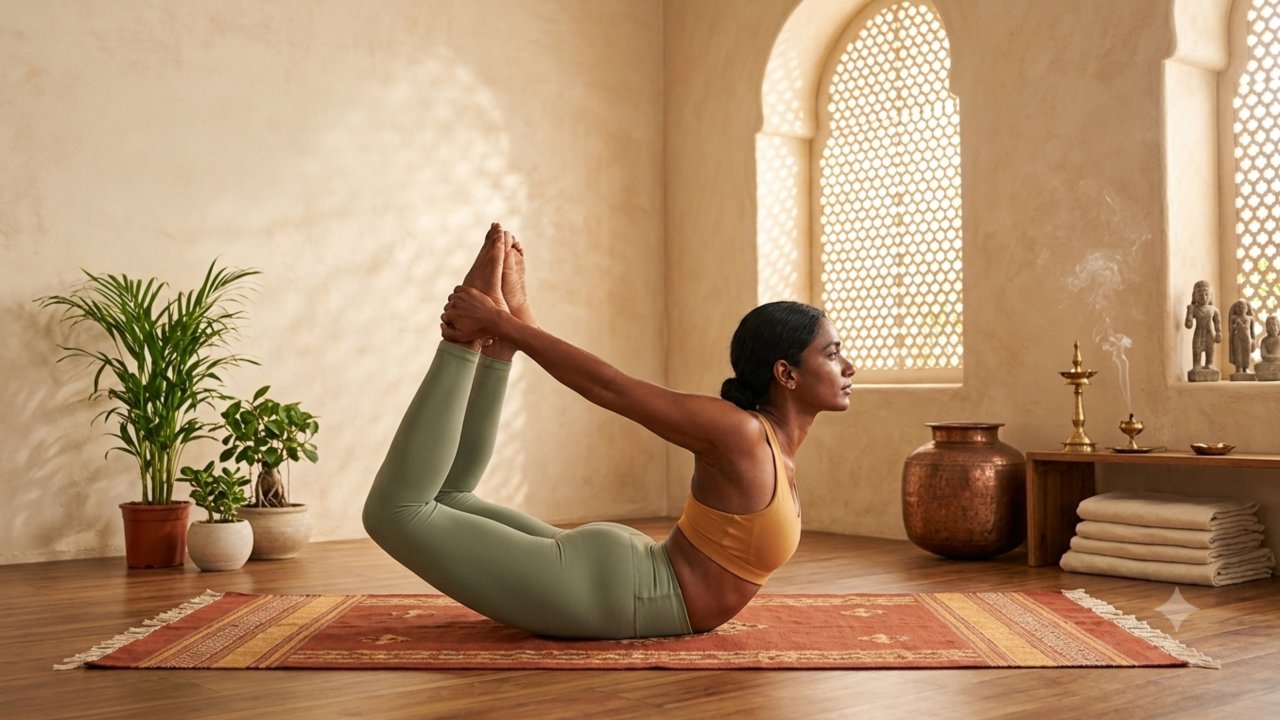 The name comes straight from Sanskrit: Dhanu means bow, and Asana means pose. When you get into position, your body literally looks like an archer’s bow. Your curved torso acts as the wood, your arms become the bowstring, and the tension holds a lot of built-up energy waiting to be released.
This isn’t a modern creation, either. Classical yoga texts have talked about it for centuries. The Gheranda Samhita, a foundational Hatha yoga text, basically describes it as lying on your stomach, reaching back to grab your ankles or toes, and pulling yourself up into a smooth curve.
To really get the most out of it, you need to pay attention to your alignment, breath, and safety. When done right, it stretches out the entire front of your body, strengthens your back, and leaves you feeling completely re-energized.
Preparation for Dhanurasana (Bow Pose)
Preparing properly for Dhanurasana is essential to protect your spine, shoulders, and lower back. Because it compresses the abdomen and deeply opens the chest, both physical and mental readiness ensure a safe and effective practice.
Essential Preparations
- Digestive Readiness: Practice on a completely empty stomach. Wait at least 3 to 4 hours after a main meal, and ensure your bowels and bladder are empty to prevent abdominal discomfort during the lift.
- Optimal Timing: Early morning is ideal for resetting your energy, though a brief warm-up is necessary to loosen morning stiffness. Evening practice works well too, as long as your stomach is clear.
- Space and Clothing: Use a non-slip yoga mat on a flat surface in a well-ventilated space. Wear stretchable, breathable clothing that won’t restrict your hips, spine, or chest.
- Systematic Warm-Up: Never enter Bow Pose cold. Prepare the body with gentle spinal mobility exercises (like Cat-Cow), shoulder openers, and mild backbends (such as Cobra Pose).
- Mental Focus & Breath: Approach the pose with smooth, deliberate movements rather than sudden jerks. Keep your breath slow and steady throughout—avoid holding your breath, which can spike blood pressure and create tension.
How to Practise Dhanurasana (Bow Pose)
Dhanurasana is not a one-size-fits-all posture. It is a progressive journey. There are three distinct variations designed to safely guide a practitioner from a beginner level to an advanced stage.
Technique 1: Saral Dhanurasana (Easy Bow Pose) – Beginner’s Bow Pose
This easier variation is suitable as an introductory stage before attempting a fuller lift. It introduces the body to the mechanics of the backbend without overwhelming the musculature.
- Starting position: Lie flat on your stomach (prone), with your forehead resting on the floor and your arms resting alongside your body, palms facing down.
- Ankle Grip: Bend your knees and reach your arms back to hold both ankles. Keep the knees separated at a distance roughly equal to the width of your hips.
- The Lift: Inhale deeply. Using the pull of your arms, slightly raise your knees, head, and chest off the floor.
- Coordination: The whole body should move simultaneously into the posture. Do not force the lift; go only as high as your lower back comfortably allows.
- Release: Exhale slowly while lowering the body, releasing the ankles, and relaxing completely flat on the floor.
Technique 2: Dhanurasana (Bow Pose) – Intermediate Bow Pose
Once the body is accustomed to Saral Dhanurasana, the practitioner can move into the classical intermediate form. Here, the “drawn bow” metaphor truly comes to life.
- Starting position: From the prone position, assume the same ankle grip as in Saral Dhanurasana, keeping the knees separated.
- The Lift: Inhale deeply and raise your legs, head, and chest as high as possible without strain.
- Foundation: Your entire body weight should balance precisely on the navel (umbilicus) and the pubic bone. This pivot point is crucial for the health of the lumbar spine.
- Alignment: Actively pull your shoulders away from your ears. This is known as scapular depression and prevents the neck from crunching.
- Hold: Hold the final position briefly, breathing normally.
- Release: Exhale slowly and mindfully come down to the floor. Lower the chest first, followed by the thighs and legs, to protect the lower back from a harsh impact.
Technique 3: Poorna Dhanurasana (Full Bow Pose) – Advanced Bow Pose
This is a highly intense variation that demands significant spinal flexibility, shoulder mobility, and core strength. It should be practiced only after months of adequate preparation and flexibility training.
- Grip Modification: Instead of holding the ankles, release them and reach back to grasp the big toes of each foot.
- Elbow Twist (External Rotation): Hold the toes of one foot and twist the elbow outward and upward. This requires intense external shoulder rotation.
- Symmetry: Repeat the exact same external rotation with the other foot and elbow.
- Head and Gaze: Keep the head in a neutral position or allow a slight backbend. Gaze toward the ceiling only if the neck feels completely comfortable and free of strain.
- Hold and Release: Hold the final position for as long as comfortable with normal breathing. Release the posture very slowly while exhaling, reversing the elbow twist before lowering the body to the mat.
Time Spent During the Practice
In yoga, duration is built gradually. Forcing the body to stay in an intense backbend for too long can lead to muscle fatigue and joint strain.
- Hold the Beginner or Intermediate pose for about 15 to 20 seconds initially.
- Repeat the pose 2 to 3 times, taking a brief rest in between.
- Beginners can start with even shorter holds (5-10 seconds) and increase gradually with consistent practice. Advanced practitioners holding Poorna Dhanurasana may extend the time to 30 seconds, provided the breath remains steady and the alignment is perfect.
Sequencing: Preparatory and Counter Poses
Yoga sequencing is an art—the poses you do before and after Dhanurasana dictate its safety and efficacy.
Preparatory Poses
These poses sequentially warm up the spine, open the hip flexors, and activate the back muscles:
- Bhujangasana (Cobra Pose): A gentle, lower-intensity backbend that initializes spinal extension.
- Urdhwa Mukha Svanasana (Upward-Facing Dog Pose): Takes the spinal extension further while engaging the arms and opening the chest.
- Salabhasana (Locust Pose): Crucial for strengthening the erector spinae and glutes, which are required to lift the legs in Dhanurasana.
Post-Dhanurasana (Counter Poses)
After deep backbending, the spine must be neutralized to prevent lingering tension and muscle spasms.
- Makarasana (Crocodile Pose): Allows the lower back to completely relax passively, returning the breath to a natural, unforced rhythm.
- Adho Mukha Svanasana (Downward-Facing Dog Pose): Gently stretches the hamstrings and calves while returning the spine to a neutral, lengthened position.
- Shashankasana (Rabbit Pose) / Balasana (Child’s Pose): Provides a gentle forward fold that elongates the posterior back muscles, offering a perfect physiological counter-stretch to the anterior stretching of the bow pose.
Health Benefits of Dhanurasana
The benefits of Dhanurasana span the physical, physiological, and psychological realms, making it a highly therapeutic posture when practiced correctly.
1. Musculoskeletal Benefits
- Strengthens and Stretches: It strengthens the deep back muscles (erector spinae) while simultaneously opening the chest, hip flexors, and anterior spine.
- Postural Correction: The backward spinal bend helps improve posture by aggressively reducing a hunched back (kyphosis) and drooping shoulders. It stretches the chest, abdomen, shoulders, thighs, and legs.
- Back Health: It provides immense help in cases of mild back weakness and stiffness, restoring spinal flexibility.
2. Digestive and Reproductive Health
- Organ Stimulation: Dhanurasana is said to stimulate the digestive, eliminatory, and reproductive organs. The deep abdominal compression acts as a massage for the internal organs.
- Metabolic Support: It supports digestive comfort and provides possible support in managing conditions such as diabetes and obesity. Notably, studies suggest that Dhanurasana paired with other asanas improved pancreatic beta-cell responsiveness and reduced glycemia, making it an excellent adjunct therapy for metabolic syndrome.
3. Respiratory and Cardiovascular Health
- Chest Expansion: Because the chest expands maximally in the pose, it is highly useful in supporting respiratory health by improving lung capacity.
- Cardiovascular Stimulation: Dhanurasana produces significant acute increases in heart rate (HR) due to its dynamic backbend and abdominal compression. Studies demonstrate its superior cardiovascular stimulation compared to supine relaxation poses, making it beneficial for gentle cardiovascular conditioning.
4. Mental and Energetic Health
- Vitality and Fatigue: It is highly useful in cases of fatigue, poor posture, and general body tightness. The pose helps increase energy and vitality by combating lethargy.
- Women’s Health: By massaging the pelvic region, it may help provide support and relief in conditions such as PMS (Premenstrual Syndrome) and PCOS (Polycystic Ovary Syndrome).
Effect on Chakras
Traditional yoga teaching transcends physical anatomy, viewing the body as a network of energy centers known as Chakras. Dhanurasana is a powerful tool for energetic awakening.
- Manipura Chakra (Solar Plexus): Dhanurasana is especially described as important for stimulating the solar plexus region. The deep bend directly over the navel activates the Manipura Chakra, which is the seat of personal power, self-esteem, digestion, and transformation.
- Vishuddhi Chakra (Throat): In the final posture, traditional teaching places concentration on the Vishuddhi chakra at the back of the neck. The extension of the neck and the opening of the chest channel energy to this center, which governs purification and authentic expression.
- Anahata Chakra (Heart): Though not explicitly mentioned in ancient texts as the primary focus, the massive expansion of the rib cage and chest undeniably stimulates the Heart Chakra, promoting feelings of openness, compassion, and emotional release.
Contraindications & Precautions: Who Should Avoid Dhanurasana?
While highly beneficial, Dhanurasana is an intense posture. Knowing when not to practice is just as important as knowing how to practice.
- Pregnancy: Absolutely avoid during pregnancy. The deep abdominal compression poses a severe risk to the fetus and can trigger uterine contractions.
- Cardiovascular Issues: Avoid in cases of uncontrolled high blood pressure or heart disease. The pose compresses the abdomen, pushing blood forcefully toward the heart and head, which can be dangerous for compromised cardiovascular systems.
- Abdominal Conditions: Avoid completely in cases of hernia (inguinal or umbilical), colitis, or peptic ulcer. The direct pressure will exacerbate these conditions.
- Spinal and Joint Injuries: Use extreme caution in case of severe back pain, recent spinal disc herniation (spondylolisthesis), or neck pain.
- Shoulder Issues: Those with shoulder impingement syndrome or frozen shoulder should avoid the pose, as reaching back to grip the ankles requires extreme shoulder extension and external rotation.
- Listening to the Body: Pain, dizziness, flushing, agitation, or breathlessness are clear signals from the nervous system to come out of the pose immediately and rest. Do not force the pose; practice only within the boundaries of comfort and current physical ability.
Modifications and Props
Yoga is inclusive, and props allow everyone to experience the benefits of a posture regardless of their current physical limitations.
- The Yoga Strap: If you cannot reach your ankles comfortably without straining your shoulders or lower back, loop a yoga strap around the front of your ankles. Hold the ends of the strap with your hands and walk your hands down the strap to create the “bowstring” tension.
- Partial Lift: Do not aim for maximum height initially. Lift the chest and legs only partially, focusing entirely on creating an even arch along the entire spine rather than cranking the lower back.
- One-Leg Variation (Ardha Dhanurasana): Practice a gentler one-leg variation as a preparation. Leave one leg straight on the floor while gripping the ankle of the other leg. This halves the physical demand on the lower back.
- Bolster Support: Placing a bolster under the thighs can provide a psychological and physical reminder to lift from the upper back rather than cramming the lower back.
The Anatomy Involved in Dhanurasana: A Deep Dive
To truly master Dhanurasana, one must understand the biomechanics occurring beneath the skin. The major movement in Dhanurasana is the extension of the vertebral column. During the posture, the neck moves into extension, and the head lifts upward and backward. However, the muscular choreography changes dramatically depending on the level of the practitioner.
The Beginner’s Bow Pose: The Reign of the Quadriceps
In the beginner’s stage of Dhanurasana, the quadriceps femoris muscles (located on the front of the thighs) are the primary muscles responsible for creating the posture. Because the back muscles may be weak or inflexible, the beginner relies on the leverage of the legs.
The quadriceps perform the following crucial actions:
- Extension of the Knee: They forcefully extend the knee joint from the flexed position.
- Lifting the Thighs: They lift the thighs off the floor against gravity.
- Drawing the Bow: By kicking the legs backward and upward, the quadriceps create a mechanical tension that pulls the chest and head off the floor, helping to “draw the bow” shape of the posture. In this stage, the back muscles are largely acting statically to stabilize the spine rather than dynamically lifting it.
Intermediate And Advanced Bow Pose: The Posterior Chain Activation
In the intermediate and advanced stages, the movement pattern undergoes a profound shift. The practitioner transitions from relying on the leverage of the legs to actively using the muscles of the back and hips.
- Erector Spinae: Initially, the quadriceps still help lift the knees. However, as the posture deepens, this action is taken over by the deep back muscles, especially the erector spinae group (iliocostalis, longissimus, and spinalis). These muscles run parallel to the spine and contract powerfully to create a stronger internal spinal arch.
- Gluteal Muscles: Further elevation of the legs and stabilization of the pelvis are then supported by the activation of the gluteus maximus. The glutes work alongside the hamstrings to extend the hips, pulling the femurs further back and deepening the curve of the lower back.
Knee Joint Actions
While the quadriceps are working to keep the legs lifted, a complex isometric battle occurs at the knee joint. The knees are flexed when the ankles are held during the posture. To maintain this flexion against the pulling force of the arms, the primary muscles involved are:
- Hamstrings: Working isometrically to maintain the knee bend.
- Gastrocnemius: The “calf muscle” (which crosses the knee joint) also assists in maintaining the flexed position of the knee while the foot is being pulled.
Shoulder Extension: The String of the Bow
Reaching back to grab your ankles demands deep shoulder extension—often the real bottleneck in Dhanurasana, given how much time modern life spends hunched forward.
Muscles Driving the Drive (Extensors)
- Posterior Deltoid: Fires up the back of the shoulder to draw the arms backward.
- Latissimus Dorsi: Pulls the arms back while drawing the elbows down toward your hips.
- Teres Major: Acts as the lat’s helper, reinforcing the backward pull.
Muscles Receiving the Stretch (Flexors)
- Pectoralis Major & Minor: The chest muscles undergo an intense, deep stretch as the collarbones broaden.
- Anterior Deltoid: The front of the shoulder lengthens fully to release built-up tightness.
Effects on the Thoracic Cavity and Respiration
The most immediate thing you feel in Dhanurasana is your chest opening wide up. By reversing the constant forward-hunch of daily life, it expands the thoracic cavity and restores natural chest mobility.
Here is what happens inside as you lift:
- Lifting the Rib Cage: The anterior ribs lift upward and outward, counteracting that downward slump from sitting at a desk.
- Stretching the Intercostals: The small muscles between your ribs get a deep, full stretch, loosening up stiffness that quietly restricts how deeply you can breathe.
- Freeing the Diaphragm: Opening the front body creates space for your diaphragm to move down fully on every inhale, making breathing feel effortless rather than forced.
Together, these adjustments force you to breathe into the upper lobes of your lungs—often neglected during shallow daily breathing—delivering that signature, deeply satisfying feeling of a fully open chest.
Common Mistakes to Avoid
Even with the best instructions, practitioners often fall into a few mechanical traps:
- Splaying the Knees: Letting your knees flare out wider than your hips dumps unwanted pressure straight into your lower back. Keep them hip-width apart to protect your spine.
- Crunching the Neck: Avoid throwing your head back violently to look up. Keep your neck long, maintaining a smooth, natural continuation of your spine’s curve.
- Gripping the Top of the Feet: Grabbing your toes or mid-foot puts unnecessary torque on the ankles. Reach lower and hold your ankles securely (or your big toes only if you’re practicing the advanced variation).
- Holding Your Breath: Bracing for the backbend often causes people to stop breathing, which instantly locks in tension. Inhale smoothly as you lift up, then keep steady, natural nasal breaths going throughout the hold.
Dhanurasana teaches us that true flexibility isn’t just about bending—it’s about balancing effort with surrender. By opening the entire front body while strengthening the back, it builds both physical resilience and a calm, focused mind.
References
- Gheraṇḍa Saṃhitā. Gheraṇḍa Saṃhitā, Chapter 2, Verse 18. Classical Hatha Yoga Text.
- Svātmārāma. Haṭha Yoga Pradīpikā. Chapter 1. Classical Hatha Yoga Text.
- Mallinson, James, and Mark Singleton. Roots of Yoga. Penguin Classics, 2017.
- Singleton, Mark. Yoga Body: The Origins of Modern Posture Practice. Oxford University Press, 2010.
- Morarji Desai National Institute of Yoga, Ministry of AYUSH, Government of India. Consumer Information on Proper Use of Yoga. Ministry of AYUSH. MDNIY
- Manjunatha, S., Vempati, R. P., Ghosh, D., and Bijlani, R. L. An investigation into the acute and long-term effects of selected yogic postures on fasting and postprandial glycemia and insulinemia in healthy young subjects. Indian Journal of Physiology and Pharmacology, 2005. PubMed
- National Center for Biotechnology Information. Observational Study on Yoga and Sudarshan Kriya in Type 2 Diabetes. National Library of Medicine. PubMed Central