Vati Kalpana: Principles of Ayurvedic Pill Making

In Ayurvedic pharmaceutics (Rasa Shastra and Bhaishajya Kalpana), turning raw plants, minerals, and natural ingredients into safe, long-lasting medicine is a carefully perfected craft. The ancient practitioners developed all kinds of dosage forms over the centuries to get the best out of these natural ingredients and make them easy to take.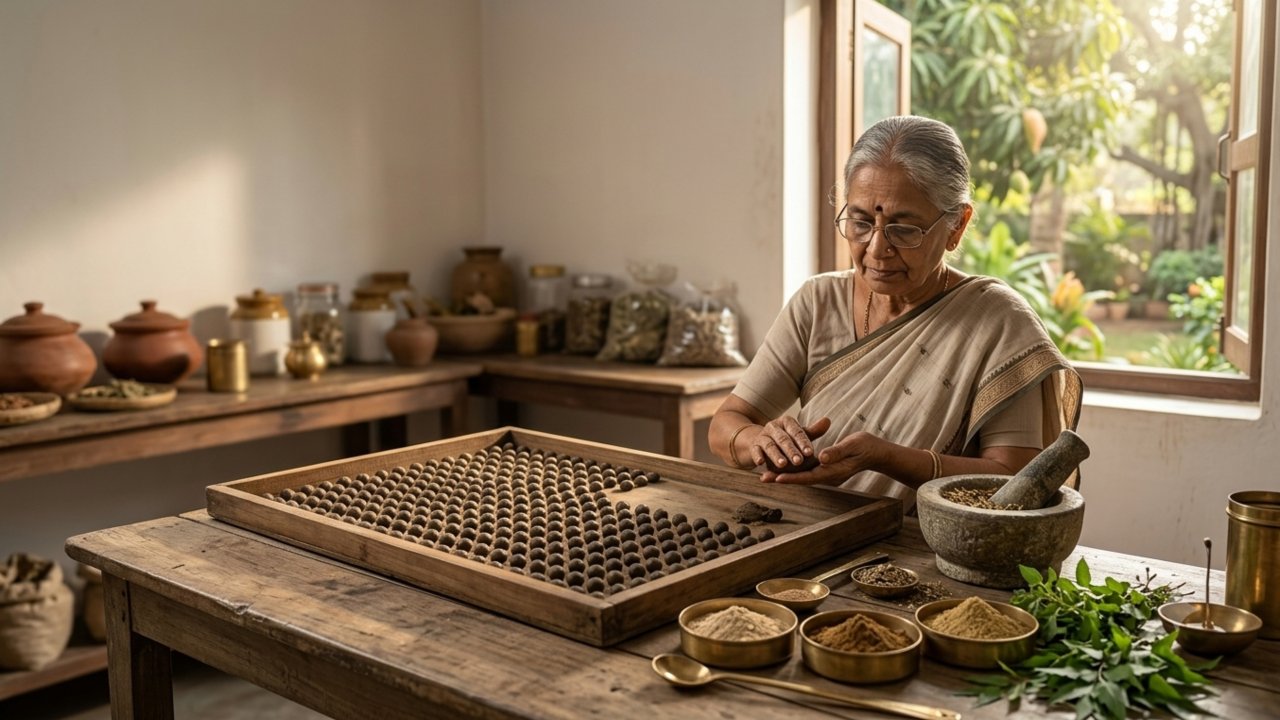 Out of all those classic formulations, Vati Kalpana—the art of making solid, rolled pills—is still one of the most popular and practical methods used today. It basically takes raw, bitter, or hard-to-swallow herbs and packs them into neat, even little tablets.
That simple tweak makes dosing much more accurate, keeps the medicine effective for longer, and saves patients from dealing with harsh raw powders or messy liquids.
- Etymology & Definition: Derived from Varta (“little round ball”) and Kalpana (“systematic preparation”), Vati Kalpana involves triturating fine medicinal powders with liquid media (bhavana dravya) or binding agents, then molding them into uniform solid pills.
- Classical Classification: It is classified as an Upa-kalpana (secondary formulation) derived from Kalka Kalpana (paste)—one of the Pancha Vidha Kashaya Kalpana (five primary extraction methods). Rolling a Kalka paste into a discrete, solid unit creates a Vati.
- Clinical Value: Bridging the gap between raw powders (Churna) and liquid extracts (Kwatha), Vati Kalpana combines concentrated potency, accurate dosing, longer shelf life, and ease of administration.
Historical Evolution and Synonyms
Roots of Vati Kalpana trace deep into the Vedic period rather than emerging as a medieval innovation, with the Rigveda documenting early pill-like formulas known as Mani for therapeutic and spiritual objectives.
Through successive eras of Ayurvedic literature, configurations like Pindi, Modaka, Vataka, and Varti gained structured prominence across foundational texts.
Textual Evolution and Standardization
- Ashtanga Hridaya: Acharya Vagbhata formalized the crucial pharmaceutical bridge between wet-ground herbal pastes (Kalka) and solid oral dosage forms, detailing the formulation of Vati, Gutika, and Varti.
- Sharngadhara Samhita: Acharya Sharngadhara revolutionized Vati Kalpana by introducing rigorous categorization, precise mathematical proportions, and definitive binding ratios that remain foundational in traditional pharmacology.
Traditional Synonyms and Structural Variations
- Vataka: A standard descriptor for spherical, ball-shaped medicinal preparations.
- Gutika: Typically designates smaller, condensed pills optimized for ease of swallowing.
- Vati: The widely adopted modern and classical nomenclature for compressed pill units.
- Modaka: Characterized by a larger, often spheroidal and palatable confection structure.
- Vatika: A localized diminutive form denoting smaller medicinal pellets.
- Pindi: Refers to a compact, dense bolus of active medicinal paste.
- Guda: Highlights heavy integration of jaggery (Guda) or concentrated sugary syrups serving as structural binding matrices.
- Varti: Represents an elongated, cylindrical, or wick-configured modality applied in specialized treatments such as nasal administration, localized application, or therapeutic fumigation.
Because of its long-standing history, Vati Kalpana is known by several synonyms, each highlighting a slight variation in its shape, size, or ingredients. Acharya Sharngadhara enumerates these in a classic verse:
वटकाश्चाथ कथ्यन्ते तन्नाम गुटिका वटी | मोदको वटिका पिण्डी गुडो वर्त्तिस्तथोच्यते || (Sharngadhara Samhita, Madhyama Khanda, 7/1)
Types of Vati Kalpana
Based on the application of heat during the preparation of the binding medium, Acharya Sharngadhara classifies Vati Kalpana into two distinct categories. This classification is crucial because the application of heat fundamentally alters the physicochemical properties of the binding agents and the final formulation.
1. Vahnisadhya Vati (Agnisiddha Vati) – Fire-Prepared Pills
When a Vati is prepared with the help of Vahni (fire), it is called Vahnisadhya Vati or Agnisiddha Vati. In this method, a binding agent—such as sugar (Sita), jaggery (Guda), or Guggulu—is boiled with water over a flame until it attains a specific, thick consistency akin to Lehyam (electuary).
Once the desired consistency is reached, the fine powders of the other medicinal ingredients are folded into this hot, sticky base to make a homogeneous paste, which is then rolled into pills.
लेहवत्साध्यते वह्नौ गुडो वा शर्करा तथा | गुग्गुलुर्वा क्षिपेत्तत्र चूर्णं तन्निर्मिता वटी || (Sha.Ma.Kh. 7/2)
Pharmaceutical Rationale: Heating jaggery or sugar causes caramelization and breaks down complex sugars into simpler forms, acting as an excellent preservative and a robust mechanical binder.
In the case of Guggulu, heating further purifies the resin, removes volatile oils (which can cause gastric irritation), and makes it sticky enough to hold the herbal powders together.
Examples: Yogaraja Guggulu, Kaishora Guggulu, Sudarshana Ghanavati.
2. Avahnisadhya Vati (Niragnisiddha Vati) – Fireless Pills
When a Vati is prepared without the application of Vahni (fire), it is called Avahnisadhya Vati or Niragnisiddha Vati. In this method, binding is achieved using readily available liquid media at room temperature, such as honey (Madhu), fresh herbal juices (Svarasa), decoctions (Kwatha), or simply water (Jala).
कुर्यादवह्निसिद्धेन क्वचिद् गुग्गुलुना वटीम् | द्र वेण मधुना वाऽपि गुटिकां कारयेद् बुधः || (Sha.Ma.Kh. 7/3)
Pharmaceutical Rationale: Many active phytochemicals, such as volatile essential oils (found in Lavanga/clove, Ela/cardamom) and heat-labile vitamins or enzymes, are destroyed by high temperatures. The Niragni method preserves these delicate constituents. Honey acts as a natural preservative and binder due to its hygroscopic and viscous nature.
Examples: Eladi Vati, Lavangadi Vati, Sanjivani Vati.
Classical Proportions for Binding Agents
To achieve the perfect consistency, Ayurvedic texts provide strict mathematical ratios for the binding agents relative to the primary herbal powder (Churna). Acharya Sharngadhara outlines these proportions:
सिता चतुर्गुणा देया वटीषु द्विगुणो गुडः | चूर्णाच्चूर्णसमः कार्यो गुग्गुलुर्मधु तत्समम् | द्रवं च द्विगुणं देयं मोदकेषु भिषग्वरैः || (Sha.Ma.Kh. 7/4)
- Sita (Sugar): 4 times the quantity of the herbal powder (if making a Modaka or heavily sweetened pill).
- Guda (Jaggery): 2 times the quantity of the herbal powder.
- Guggulu: Equal to the quantity of the herbal powder.
- Madhu (Honey): Equal to the quantity of the herbal powder.
- Drava (Any liquid like Kwatha/Svarasa): 2 times the quantity of the herbal powder.
These ratios ensure that the final product is neither too hard nor too crumbly, and that the binder effectively coats every particle of the powder.
General Steps in the Method of Preparation
The manufacture of Vati Kalpana is a meticulous process that requires precision, patience, and pharmaceutical insight. The general steps involved are:
1. Collection and Purification (Shodhana) of Ingredients: Ayurveda does not use raw drugs as they exist in nature. Herbs may contain pesticides, dirt, or natural toxins; minerals and metals are inherently toxic. Therefore, every ingredient must undergo Shodhana (purification and detoxification). For example, Guggulu is purified by boiling it in Triphala Kwatha (decoction) to remove impurities and aromatic volatile oils that can cause skin rashes and gastric upset.
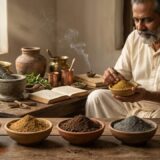
2. Preparation of Fine Powder (Churna Nishpatti) The purified herbal ingredients are dried thoroughly to remove all residual moisture. They are then ground individually into a fine powder (Churna). In classical times, this was done using a mortar and pestle (Okhali and Musala); today, mechanical pulverizers are used. The fineness of the powder is critical—ideally, it should pass through an 80 to 100-mesh sieve. If mineral ingredients are used, they must first be converted into Bhasma (ash) or Sindhoora (red oxide of sulfur/mercury) through complex Marana (incineration) processes.
3. Preparation of Kajjali (Specific to Rasa Shastra Formulations): If the formulation contains Parada (mercury) and Gandhaka (sulphur), they are triturated together in a completely dry state until they form a lusterless, fine, black powder known as Kajjali (literally, “collyrium” or kohl, due to its intense black color). This step neutralizes the toxicity of mercury and forms mercury sulfide, a safe and highly bioavailable compound.
4. Preparation of the Binding Medium: Depending on whether the formulation is Agnisiddha or Niragnisiddha, the binder is prepared. For Agnisiddha Vatis, jaggery or Guggulu is melted to a specific thread-like consistency (Guda Paak). For Niragnisiddha Vatis, fresh juice is extracted, or honey is kept ready.
5. Mixing and Trituration (Mardana / Bhavana): This is the most crucial step. The fine powders and the binding medium are placed in a mortar. The pharmacist begins Bhavana (wet trituration). This is not mere mixing; it is a mechanical process of rubbing, grinding, and pounding. Bhavana achieves three things:
- It ensures uniform distribution of the binder and active principles.
- It reduces the particle size of the powder even further through friction.
- In Kajjali-based Vatis, the process of Bhavana with herbal juices impregnates the micro-pores of the metallic/mercurial ash with organic phytochemicals, enhancing bioavailability and reducing toxicity. The trituration continues until a smooth, non-sticky, pliable dough-like mass is formed.
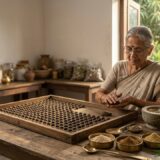
6. Rolling and Shaping: The homogeneous mass is then divided into smaller portions. Using the palms and fingers (often dusted with dry powder to prevent sticking), each portion is rolled into a perfectly spherical pill of a specified size and weight. In modern GMP (Good Manufacturing Practice) facilities, this is done using automatic pill-rolling machines to ensure absolute uniformity in weight (e.g., 250mg, 500mg pills).
7. Drying: The freshly rolled Vatis are soft. They must be dried to harden them. Niragnisiddha Vatis (especially those containing volatile oils or honey) are strictly dried in the shade (Chhaya Shushka) to prevent the evaporation of delicate therapeutic compounds. Agnisiddha Vatis may sometimes be sun-dried, depending on the ingredients.
8. Packaging and Storage: Once completely dry and hard, the Vatis are stored in airtight glass or food-grade PET containers. They must be kept away from moisture and direct sunlight to prevent fungal growth or degradation.
Dosage, Anupana, and Administration
The administration of Vati Kalpana is highly personalized, adhering to the fundamental Ayurvedic principle that there is no fixed dose for all individuals.
Dosage (Matra)
कर्षप्रमाणा तन्मात्रा बलं दृष्ट्वा प्रयुज्यताम् || (Sh.Ma.Kh. 7/5)
According to Acharya Sharngadhara, the standard dose of Vati is one Karsha. A Karsha is an ancient unit of measurement roughly equivalent to 12 grams.
However, in modern clinical practice, due to the concentrated nature of formulations and the potency of purified minerals (like Bhasma), the dosage is significantly lower—usually ranging from 125 mg to 500 mg (1 to 2 pills), taken once or twice a day.
Before administering any Vati, the physician must carefully evaluate:
- Bala (Strength): The physical strength and immunity of the patient.
- Agni (Digestive Fire): A patient with strong digestion can handle heavier, larger pills or higher doses.
- Kala (Time/Season): Dosages may be altered based on seasonal strengths and weaknesses of the body.
- Roga (Disease): Acute conditions may require different dosing than chronic, long-term ailments.
Anupana (The Vehicle): The concept of Anupana is a unique hallmark of Ayurvedic pharmacology. Anupana is the liquid or substance with which a medicine is swallowed.
It acts as a vehicle, a bioenhancer, and a targeted delivery system. The same Vati can produce entirely different therapeutic effects depending on the Anupana used:
- Warm Water (Ushnodaka): The most common Anupana for digestive and carminative Vatis (like Hingvastak Vati). It kindles Agni and helps dissolve the pill quickly.
- Milk (Ksheera): Used as an Anupana for rejuvenative (Rasayana) Vatis, or those meant to balance Vata and Pitta doshas. Milk acts as a nourishing medium.
- Ghee (Ghrita): Ideal for Vatis targeting the brain, nervous system, or reproductive organs, as ghee crosses the blood-brain barrier effectively.
- Honey (Madhu): Prescribed for Vatis aimed at respiratory disorders (like Lavangadi Vati) or obesity, as honey acts as a Yogavahi (catalyst) and has expectorant properties.
- Herbal Decoctions (Kwatha): A specific decoction (e.g., Dashamoola Kwatha) may be used as an Anupana to synergize with the Vati’s action for conditions like arthritis.
Shelf Life of Vati Kalpana
Shelf Life Guidelines for Vati Kalpana
- Classical Standard: Acharya Sharngadhara defined the shelf life as strictly one year, accounting for the natural degradation of active phytoconstituents caused by atmospheric moisture and temperature shifts over time.
- Modern Regulatory Standard: Rule 161B of the Drugs and Cosmetics Act of India extends the official shelf life to two years, dependent upon proper storage in tightly sealed, moisture-free containers away from direct sunlight.
- Special Formulations: Preparations incorporating Guggulu or heavy metals require heightened storage vigilance to prevent oxidation, softening from ambient humidity, and subsequent fungal proliferation.
Advantages of Vati Kalpana Over Other Dosage Forms
Vati Kalpana has endured for millennia because it solves several practical challenges associated with other Ayurvedic dosage forms like Kwatha (decoctions), Svarasa (fresh juices), Churna (powders), and Avaleha (jams). Its advantages are multifaceted, spanning patient compliance, pharmaceutical stability, and clinical efficacy.
1. Ease of Administration: Consider the alternative: Kwatha (decoction) requires a patient to boil specific herbs, reduce the liquid, strain it, and consume it while hot. This is highly impractical for modern working individuals, travelers, or hospitalized patients. Vatis, on the other hand, are “ready-to-use.” They require no preparation, no cooking, and no special equipment. One simply pops the pill in the mouth and swallows it with the prescribed Anupana.
2. Precise and Accurate Dosage: In dosage forms like Churna (powder), there is a high risk of dosage error. A patient might take a slightly heaped spoon one day and a leveled spoon the next, leading to fluctuating therapeutic blood levels. Because Vatis are molded into specific weights (e.g., exactly 250 mg per pill), the dosage is incredibly precise. The physician knows exactly how many milligrams of the active drug the patient is ingesting, ensuring consistent therapeutic outcomes and minimizing the risk of toxicity.
3. Masking Unpleasant Taste and Odor (Palatability): Ayurvedic pharmacopeia utilizes highly potent herbs, many of which are extremely bitter (Tikta), astringent (Kashaya), or pungent (Katu). Raw powders of herbs like Guduchi, Neem, or Kutki can cause gag reflexes or nausea. When these powders are bound with jaggery, sugar, ghee, or honey to make a Vati, the sweet and oily binding agents effectively mask the harsh, bitter tastes. This dramatically improves patient compliance, especially among children and the elderly, who are notoriously averse to bitter medicines.
4. Extended Shelf Life and Stability: Liquid formulations like Svarasa (fresh juice) spoil within hours, while Asava and Arishta (fermented liquids) require careful corking and can explode if exposed to high temperatures. Kalka (paste) spoils in a few days. Vati Kalpana, having very low moisture content (usually less than 5-10%), is highly resistant to microbial growth and enzymatic degradation. The solid matrix protects the active compounds from oxidation and hydrolysis, granting it a shelf life of up to two years.
5. Convenience in Storage and Transportation: Because Vatis are solid, compact, and lightweight, they occupy a fraction of the space required by liquid medicines. A week’s dose of a decoction might require heavy glass bottles, whereas a week’s dose of Vatis can fit into a small, pocket-sized plastic or glass container. They are less prone to spillage, breakage, or contamination during transit. This makes Vatis the ideal dosage form for travelers, soldiers, and for large-scale distribution in public health campaigns.
6. Unmatched Suitability for Diverse Ingredients: This is perhaps the greatest pharmaceutical advantage of Vati Kalpana. It is incredibly versatile. You can make a Vati using only plant powders. You can make a Vati using resins (like Guggulu or Shilajit) which are otherwise sticky and hard to handle. Most importantly, Vati is the only dosage form that seamlessly integrates purified metals, minerals, and mercury (Rasa Aushadhis) with herbal powders. The process of Bhavana (trituration) used in Vati making allows heavy metallic Bhasmas (which are nano-particulate and highly reactive) to be safely coated and bound within an organic herbal matrix, facilitating safe absorption and targeted delivery in the human body.
7. Economic Feasibility: From a manufacturing perspective, Vatis are highly economical. They do not require expensive sterilization techniques, large glass bottling, or cold storage. The raw material wastage is minimal because every speck of powder is incorporated into the binding medium. Even on a small scale (like an Ayurvedic physician making medicines in their own clinic), Vatis can be made with basic equipment (mortar and pestle), making Ayurvedic healthcare accessible and affordable to the masses.
Vati Kalpana represents the zenith of classical Ayurvedic pharmaceutical wisdom. It is a perfect synthesis of ancient alchemical principles (Rasa Shastra) and practical herbal medicine (Dravyaguna). By evolving from the simple pastes of the Vedic era into mathematically precise, standardized pills during the time of Acharya Sharngadhara, Vati Kalpana demonstrated a profound understanding of drug delivery systems long before modern pharmaceutics existed.
FAQ’s
1. What is Vati Kalpana in Ayurveda?
Vati Kalpana is a traditional Ayurvedic pharmaceutical method used to prepare medicines in the form of pills or tablets.
2. What are the basic principles of Vati Kalpana?
The key principles include proper selection and processing of ingredients, appropriate trituration and binding, uniform pill formation, proper drying, and suitable storage.
3. How are Vati formulations prepared?
Medicinal ingredients are generally powdered, mixed and processed with a suitable liquid or binding medium, shaped into pills, and dried appropriately.
4. What ingredients are commonly used in Vati Kalpana?
Depending on the formulation, ingredients may include herbal powders, extracts, mineral preparations, and traditional liquid or binding media.
5. What is the purpose of using Vati as an Ayurvedic dosage form?
Vati provides a convenient, compact, and portable solid dosage form that can simplify the administration and storage of Ayurvedic medicines.
6. What is the role of a binding agent in Vati preparation?
A suitable binding medium helps the powdered ingredients combine effectively and maintain the desired shape and consistency of the pills.
7. What factors determine the quality of Vati formulations?
Ingredient quality, accurate proportions, proper processing, uniform size, adequate drying, packaging, and storage conditions can affect the quality of Vati formulations.
8. What is the difference between Vati and other Ayurvedic dosage forms?
Vati is a solid pill or tablet preparation, while other Ayurvedic dosage forms include powders, decoctions, medicated oils, pastes, and fermented preparations.
9. Is Vati Kalpana relevant to modern Ayurvedic pharmacy?
Yes. Vati remains an important Ayurvedic dosage form, with traditional preparation principles increasingly supported by modern quality-control and manufacturing practices.
10. Why is Vati Kalpana important in Ayurvedic pharmaceutics?
Vati Kalpana is important because it converts medicinal ingredients into a practical solid dosage form while following traditional Ayurvedic principles of pharmaceutical preparation.
References
- Sharangadhara. Sharangadhara Samhita, Madhyama Khanda, Chapter 7: Vati/Gutika Kalpana. Classical Ayurvedic Pharmaceutics.
- Sharangadhara. Sharangadhara Samhita. Madhyama Khanda, Vati Kalpana, verses 1–5. Classical Ayurvedic text.
- Ministry of AYUSH, Government of India. The Ayurvedic Pharmacopoeia of India. Pharmacopoeia Commission for Indian Medicine & Homoeopathy. Ayurvedic Pharmacopoeia of India
- Central Drugs Standard Control Organization, Ministry of Health & Family Welfare, Government of India. Drugs Rules, 1945. Rule 161B: Expiry date/shelf life of Ayurvedic, Siddha and Unani medicines. CDSCO
- Mehta, N. J., et al. Bhaishajya Kalpanaa – The Ayurvedic Pharmaceutics: An Overview. Ancient Science of Life. PubMed Central
- Panda, P., Das, B., Bhuyan, G. C., Meher, S. K., & Rao, M. M. Ayurvedic Pharmaceutical Dosage Forms—A Review. International Journal of Applied Ayurved Research. 2017;3(5):926–934. IJAAR
- Kshirsagar, S. S., & Avalaskar, A. Review of Swarasa Kalpana of Single Drug by Sharangadhara Samhita wsr to Phytochemical Analysis. International Journal of Ayurveda and Pharma Research. 2023;11(10):58–64. IJAPR
- Rani, P., Sharma, K., & Kumar, A. Probable Mode of Action of Sanjivani Vati – A Critical Review. International Journal of Health Sciences and Research. 2018;8(8):295–307. IJHSR
- Tracking the Transitions in Guggulu Kalpana: An Extensive Review Through Brihat Trayi and Laghu Trayi. Ancient Science of Life. PubMed Central
- Agarwal, R., & Shukla, G. S. Sharangadhara Samhita: A Review of Its Unique Contributions to Ayurvedic Science. World Journal of Pharmacy and Medical Sciences. 2026;2(8):57–63. Zenodo