Pancha Mrittika: The Five Sacred Earths in Ayurveda and Rasa Shastra

Far beyond simple herbalism, Ayurveda houses a sophisticated pharmaceutical alchemy called Rasa Shastra. This ancient discipline processes minerals, metals, and poisons to treat diseases deeply.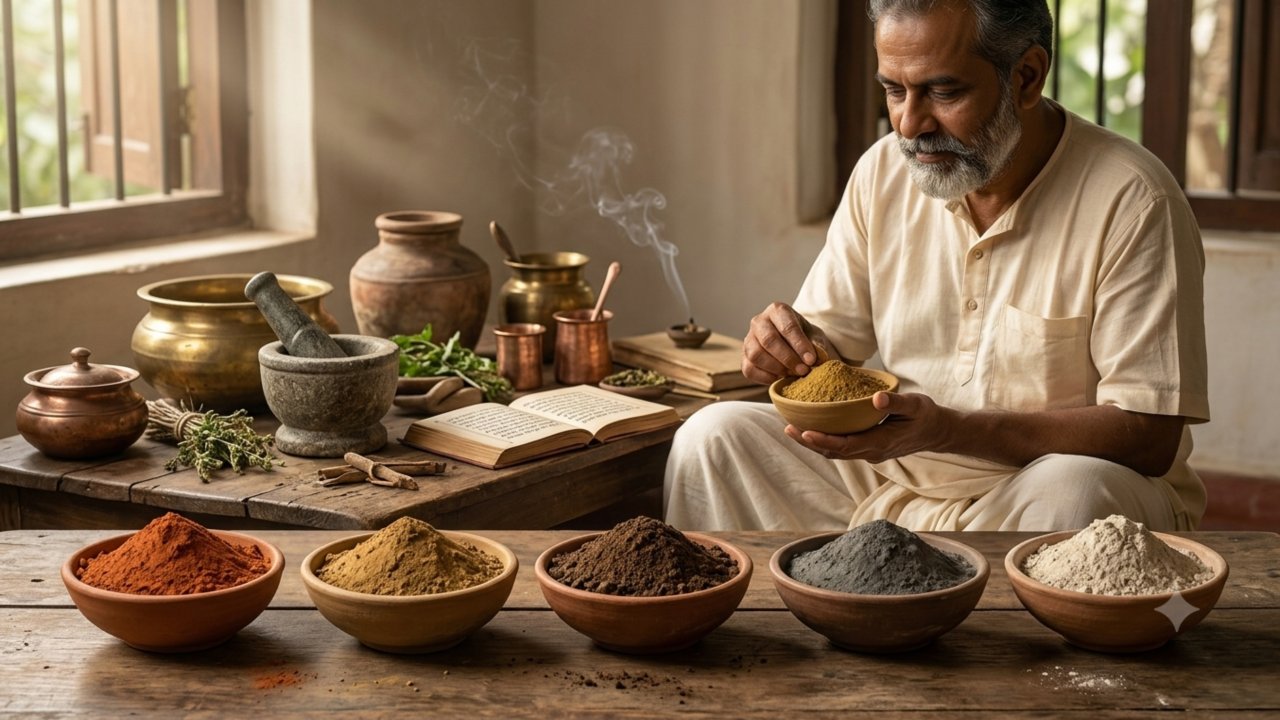 Lacking modern laboratory tools, ancient alchemists engineered brilliant natural alternatives. They utilized clever organic materials to build powerful adsorbents, fluxes, refractories, and seals for intense heat.
Central to this sophisticated alchemical engineering is Pancha Mrittika. This revered technique relies on a precise combination of five distinct natural earths to secure crucibles.
These traditional methods showcase an astonishing empirical mastery of chemistry. Long before modern laboratories existed, ancient practitioners achieved remarkable material transformations using purely earth-based resources.
The Ingredients of Pancha Mrittika
- Ishtika (Brick Powder): Ground red brick rich in silica (SiO2) and alumina (Al2O3). It provides thermal insulation and acts as a porous adsorbent.
- Gairika (Red Ochre): Hydrated iron oxide (Fe2O3⋅nH2O) that serves as a mild flux and mineral catalyst during high-heat processing.
- Lavana (Rock Salt): Mineral-rich sodium chloride (NaCl) used to lower eutectic temperatures and break down metal oxides.
- Bhasma (Wood Ash): Alkaline ash high in potash (K2CO3) and calcium carbonate (CaCO3) that functions as a deoxidizer and flux.
- Valmika Mrittika (Termite Mound Soil): Fine, organically modified clay that delivers superior binding strength and refractory heat resistance.
Classical Rasa Shastra texts like the Rasa Ratna Samucchaya and Rasa Jala Nidhi hold Pancha Mrittika in the highest esteem.
Codified as Mrid-Panchaka (“the group of five earths”), this formulation comprises Ishtika (brick powder), Gairika (red ochre), Lavana (salt), Bhasma (ash), and Valmika Mrittika (termite mound soil).
Far from a random mixture of soil, it functions as a purpose-driven composite engineered to interact with metals during complex alchemical procedures.
Ingredients & Chemical Roles
- Ishtika (Brick Powder): Powdered red clay rich in silica ($SiO_2$) and alumina ($Al_2O_3$). Provides high thermal insulation, structural framework, and porous adsorption.
- Gairika (Red Ochre): Hydrated iron oxide ($Fe_2O_3 \cdot nH_2O$). Serves as an inorganic flux and catalyst that stabilizes trace mineral reactions during heating.
- Lavana (Rock/Sea Salt): Halite ($NaCl$) that lowers eutectic melting points, breaks down stubborn surface oxides, and creates osmotic gradients.
- Bhasma (Wood/Calcinated Ash): Potash-rich alkaline mass ($K_2CO_3, CaCO_3$) acting as a chemical neutralizer, reducing agent, and flux.
- Valmika Mrittika (Termite Mound Soil): Fine clay bound by organic insect secretions. Delivers exceptional plasticity, fine particle distribution, and thermal shock resistance.
Applications & Therapeutic Functions
Prithvi Mahabhuta and Parthiva Sharira: Exploring the Macrocosm and Microcosm
In Ayurvedic physiology, the concept of Loka-Purusha Samya establishes that the individual microcosm mirrors the universal macrocosm.
Prithvi Mahabhuta (the Earth element) governs mass, structure, density, and stability. Because human physiology—termed the Parthiva Sharira—relies on earth for its structural matrix (bones, tissues, cellular walls), soil is viewed not as foreign debris, but as a foundational bio-element.
Therapeutic Principles of Parthiva Chikitsa
- Principle of Similarity (Samanya): Earth-derived minerals directly replenish and stabilize structural tissues (Dhatus), reinforcing the body’s physical architecture.
- Principle of Opposition (Vishesha): The heavy (Guru), stable (Sthira), and ground-binding nature of refined clays directly counteracts the hyper-mobile, volatile properties of Vata and the intense heat of Pitta.
- Affinity for Trace Minerals: The skin absorbs essential micro-nutrients via osmotic transport when micro-fine natural earths are applied as medicated pastes (Lepas).
Evolution from Clinical Mud Therapy to Alchemical Science
Deep Dive into the Ingredients of Pancha Mrittika
The genius of Pancha Mrittika lies in the synergistic properties of its five ingredients. Each component brings a unique physical, chemical, and energetic characteristic to the formulation, creating a complete alchemical tool.
1. Ishtika (Brick Powder)
- Identification: Ishtika refers to the powder of a well-baked, pure brick. In classical times, bricks that were old, exposed to the elements (rain and sun), and free from modern pollutants were selected.
- Ayurvedic Properties: It is characterized by Ruksha (dry) and Laghu (light) qualities. Its primary pharmacological action is Shoshana—intense absorption and drying.
- Role in the Matrix: In metallurgy, raw metals often have an oily or greasy residue, either from the earth (organic matter) or from previous processing. Ishtika acts as a powerful desiccant, physically scrubbing and absorbing these lipids and moisture from the surface of the metal.
- Modern Understanding: Brick powder is predominantly amorphous silica and aluminum silicates. Its structure is highly porous, providing a massive surface area for physical adsorption. In modern terms, Ishtika acts as a silica-rich adsorbent, drawing out non-polar impurities (oils) through capillary action.
2. Gairika (Red Ochre)
- Identification: Gairika is a naturally occurring earth pigment, widely known as Red Ochre. It is sourced from specific rocky terrains or riverbeds.
- Ayurvedic Properties: It possesses Guru (heavy) and Sheeta (cool) qualities. Its actions are Stambhana (stabilizing, astringent, binding) and Rakta-Pitta Shamaka (pacifying the blood and Pitta dosha).
- Role in the Matrix: While Ishtika absorbs, Gairika stabilizes. It provides a binding matrix that holds the other ingredients together. When rubbed on metals, it provides a smooth, stabilizing friction. Furthermore, because metal purification generates intense heat (Tejas), the cooling property of Gairika prevents the metal from oxidizing or becoming brittle due to thermal shock.
- Modern Understanding: Geologically, Gairika is Hematite, composed almost entirely of Iron Oxide (Fe2O3). Its high thermal mass allows it to absorb and dissipate heat evenly. It acts as a gentle abrasive (micro-scrubber) and provides a stable iron-rich matrix that facilitates ionic exchange during the purification process.
3. Lavana (Salt)
- Identification: While various salts are used in Ayurveda (like Saindhava or rock salt), in the context of Pancha Mrittika, it generally refers to a purified, crystalline salt.
- Ayurvedic Properties: Lavana is Sukshma (subtle/micro-penetrating) and Marganusari (channel-clearing). It has a piercing nature.
- Role in the Matrix: Salt is the chemical catalyst in this earthen combination. Metals have tightly bound surface layers. Salt helps in breaking the surface tension, allowing the acidic or alkaline media (used alongside Pancha Mrittika) to penetrate the micro-cracks of the metal and reach the impurities hidden within.
- Modern Understanding: Salt (Sodium Chloride) provides a strong ionic medium. When dissolved in the liquid medium used during purification, it acts as an electrolyte. It facilitates electrochemical corrosion of the unwanted impurities while leaving the noble metal intact. It essentially acts as a flux, lowering the melting point of impurities and enhancing chemical penetration.
4. Bhasma (Ash)
- Identification: In this specific context, Bhasma usually refers to the white ash of specific plant materials (like Palasha or Tinisa) or specific mineral ashes.
- Ayurvedic Properties: It is Teekshna (sharp) and Kshara (alkaline) in nature. Its primary action is Shodhana (cleansing).
- Role in the Matrix: Bhasma provides the chemical firepower for the mixture. It reacts with organic toxins, acidic residues, and non-metallic impurities, neutralizing them so they can be easily absorbed by the Ishtika and Valmiki.
- Modern Understanding: Plant and mineral ashes are highly alkaline, rich in carbonates (like potassium carbonate) and oxides. This alkalinity creates a saponification effect. Just as alkaline soap breaks down grease, the alkaline Bhasma chemically breaks down complex organic impurities and acidic toxins on the metal’s surface, rendering them water-soluble or easily adsorbable.
5. Valmika Mrittika (Ant-hill Soil)
- Identification: This is the specific earth excavated from anthills (termite mounds). The soil is chosen from mounds that are active but built in clean, arid environments.
- Ayurvedic Properties: It is highly revered for its Vishaghna (anti-poisonous) and Shodhana (cleansing) properties. It is light, porous, and incredibly absorbent.
- Role in the Matrix: Valmiki is the ultimate detoxifier of the group. While the other ingredients prep and break down the impurities, Valmiki acts as the final trap. It absorbs the dissolved toxins and microscopic contaminants, ensuring they do not re-deposit onto the metal.
- Modern Understanding: Termite mounds are geological marvels. The insects meticulously select the finest clay particles, enriching the soil with specific minerals (calcium, magnesium, silica) and organic enzymes. The resulting soil is exceptionally porous, with a massive surface area and high cation-exchange capacity (CEC). It acts as a highly efficient molecular sieve and absorbent for heavy metal toxins.
The Synergistic Matrix: When these five are combined, they create a perfect alchemical storm: Bhasma chemically breaks down impurities (alkaline action).
Lavana creates ionic pathways for the impurities to leave the metal (penetrative action); Gairika provides a stable, heat-dissipating medium for the reaction (stabilizing action).
Ishtika physically scrubs and absorbs non-polar wastes (adsorbent action); and Valmiki traps the dissolved toxins (porous absorption).
Core Uses of Pancha Mrittika in Rasa Shastra
The primary theater of operation for Pancha Mrittika is the Rasa Shastra laboratory, where it serves three indispensable functions:
1. Shodhana (Purification and Detoxification of Metals)
In Rasa Shastra, raw metals and minerals (Dhatu and Maharasa) are considered to possess Doshas (flaws/impurities), Vishas (toxins), and Malas (waste matter). Using them directly in medicine would be lethal. Shodhana is the process of removing these negative attributes.
Pancha Mrittika is the medium of choice for the Mardana (rubbing/grinding) and Paka (roasting) phases of Shodhana. The metal (often in the form of thin leaves or small pieces) is repeatedly ground with the Pancha Mrittika paste and specific liquids (like lemon juice or Kanjika).
The earth matrix absorbs the physical grime, while the chemical reactions strip away toxic alloyed metals (like lead or copper from raw gold). The combination is especially famous for Swarna Shodhana (purification of gold), but is also used for silver, iron, and other metals.
2. Preparing Mushas (Refractory Crucibles)
Mushas are the crucibles used for Puta (incineration) and melting of metals. Ordinary clay pots cannot withstand the extreme, prolonged temperatures (often exceeding 1000°C) required to calcine metals like iron or mica.
Pancha Mrittika is used as the core material for crafting high-grade Mushas, or as a thick protective lining (Avarana) inside standard crucibles.
The high silica content from the Ishtika, combined with the thermal stability of Gairika and the binding nature of the ash and salt, creates an exceptional refractory composite.
These specialized crucibles can withstand intense thermal shock without cracking, ensuring the metal inside is evenly calcined and does not escape through vessel failure.
3. Sealing the Yantras (Alchemical Apparatus)
Yantras are complex glass, earthen, or metallic apparatuses used for distillation, sublimation, and extracting essences. The most critical procedures involve Parada (mercury) and Gandhaka (sulfur). Mercury vapor is highly toxic, and its escape into the laboratory is dangerous.
To prevent this, the joints, lids, and openings of the Yantras must be hermetically sealed. Pancha Mrittika is mixed with wet cow dung, clay, and jute fibers to create a dense, pliable paste.
This is smeared over the joints. As the Yantra heats up, the organic matter in the cow dung burns off, and the Pancha Mrittika bakes into an incredibly hard, stone-like, airtight seal.
The porous nature of the Valmiki and Ishtika expands slightly under heat, perfectly filling any microscopic gaps and ensuring zero vapor escape.
4. Therapeutic Benefits and Medicinal Actions of Mrittika
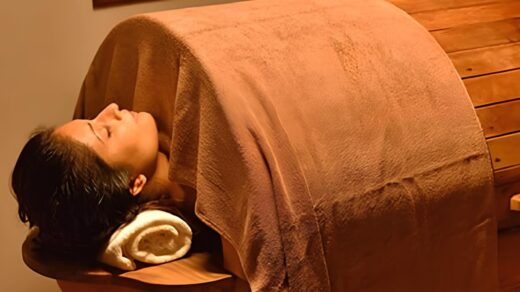
While Pancha Mrittika is primarily an alchemical tool, the individual muds within it, and the broader concept of medicinal earth therapy (Mrittika Chikitsa), hold massive significance in clinical Ayurveda.
When applied externally, these earths interact directly with the Parthiva Sharira (the physical body).
5. Vishaghna (Anti-Toxic and Detoxifying Action)
Certain Mrittikas, particularly Valmiki (ant-hill soil), possess profound Vishaghna properties. In cases of spider bites, snakebites, or contact with toxic plants, a paste of these earths applied to the site acts as a mechanical and chemical sponge.
It binds to the protein-based toxins or alkaloid poisons on the skin, preventing their absorption into the bloodstream, and draws them out of the tissue. This principle of using earth to neutralize poison is a cornerstone of Ayurvedic toxicology (Agada Tantra).
6. Daha Shamana (Cooling and Anti-Inflammatory Action)
Pitta dosha, characterized by heat, manifests on the skin as Daha (burning sensation), redness, and inflammation—seen in conditions like urticaria, allergic dermatitis, sunburns, and herpes.
Mrittikas like Gairika possess Sheeta Veerya (cold potency). When applied as a cold paste (Lepa), the earth physically absorbs the heat from the skin through conduction, while its inherent pharmacological properties pacify the localized Pitta. This provides immediate relief from burning and reduces inflammatory markers.
7. Kleda Shoshana and Shothahara (Fluid Absorption and Anti-Edematous Action)
Kleda refers to excessive moisture, fluid retention, or exudate in the body. When Kleda accumulates in the interstitial spaces, it causes Shotha (edema or swelling).
Mrittikas are natural desiccants. When applied to swollen joints (as in rheumatoid arthritis or gout), or to weeping eczema, the clay performs Kleda Shoshana.
Through osmotic pressure, it draws the excess interstitial fluid out of the tissues and into the clay matrix, visibly reducing the swelling and providing mechanical relief from pressure pain.
8. Vrana Shodhana and Ropana (Wound Cleansing and Healing)
In the management of Vrana (wounds and ulcers), Mrittika plays a dual role.
- Shodhana (Cleansing): Infected or necrotic wounds produce purulent discharge (pus). Mrittika pastes absorb this discharge, keeping the wound bed clean. Furthermore, the alkaline nature of the ash component alters the pH of the wound bed, creating an environment hostile to bacteria (particularly anaerobes and acid-loving pathogens).
- Ropana (Healing): By keeping the wound dry and clean, and by supplying trace minerals (like silica and calcium from the earth), Mrittika promotes the formation of healthy granulation tissue, speeding up the healing process.
9. Mineral Supply (Transdermal Nutrition)
The skin is not an impermeable barrier; it can absorb microscopic particles and dissolved ions. When medicated muds are applied as a part of therapy (much like modern pelotherapy or mud baths), the body absorbs trace minerals naturally present in the clay—such as silica, iron, calcium, magnesium, and potassium.
This acts as a form of transdermal mineral supplementation, replenishing the Parthiva Sharira directly, which is highly beneficial in conditions like osteoporosis, chronic fatigue, and generalized debility.
10. The Magnum Opus Application: Swarna Shodhana (Purification of Gold)
To fully grasp the operational brilliance of Pancha Mrittika, we must examine its premier application: Swarna Shodhana, as detailed in Volume 3 of Rasa Jala Nidhi.
Gold (Swarna) is a noble metal, but when mined, it is invariably alloyed with traces of copper, silver, lead, and iron. To convert gold into a bio-available nano-medicine (Swarna Bhasma), it must be purified to an absolutely pristine state.
The Classical Procedure:
- Formulation: The five ingredients of Pancha Mrittika are finely ground into a homogeneous powder.
- Medium: This powder is mixed with Jambira Swarasa (fresh lime juice) or Aranala / Kanjika (a sour, fermented, acidic liquor). This creates a highly acidic, abrasive paste.
- Application: This paste is thickly smeared over thin, hammered-out Gold Leaves (Swarna Patras).
- Processing (Putapaka): The coated gold leaves are placed inside a specialized earthen vessel (Sharava) and sealed. This sealed vessel is subjected to Putapaka—a specific type of controlled, enclosed heating (similar to baking).
Mode of Action (The Ayurvedic Perspective):
- Shodhana: The acidic medium chemically reacts with the base metal impurities (oxides of copper, lead, etc.) on the surface of the gold. The Pancha Mrittika matrix immediately absorbs these dissolved toxins.
- Agni Samskara: The Puta (fire) subjects the gold to a profound thermal alteration. This “fire transformation” changes the crystalline structure of the gold, making it brittle and friable, which is an absolute prerequisite for reducing it to Bhasma (ash) in subsequent steps.
- Kshara-Amla Interaction: The alkaline ash (Bhasma) in the Pancha Mrittika reacts with the acidic lime juice in a complex acid-base interaction. This facilitates Sukshmikarana—the subtle processing of the metal, ensuring impurities are not just wiped away, but chemically transformed and locked within the earth.
The Modern Scientific Perspective:
When viewed through modern metallurgy, this ancient process is astonishing. The lime juice (citric acid) acts as a weak organic chelating agent, selectively dissolving non-gold metal oxides on the surface of the leaf.
The Pancha Mrittika provides the mechanical abrasive scrubbing and the porous medium to trap the chelated impurities.
The controlled heating (Putapaka) allows for thermal annealing—relieving the internal stresses in the gold lattice caused by the initial hammering, while simultaneously driving off any volatile impurities.
Modern gold refineries use highly toxic acids like aqua regia (a mixture of nitric and hydrochloric acid) to purify gold, generating massive amounts of toxic waste.
The Rasa Shastra method achieves a remarkably pure, bio-compatible product using completely natural, ecologically sound materials: earth, salt, ash, and lemon juice.
Textual Legacy and Conclusion: The unparalleled importance of this combination is immortalized in the Rasa Ratna Samucchaya (Chapter 5, Loha Vijnaniya):
इष्टिका गैरिकं चैव लवणं भस्म वल्मिकम् । एतत् पञ्चमृदा प्रोक्तं सर्वकर्मसु पूजितम् ॥
“Ishtika, Gairika, Lavana, Bhasma, and Valmika—these five earths are proclaimed, and are praised/essential in all procedures.”
The phrase Sarva Karma Su Pujitam is a profound endorsement. In a dangerous science where a single mistake could result in a lethal medicine or a laboratory explosion, the Rasa Vaidyas needed a “gold standard” composite they could trust for every procedure—from purifying mercury to sealing a distillation flask. Pancha Mrittika was that standard.
Pancha Mrittika is a masterpiece of ancient Indian material science. Without the aid of modern chemistry, the Rasa Siddhas (perfected alchemists) understood the principles of adsorption, ionic exchange, thermal refractory behavior, and acid-base neutralization. They encoded this advanced knowledge into a simple, elegant formula of five.
References
- Vāgbhaṭa. Rasaratna Samuccaya. Chapter 10, verse 81. Sanskrit text. TransLiteral. TransLiteral
- Mookerjee, Bhudeb. Rasa Jala Nidhi, Volume 3: Metals, Gems and Other Substances. Section: Purification of Gold. Wisdom Library. Wisdom Library
- Walkikar, Shilpa Shankarrao, & Mishra, Sangeeta. Critical Review of Mrittika in Ayurvedic Classical Texts. International Journal of Ayurveda and Pharma Research, 2023; 11(Suppl 3):70–73. DOI: 10.47070/ijapr.v11iSuppl3.2889. International Journal of Ayurveda and Pharma Research
- Jairam, K. V., Ajitha, K., Sivaram, A., Abhilash, M., & Hakkem Panthappulan. Conceptual analysis and revalidation of Loka-Purusha-Samya-Siddhanta based upon evidences from contemporary sciences. Kerala Journal of Ayurveda, 2022; 1(1):29–34. DOI: 10.55718/kja.86. Kerala Journal of Ayurveda
- A Conceptual Study on Hridayavarnaka Karma of Gairika w.s.r. to Hridroga. International Journal of Ayurveda and Pharma Research, 2023; 11(11):80–82. International Journal of Ayurveda and Pharma Research
- Mookerjee, Bhudeb. Rasa Jala Nidhi, Volume 1: Initiation, Mercury and Laboratory. Definition of Pañca-mṛttikā / Mṛt-pañcaka. Wisdom Library. Wisdom Library