
List of 26 Indian Herbs and Spices: Their Uses in Cooking

Indian cuisine is not merely a method of feeding oneself; it is an intricate, centuries-old alchemy. It is a culinary tradition that treats spices not as mere seasonings, but as the very soul of the dish. To understand Indian cooking is to understand its spices.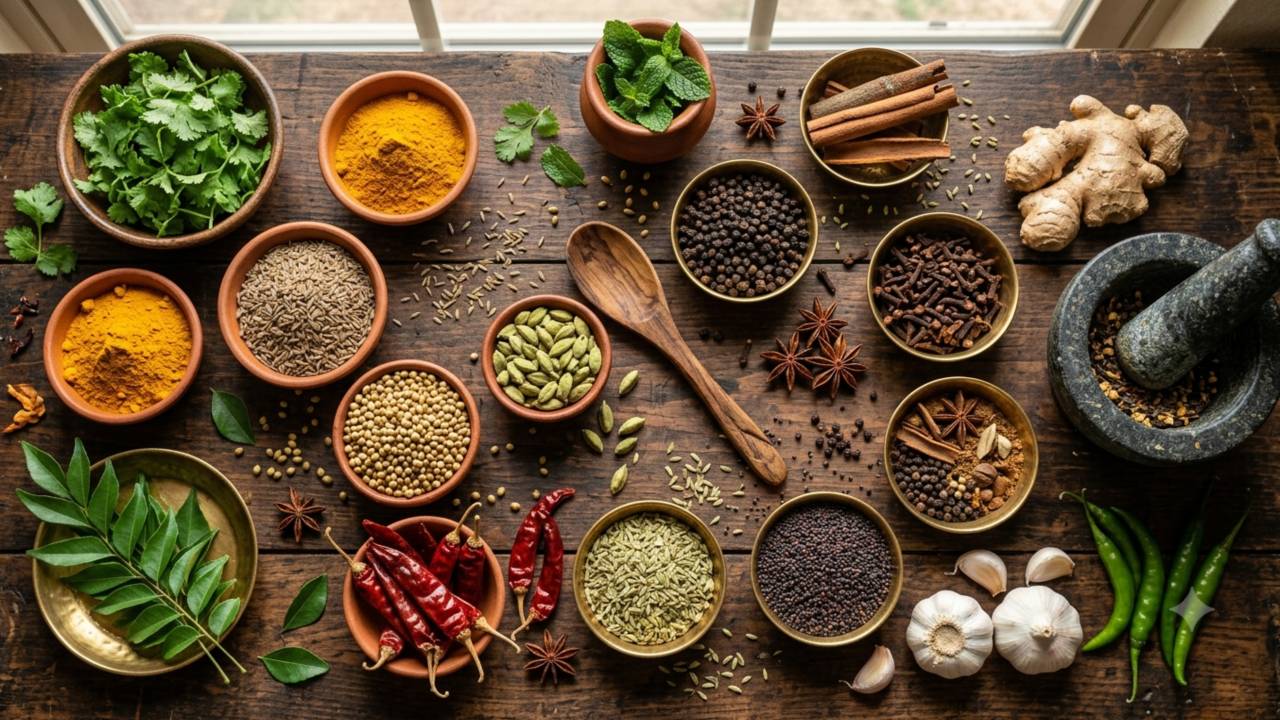 The difference between a bland stew and a deeply complex, aromatic curry lies not in the technique alone, but in the precise, knowing application of roots, barks, seeds, and leaves. The list of Indian herbs and spices is seemingly infinite, varying not just from state to state, but often from kitchen to kitchen.
A spice box (Masala Dabba) in an Indian home is a highly personalized fingerprint, containing the exact blends and ratios passed down through generations. In the Western culinary paradigm, herbs usually refer to the leafy green parts of a plant, while spices come from the roots, stems, seeds, bark, or buds.
In India, this distinction is slightly blurred, with the word masala acting as an umbrella term for both. This comprehensive guide will explore the essential herbs and spices of the Indian kitchen, detailing their flavor profiles, regional significance, and, most importantly, exactly how they are used in cooking.
The Foundational Whole Spices
Whole spices are the backbone of Indian cooking. They are typically bloomed in hot oil or ghee at the very beginning of the cooking process—a technique known as tadka or tempering—to extract their essential oils and lay the foundational flavor profile of the dish.
1. Cumin Seeds (Jeera)
If there is one spice that defines everyday Indian savory cooking, it is cumin. These tiny, boat-shaped seeds have a deeply earthy, slightly nutty, and warming flavor.
- Culinary Uses: Cumin is almost always the first spice to hit hot oil in a North Indian kitchen. It is the starting point for most dals (lentil soups), * sabzis* (vegetable stir-fries), and curries. When the seeds crackle and pop, they release their aroma, signaling that the oil is ready for the next ingredients. Cumin is also dry-roasted and ground to make jeera powder, which is often sprinkled over raitas (yogurt condiments) or used in marinades.
- Pro Tip: Always add cumin to hot oil, but never burn it, as burnt cumin turns intensely bitter and will ruin the entire dish.
2. Coriander Seeds (Dhania)
While cilantro leaves are treated as an herb, the dried seeds of the coriander plant are a fundamental spice. Raw coriander seeds have a citrusy, floral aroma, but when dry-roasted, they develop a deep, nutty, and slightly sweet flavor.
- Culinary Uses: Coriander seeds are rarely used whole in cooking, except in pickles (achars) or certain regional biryanis. Their primary use is as a ground powder. Dhania powder forms the bulk of the thickening and flavoring base for almost every Indian gravy. It has a remarkable ability to marry disparate spices together, mellowing the harshness of chilies and complementing the warmth of cumin.
3. Green Cardamom (Choti Elaichi)
Known as the “Queen of Spices,” green cardamom is intensely aromatic, with a complex flavor that is sweet, floral, minty, and slightly eucalyptus-like.
- Culinary Uses: In savory cooking, whole green cardamom pods are dropped into hot oil alongside cinnamon and cloves to flavor the base of rich curries, pulaos (pilafs), and biryanis. It is a non-negotiable component of Garam Masala. Beyond savory dishes, it is the dominant flavor in Indian desserts like kheer (rice pudding) and is ubiquitously crushed and added to masala chai.
4. Black Cardamom (Kali Elaichi)
Do not confuse black cardamom with its green cousin. Black cardamom is dried over an open fire, giving it a smoky, camphor-like, aggressively pungent aroma.
- Culinary Uses: It is almost exclusively used in savory dishes, particularly in slow-cooked meat curries, rich kormas, and the iconic Dal Makhani. It is a staple in Kashmiri cuisine and is heavily used in the biryanis of Lucknow and Hyderabad. A single large pod is usually enough; using too much can make a dish taste medicinal.
5. Cloves (Laung)
Cloves are dried flower buds with a intensely sweet, warm, and highly aromatic flavor that leaves a slight numbing sensation on the tongue due to the compound eugenol.
- Culinary Uses: Because of their overpowering nature, cloves are used sparingly. They are typically added whole to the tadka for rice dishes and rich meat gravies. They are also a key ingredient in commercial garam masala blends. In South India, cloves are often ground with coconut to form the base for certain curries.
6. Cinnamon (Dalchini)
Indian cinnamon is technically cassia bark, which is thicker, darker, and more pungent than the delicate cinnamon sticks found in Western bakeries. It has a warm, sweet, and woody flavor.
- Culinary Uses: Broken pieces of cinnamon bark are thrown into hot oil to flavor the gravy bases of dishes like Rajma (kidney bean curry) and Chole (chickpea curry). It is essential in all biryani and pulao preparations, lending a sweet woodiness that permeates the rice.
7. Black Peppercorns (Kali Mirch)
Known as the “King of Spices,” black pepper is indigenous to the Malabar Coast of India. Before the introduction of chili peppers by the Portuguese, black pepper was the sole source of heat in Indian food.
- Culinary Uses: Whole peppercorns are used in slow-cooked dishes, biryanis, and pickles. Crushed or ground black pepper is heavily used in South Indian cooking, most notably in Rasam—a tangy, spicy, tamarind-based soup that is revered for its digestive properties. It is also used to finish North Indian dishes like Matar Paneer when a chili-heat is not desired, but a sharp, biting warmth is.
The Aromatic Seeds and Pods
These spices often serve as bridges, connecting the foundational whole spices to the ground spice powders, adding unique textural and flavor dimensions.
8. Mustard Seeds (Rai / Sarson)
Mustard seeds come in black, brown, and yellow varieties, with the black and brown being most common in Indian cooking. When added to hot oil, they pop and crackle, releasing a sharp, nutty, and slightly bitter flavor.
- Culinary Uses: Mustard seeds are the undisputed kings of South Indian and Bengali cooking. In South India, the classic tadka consists of mustard seeds, urad dal (split black gram), and curry leaves sizzled in coconut or sesame oil, which is then poured over idli, dosa, and chutneys. In Bengal, ground mustard paste is the primary flavoring agent in iconic fish curries (Machher Jhol).
9. Fenugreek Seeds (Methi Dana)
Fenugreek seeds are small, hard, and angular, resembling tiny pieces of gravel. They have a highly complex flavor—bitter, slightly sweet, and distinctly maple-like.
- Culinary Uses: Fenugreek must be used with caution. A pinch of dry-roasted fenugreek seeds is crucial in South Indian Sambar and Rasam powders, as well as in Bengali Panch Phoron (a five-spice blend). They are also a primary ingredient in many Indian pickle bases, where their bitterness is mellowed by oil and time.
10. Fennel Seeds (Saunf)
Fennel seeds look like enlarged cumin seeds but have a completely different flavor profile—sweet, anise-like, and highly cooling.
- Culinary Uses: In Kashmiri Pandit cuisine, fennel powder is the primary spice, used generously in their signature meat curries (where onion and garlic are traditionally avoided). In the rest of India, whole fennel seeds are often used in the tadka for biryanis to add a sweet note, and coarsely ground fennel is a key ingredient in the marinades for Tandoori meats, as it aids in tenderization and provides a fresh aroma.
11. Nigella Seeds (Kalonji / Kala Jeera)
Nigella seeds are small, black, teardrop-shaped seeds. Despite sometimes being called “black cumin,” they are entirely unrelated. They have a pungent, oregano-like, slightly oniony flavor.
- Culinary Uses: Kalonji is most famous for its role in Panch Phoron, the Bengali five-spice blend. It is also the traditional topping sprinkled on top of Naan bread and various South Asian flatbreads like Laal Pari. In North India, it is used to temper certain potato dishes and lentils.
12. Star Anise (Chakra Phool)
Though native to China, star anise has been wholly adopted into Indian cooking, particularly in the Mughlai culinary tradition. It looks like a wooden star and has a strong, sweet licorice flavor.
- Culinary Uses: Star anise is almost exclusively used in the tadka for rich Mughlai dishes like Biryani, Nihari (a slow-cooked meat stew), and Korma. Usually, one or two whole stars are enough to perfume an entire pot of rice or meat.
The Ground Powders (The Color and Body)
Ground spices provide the visual appeal (color) and the physical body (thickening) to Indian gravies. They are usually added after the onions, tomatoes, and ginger-garlic have been cooked down.
13. Turmeric (Haldi)
Turmeric is a rhizome related to ginger, dried and ground into a brilliant golden-yellow powder. It has an earthy, slightly bitter, and musky flavor.
- Culinary Uses: Turmeric is the omnipresent spice in India. A pinch of it goes into virtually every savory dish, every lentil soup, and every vegetable preparation. It serves both as a colorant and a preservative. Turmeric is almost always added at the very beginning of the cooking process, often right after the tadka, because cooking it thoroughly removes its raw, earthy bitterness. It is also used in Indian pickles to prevent bacterial growth.
14. Red Chili Powder (Lal Mirch)
In India, “chili powder” is not a blend of spices like in the Americas; it is simply dried, ground red chilies. The heat and color vary drastically depending on the chili used. Kashmiri mirch is vibrant red but mildly hot, while Guntur mirch from Andhra Pradesh is fiercely spicy but less red.
- Culinary Uses: Chili powder provides the visual “red” that international diners often associate with Indian food. It is bloomed in hot oil along with other ground spices like coriander and cumin. Cooks use a mix of Kashmiri and spicier chilies to achieve the perfect balance of bright red color and searing heat.
15. Garam Masala
Garam means warm, and Masala means spice blend. Despite its name, it does not necessarily mean “spicy hot,” but rather that the spices contained within are “warming” to the body according to Ayurvedic principles.
- Culinary Uses: Every Indian family has its own Garam Masala recipe, but it usually contains toasted and ground black pepper, cardamom, cinnamon, cloves, cumin, and coriander. The golden rule of Garam Masala is that it is almost always added at the end of the cooking process, or even sprinkled off the heat. If you boil Garam Masala, its delicate, volatile aromatic oils evaporate, leaving behind a flat, bitter taste. Stirring a pinch into a finished curry awakens the dish.
16. Dry Mango Powder (Amchur)
Amchur is made from unripe green mangoes that are dried and ground into a pale beige powder. It is highly acidic and sour.
- Culinary Uses: Amchur is primarily a North Indian spice. It is used as a souring agent in dishes where adding liquid (like tamarind pulp or lemon juice) would make the dish too watery. It is a mandatory ingredient in Samosa fillings, Aloo Tikki (potato patties), and dry vegetable stir-fries like Aloo Gobhi (potato and cauliflower).
17. Asafoetida (Hing)
Asafoetida is a dried resin extracted from the root of a giant fennel plant. In its raw form, it has a pungent, sulfurous smell (hence the nickname “devil’s dung”). However, when cooked in a tiny amount of hot fat, it transforms completely, imparting a rich, savory, umami flavor reminiscent of leeks, onions, and garlic.
- Culinary Uses: Hing is indispensable in certain dietary traditions in India, particularly Jain and strict Brahmin vegetarian diets, where onions and garlic are forbidden. A tiny pinch—a speck the size of a pinhead—is added to the hot oil at the very beginning of cooking dals, sambars, and potato dishes. It acts as a flavor enhancer, making the dish taste deeply savory.
The Fresh Herbs (The Finishers)
While spices provide the structure, fresh herbs provide the breath of fresh air that lifts an Indian dish from heavy and rich to vibrant and balanced.
18. Cilantro / Coriander Leaves (Dhania Patta)
Cilantro is the most widely used fresh herb in India, valued for its bright, citrusy, and slightly peppery flavor.
- Culinary Uses: Cilantro has two primary uses. First, massive bunches of it are blended raw with green chilies, ginger, and lemon juice to make Green Chutney, the ubiquitous condiment served with snacks. Second, finely chopped cilantro is used as a garnish. However, in Indian cooking, a garnish is not just for looks. A heavy handful of raw cilantro is stirred into a curry right at the end of cooking. The heat of the dish wilts the herb slightly, releasing its essential oils and cutting through the richness of the gravy.
19. Curry Leaves (Kadi Patta)
Curry leaves are native to the Indian subcontinent and are entirely unrelated to the curry powder blend created by the British. These small, shiny, dark green leaves have a highly complex aroma—reminiscent of citrus, anise, lemongrass, and asparagus.
- Culinary Uses: Curry leaves are almost never eaten raw; their flavor is locked within their cell walls and must be released by heat. They are a foundational element of South Indian cooking. A classic South Indian tadka involves splattering mustard seeds, urad dal, dried red chilies, and a generous sprig of curry leaves in smoking hot coconut oil. This aromatic oil is poured over dosas, idlis, and into Sambar. In recent years, their use has spread north, where they are now frequently tempered into dal and coconut chutneys across the country.
20. Fresh Mint (Pudina)
Mint has a cool, sharp, and refreshing flavor that provides a necessary counterpoint to the heavy spices and rich fats prevalent in Indian food.
- Culinary Uses: Mint is heavily used in Indian appetizers and street food. It is blended with cilantro to make the classic Hari Chutney served with Samosas and Pakoras. Mint is also used to make Pudina Raita (yogurt dip with roasted cumin and mint), which acts as a cooling palate cleanser. In biryanis, fresh mint leaves are layered between the meat and the rice, steaming slowly to infuse the entire dish with a bright, herbaceous perfume.
21. Dried Fenugreek Leaves (Kasuri Methi)
While fresh fenugreek leaves are used as a vegetable, Kasuri Methi—dried fenugreek leaves that have been crushed—is treated as a spice/herb. Drying concentrates their flavor, resulting in a highly potent, slightly bitter, and intensely aromatic ingredient with a scent reminiscent of celery and hay.
- Culinary Uses: Kasuri Methi is the secret weapon of North Indian restaurants. A tablespoon of crushed dried leaves is stirred into butter chicken, Paneer Butter Masala, and Dal Makhani just before serving. It adds an inexplicable depth of flavor that is difficult to pinpoint but deeply missed if absent. To use it, always crush it between your palms right before adding it to the dish to release the oils.
Exotic and Regional Specialty Spices
To truly grasp the diversity of Indian cuisine, one must look beyond the everyday spices and explore the highly regional ingredients that define specific local cuisines.
22. Saffron (Kesar)
Saffron is the stigma of the crocus flower and is the most expensive spice in the world by weight. It has a deeply floral, honey-like aroma and imparts a brilliant golden-orange hue.
- Culinary Uses: Saffron is the crown jewel of Mughlai cuisine. It is never added directly to a hot pan; instead, a few strands are soaked in a couple of tablespoons of warm milk for 10 to 15 minutes. This golden milk is then poured over biryanis, pulaos, and rich desserts like Phirni and Kulfi. It is an essential ingredient in the famous Kashmiri Kahwa (a green tea brewed with saffron, cinnamon, and almonds).
23. Kokum (Garcinia Indica)
Kokum is a deep purple, dried fruit rind native to the Western Ghats of India. It looks somewhat like a dark, shriveled plum. It has a sharp, fruity, and highly acidic sourness.
- Culinary Uses: Kokum is the preferred souring agent in Maharashtrian, Goan, and Gujarati cuisines, particularly in coastal regions where tamarind is less common. It is simmered in fish curries (like Malvani Fish Curry), lentil stews, and the famous Sol Kadhi—a refreshing, pink drink made of coconut milk and kokum, served chilled. Unlike tamarind or lemon, kokum adds a beautiful deep purple-red color to the dish without overpowering the other spices.
24. Black Salt (Kala Namak)
Black salt is a Himalayan rock salt that has been heated in a kiln with charcoal, herbs, and seeds in a ceramic jar for 24 hours. The result is a reddish-black salt that, when ground, is pinkish-grey. It has a highly distinctive, sulfurous, egg-like smell and taste.
- Culinary Uses: Kala Namak is rarely used in the actual cooking process of main dishes. Instead, it is a finishing salt. It is the magical ingredient that gives Indian “fruit chaat” (spiced fruit salads) its unique tang, and it is the primary flavoring in Chat Masala. It is also heavily used in vegan Indian cooking to mimic the taste of eggs in dishes like Bhurji (scrambled tofu).
25. Stone Flower (Dagad Phool / Pathar Phool)
Stone flower is not a flower at all, but a type of lichen found on rocks and tree bark. It looks like a dried, pale grey, paper-thin mushroom or flower. It has virtually no aroma in its dry state but releases a strong, earthy, woody, and slightly musky flavor when cooked.
- Culinary Uses: Stone flower is a closely guarded secret of Maharashtrian cuisine, specifically as a key ingredient in Goda Masala (a complex, sweet-spicy blend). It is also increasingly used by biryani chefs in Hyderabad and Lucknow, who add a small piece to their tadka. It acts as a flavor fixative, binding the other spices together and giving the gravy a lingering, earthy depth.
26. Mace and Nutmeg (Javitri and Jaiphal)
Nutmeg is the hard, egg-shaped seed of a tropical evergreen tree, and mace is the dried, lacy reddish covering (aril) that surrounds the nutmeg inside the fruit. Mace is lighter, more delicate, and slightly more pungent than nutmeg, which is warmer and sweeter.
- Culinary Uses: Both are almost exclusively used in Mughlai and North Indian cooking. They are typically grated fresh or added as tiny pieces to the tadka of rich kormas, biryanis, and Nihari. In Indian dessert making, especially in Bengal and the South, a tiny pinch of freshly grated nutmeg is often the final flourish on a pot of Payasam or Rasmalai, adding an intoxicating, warm sweetness.
The Synthesis: How to Put It All Together
Understanding individual spices is only half the battle. The true art of Indian cooking lies in knowing when and how to combine them. Indian cooking is not a “dump it all in and boil” methodology; it is a highly structured, sequential layering of flavors.
To visualize this, let’s look at the anatomy of a standard North Indian curry:
- The Tadka (Tempering): Hot ghee or oil. Whole spices go in first—cumin seeds, cinnamon, cardamom, cloves. They sizzle, pop, and infuse the fat. This takes 15 to 30 seconds.
- The Aromatics: Onions are added to the spiced fat. They are cooked down until deeply golden brown. Next comes the ginger and garlic paste, sautéed until the raw smell disappears.
- The Ground Spices (The Body): The heat is lowered. Turmeric, coriander powder, and red chili powder are added. They must be stirred vigorously for 30 to 60 seconds. This step, called “bhunna,” toasts the ground spices, cooking off their raw, dusty flavors and blooming their oils into the fat.
- The Acids and Mains: Tomatoes are added to provide moisture and acidity, breaking down to form a thick paste. Finally, the main ingredient—chicken, paneer, or vegetables—is added and coated in this thick masala. Water is added, and the dish is simmered slowly.
- The Finishers (The Herbs): Once off the heat, a final dusting of Garam Masala is folded in, along with a heavy handful of chopped cilantro.
Cooking with Indian spices is a sensory experience. Listen to cumin crackle, watch onions turn golden-brown, and smell turmeric bloom. Once you understand each spice’s role, Indian cooking becomes simple, flavorful, and rewarding.
FAQ’s
1. What are the most commonly used Indian herbs and spices?
Indian cooking commonly uses spices like turmeric, cumin, coriander, cardamom, cloves, cinnamon, black pepper, and herbs like coriander leaves, mint, and curry leaves.
2. What are the essential Indian spices every kitchen should have?
Essential Indian spices include turmeric powder, cumin seeds, coriander powder, red chili powder, garam masala, mustard seeds, and black pepper.
3. What is the difference between Indian herbs and spices?
Herbs usually come from the leafy parts of plants, such as mint and coriander leaves, while spices are made from seeds, roots, bark, fruits, or other plant parts.
4. How are Indian spices used in cooking?
Indian spices are used to add flavor, aroma, color, and depth to curries, rice dishes, snacks, breads, and traditional recipes.
5. Which Indian spices are used for making curry?
Common curry spices include turmeric, cumin, coriander, garam masala, chili powder, cardamom, cloves, and cinnamon.
6. What herbs are commonly used in Indian cuisine?
Popular Indian cooking herbs include coriander leaves, curry leaves, mint, fenugreek leaves (kasuri methi), and holy basil (tulsi).
7. How should Indian spices be stored to keep them fresh?
Store Indian spices in airtight containers away from sunlight, moisture, and heat to preserve their flavor and aroma.
8. What are the most aromatic Indian spices?
Cardamom, cinnamon, cloves, star anise, bay leaves, and cumin are among the most aromatic spices used in Indian cooking.
9. How can beginners start using Indian spices in cooking?
Beginners can start with basic spices like turmeric, cumin, coriander, chili powder, and garam masala to prepare simple Indian dishes.
10. Why are Indian herbs and spices important in traditional cooking?
Indian herbs and spices are important because they enhance taste, create unique aromas, and form the foundation of many regional Indian recipes.
References
- Spices Board India, Ministry of Commerce & Industry, Government of India. Incredible Spices of India. Spices Board India. Spices Board India
- Spices Board India, Ministry of Commerce & Industry, Government of India. Whole Spices. Spices Board India. Spices Board India
- Spices Board India, Ministry of Commerce & Industry, Government of India. Quality Standards for Spices. Spices Board India. Spices Board India
- Spices Board India, Ministry of Commerce & Industry, Government of India. Chilli. Spices Board India. Spices Board India
- Spices Board India, Ministry of Commerce & Industry, Government of India. Spices Board India. Ministry of Commerce & Industry, Government of India. Spices Board India
- Royal Botanic Gardens, Kew. Cuminum cyminum L. Plants of the World Online. Kew – Plants of the World Online
- Royal Botanic Gardens, Kew. Coriandrum sativum L. Plants of the World Online. Kew – Plants of the World Online
- Royal Botanic Gardens, Kew. Piper nigrum L. Plants of the World Online. Kew – Plants of the World Online
- Royal Botanic Gardens, Kew. Bergera koenigii L. (syn. Murraya koenigii). Plants of the World Online. Kew – Plants of the World Online
- Royal Botanic Gardens, Kew. Crocus sativus L. Plants of the World Online. Kew – Plants of the World Online
- Serious Eats. How to Make Tadka: Tarka, Chaunk, Chhonk, Baghaar. Serious Eats. Serious Eats
- University of Vermont Extension. Saffron: World’s Most Expensive Spice. University of Vermont. University of Vermont Extension
- National Center for Biotechnology Information. PubChem: Curcumin. National Library of Medicine, National Institutes of Health. PubChem
- National Center for Biotechnology Information. PubChem: Piperine. National Library of Medicine, National Institutes of Health. PubChem
- National Center for Biotechnology Information. PubChem: Eugenol. National Library of Medicine, National Institutes of Health. PubChem
- National Center for Biotechnology Information. PubChem: Anethole. National Library of Medicine, National Institutes of Health. PubChem
- National Center for Biotechnology Information. PubChem: Safranal. National Library of Medicine, National Institutes of Health. PubChem
- National Center for Biotechnology Information. PubMed. U.S. National Library of Medicine, National Institutes of Health. PubMed
- Food and Agriculture Organization of the United Nations. FAOSTAT: Crops and Livestock Products. Food and Agriculture Organization of the United Nations. FAOSTAT
- World Health Organization. WHO Monographs on Selected Medicinal Plants. World Health Organization. World Health Organization




















Very nice article.
You have provided really usefull information.
Thanks
Thank you for your fabulous article. can you recommend any spices that tighten and preserve sagging skin please?
To known More about how to control and equally maintained your vata, pita and kapha to avoid diseases.
This is such a helpful guide! It’s great to see all these herbs and spices with their uses in cooking—definitely adding some of these to my kitchen.