Ama in Ayurveda: Causes, Symptoms & How to Remove Toxins

Modern wellness often focuses on removing toxins, but Ayurveda introduced the concept of internal toxicity thousands of years ago. This ancient wisdom identifies Ama as a major health concern. According to Ayurveda, Ama is an accumulated toxic residue caused by poor digestion and weak Agni. It can disturb balance, reduce vitality, and contribute to various health problems.
Ama is considered a hidden root of disease, affecting the body through fatigue, digestive issues, inflammation, and metabolic imbalance. Understanding Ama helps restore harmony and prevent illness naturally.
This guide explores Ama’s meaning, causes, symptoms, types, and Ayurvedic approaches for removal. Learn how traditional practices strengthen digestion, cleanse the body, and support lasting wellness.
What Exactly Is Ama?
The word “Ama” in Sanskrit translates literally to “unripe,” “uncooked,” “raw,” or “undigested.” In the context of the human body, Ama refers to metabolic waste that has not been properly digested, absorbed, or assimilated.
To understand Ama, you must first understand Agni, the digestive fire. According to Ayurveda, Agni is the gatekeeper of good health. It is not just stomach acid; it is the fundamental biological intelligence responsible for transforming food into energy, tissues, and consciousness.
When Agni is strong and balanced (Sama Agni), it breaks down food into a fine, nourishing essence called Ahara Rasa, which feeds the body’s tissues (Dhatus). The waste products (Malas)—such as sweat, urine, and feces—are cleanly separated and eliminated.
However, when Agni is weakened due to poor diet, lifestyle, or stress, it cannot fully “cook” the food. The half-digested food matter turns into a toxic, sticky, white- or grayish-colored substance known as Ama.
Think of it like making soup on a stove. If the flame (Agni) is too low, the vegetables (food) will not cook properly. Instead of breaking down into a wholesome broth, they become a soggy, indigestible mess. If you eat that mess, your body cannot process it.
The Journey of Ama in the Body
Ama does not just sit in the stomach. Because it is sticky and heavy, it overflows from the digestive tract and enters the body’s macro and micro-channels, known as Srotas.
These channels are responsible for transporting everything from nutrients to nerve impulses. When Ama clogs these channels, it prevents nutrients from reaching the tissues and prevents waste from leaving them.
This creates a state of stagnation known as Srotorodha (channel blockage), which is the literal breeding ground for disease.
Furthermore, Ama acts as a foreign invader. The body’s immune system recognizes it as an antigen and mounts an immune response.
This constant, low-grade inflammation is what Ayurveda links to chronic illnesses, allergies, and autoimmune disorders.
The Three Types of Ama
While the fundamental nature of Ama is the same—undigested metabolic waste—its qualities change depending on which of the three doshas (Vata, Pitta, Kapha) it interacts with, and where it lodges in the body.
1. Kapha-Associated Ama (Sama Ama)
When Ama mixes with Kapha dosha (which is naturally heavy, cold, sticky, and wet), it becomes exceptionally thick, slimy, and dense.
- Qualities: White or pale coating, thick mucus, cold to the touch, heavy.
- Location: Primarily lodges in the stomach, lungs, and upper respiratory tract.
- Manifestation: This type of Ama is responsible for excessive mucus production, chronic sinusitis, bronchitis, obesity, lethargy, and cysts. The body feels swollen and heavy, and the mind feels dull or depressed.
2. Pitta-Associated Ama (Vidagdha Ama / Pachaka Ama)
When Ama mixes with Pitta dosha (which is hot, sharp, and liquid), the Ama becomes sour, acidic, and burning. It is essentially “fermented” toxins.
- Qualities: Yellowish or greenish coating, foul-smelling, hot, acidic.
- Location: Primarily lodges in the small intestine, liver, blood (Rakta dhatu), and skin.
- Manifestation: This type leads to acid reflux, heartburn, hyperacidity, skin rashes, acne, hives, inflammatory bowel diseases, and burning sensations in the body. The mind may become irritable, angry, or judgmental.
3. Vata-Associated Ama (Vishama Ama)
When Ama mixes with Vata dosha (which is dry, cold, light, and mobile), the Ama dries out and becomes erratic.
- Qualities: Brownish or dark coating, dry, hard, moving.
- Location: Primarily lodges in the colon, joints, nervous system, and bones.
- Manifestation: This type causes severe joint pain, arthritis (especially Rheumatoid arthritis, known in Ayurveda as Amavata), constipation, gas, bloating, numbness, tingling, and nerve pain. The mind becomes anxious, fearful, and scattered.
4. Sannipatika Ama
In severe, chronic cases, Ama can mix with all three doshas simultaneously. This is the most difficult type of Ama to treat, as it presents a complex web of symptoms (e.g., a patient with joint pain, burning inflammation, and excessive mucus all at once).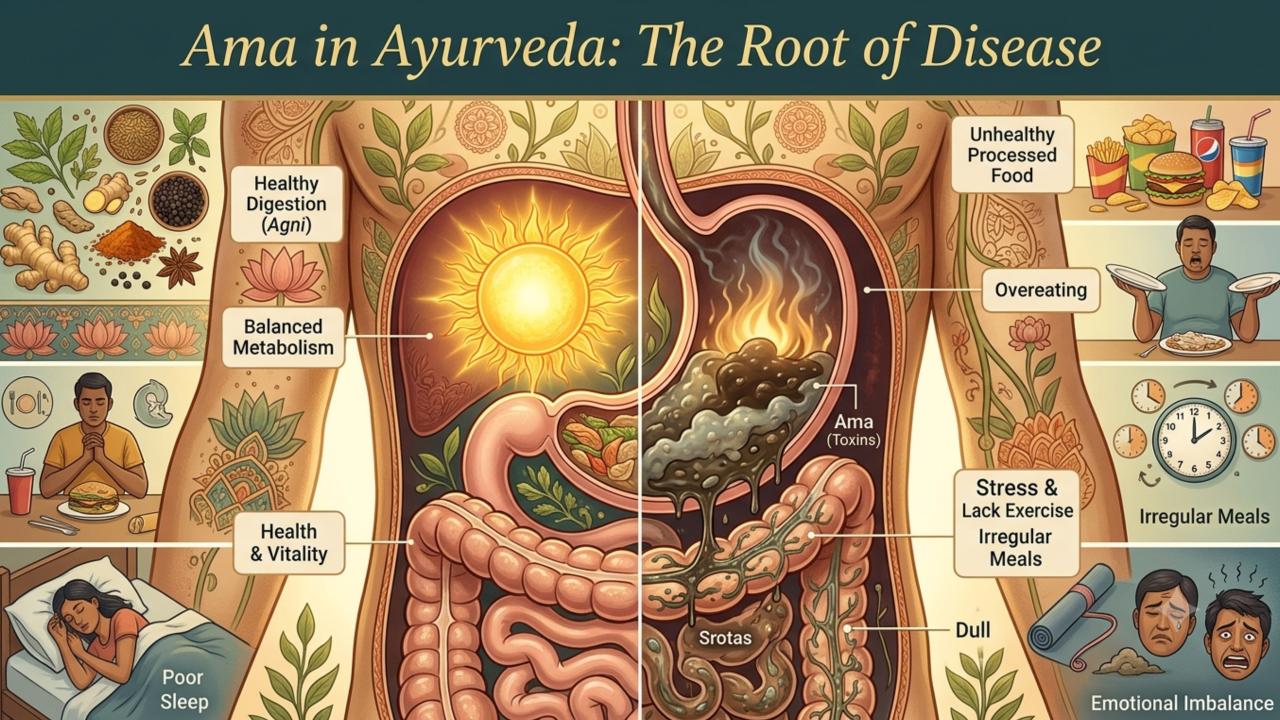
The Root Causes of Ama Formation
Ayurveda operates on the principle that like increases like and opposites create balance. Ama is caused by anything that dampens, smothers, or disrupts the digestive fire (Agni). These causes can be broadly categorized into dietary, lifestyle, psychological, and environmental factors.
1. Dietary Causes (Ahara)
- Overeating (Ati Matra): Eating more food than the digestive fire can handle is the most common cause of Ama. The flame is literally drowned by the sheer volume of fuel.
- Wrong Food Combinations (Viruddha Ahara): Ayurveda strictly dictates how foods should be combined. Eating foods with conflicting energies confuses Agni. Classic examples include milk with fish, milk with sour fruits, honey heated to high temperatures, and eating raw and cooked foods together in the same meal.
- Eating Before the Previous Meal is Digested: Snacking constantly throughout the day does not allow Agni to complete its digestive cycle. It is like throwing wet wood on a fire that is just starting to catch.
- Cold, Raw, and Heavy Foods: Ice water, iced smoothies, raw salads, and heavy cheeses require massive amounts of energy to digest. They literally extinguish the digestive fire.
- Eating While Distracted: Watching TV, scrolling on a phone, or eating while working redirects the blood flow and nervous system attention away from the digestive organs, severely weakening Agni.
- Incompatible Foods for Your Constitution: A person with a slow Kapha digestion eating a heavy, cheesy, cold meal will inevitably create Ama, whereas a person with strong Pitta digestion might process it fine.
2. Lifestyle Causes (Vihara)
- Sedentary Lifestyle: Lack of physical movement leads to stagnation in the body. Without the internal heat generated by exercise, Agni becomes sluggish.
- Sleeping Immediately After Meals: Lying down horizontally after eating causes the gastric juices to pool and the digestive process to stall, leading to fermentation and Ama.
- Suppressing Natural Urges (Vega Vidharana): Ayurveda lists 13 natural urges (such as urination, defecation, flatulence, sneezing, coughing, hunger, thirst, sleep, and crying) that should never be suppressed. Holding in waste products forces toxins back into the systemic circulation, creating Ama.
- Irregular Daily Routines: The body’s Agni is tied to the natural cycles of the sun. Eating meals at erratic times, or waking and sleeping at erratic times, throws Agni out of sync.
3. Psychological Causes (Manas)
- Chronic Stress and Anxiety: When you are in a “fight or flight” state (sympathetic nervous system dominance), the body shuts down digestion (parasympathetic nervous system). Chronic stress equals chronic low Agni.
- Emotional Eating: Eating to soothe sadness or anxiety usually involves heavy, sweet, or processed comfort foods, which are highly Ama-forming.
- Unprocessed Emotions: Just as undigested food creates physical Ama, unprocessed grief, anger, or fear creates “mental Ama” (Manasa Ama), which clouds the mind and eventually manifests as physical disease.
4. Environmental and Seasonal Causes
- Seasonal Transitions: During the change of seasons (especially winter to spring, and summer to autumn), the body’s Agni naturally fluctuates. If one does not adjust their diet and lifestyle to the season, Ama accumulates.
- Exposure to Toxins: Polluted air, contaminated water, and exposure to industrial chemicals introduce foreign toxins that the body struggles to metabolize, turning them into Ama.
Symptoms of Ama: How to Know if You Have It
Ama is a master of disguise. Its symptoms can be incredibly subtle, often mimicking general fatigue or a “bad day,” or they can be severely debilitating.
Ayurveda divides the symptoms into general, digestive, systemic, and psychological categories.
1. The Classic “Tongue Test” (The Easiest Self-Diagnostic)
The most immediate, visible sign of Ama is on the tongue upon waking in the morning. A healthy tongue should be pink, clean, and slightly moist.
If you have Ama, you will wake up with a thick, white, yellow, or brown coating on the back or middle of the tongue.
This coating is literally Ama that has been pushed up from the digestive tract during the night. Bad breath (halitosis) upon waking is a secondary confirmation.
General Physical Symptoms
- Persistent Fatigue (Alasya): Feeling tired even after 8 hours of sleep. Because Ama blocks the channels, nutrients cannot reach the cells, leading to cellular starvation and exhaustion.
- Heaviness (Gaurava): A feeling of being weighed down in the body, as if you are carrying extra invisible weight.
- Body Aches and Stiffness: Especially in the morning. Ama accumulates in the joints overnight, causing stiffness that usually improves with movement (which temporarily burns off the superficial Ama).
- Loss of Taste and Appetite (Aruchi): The tongue is coated, so food tastes bland, and the body, recognizing it is full of waste, suppresses the appetite.
- Coldness: Ama acts as an insulator, blocking the body’s natural metabolic heat. People with heavy Ama often feel cold, especially in their hands and feet.
Digestive Symptoms
- Bloating and Gas (Adhmana): Fermented Ama produces gas that gets trapped in the GI tract.
- Sluggish Bowels: Constipation with sticky, sinking stools (a sign of Kapha Ama), or alternating constipation and diarrhea (a sign of Vata Ama).
- Heartburn and Acid Reflux: A sign of Pitta Ama (sour, fermented toxins irritating the esophagus).
- Nausea: The body’s natural reflex to reject the toxic buildup.
Systemic and Advanced Symptoms
- Frequent Infections: Ama weakens the immune system. Frequent colds, flus, and respiratory infections indicate Ama in the respiratory tract.
- Skin Issues: Acne, rashes, eczema, and dull, lifeless skin. The skin is a major eliminative organ; when Ama overloads the internal systems, the body pushes it out through the skin.
- Excessive Mucous: Constantly clearing the throat, post-nasal drip, or runny nose.
- Foul-Smelling Sweat, Urine, and Stool: When the body’s waste products are mixed with fermented Ama, they emit a strong, offensive odor.
- Edema and Water Retention: Ama mixed with Kapha causes fluid to pool in the lower extremities (ankles, legs).
Psychological Symptoms (Mental Ama)
Ayurveda teaches that the body and mind are inseparable. Physical Ama deeply affects the mind (Manas).
- Brain Fog: Difficulty concentrating, poor memory, and a feeling of a “veil” over the brain.
- Lethargy and Depression: A lack of motivation and enthusiasm for life.
- Irritability and Mood Swings: Especially with Pitta Ama, the mind feels hot, angry, and easily agitated.
- Anxiety: Particularly with Vata Ama, the nervous system is blocked and erratic, leading to ungrounded fear and worry.
Diagnostic Tools: How Ayurvedic Doctors Detect Ama
While the tongue test is a great starting point, an Ayurvedic practitioner (Vaidya) uses a multi-faceted approach to diagnose the presence, location, and severity of Ama.
- Nadi Pariksha (Pulse Diagnosis): A skilled Vaidya feels the radial pulse at the wrist. An Ama-filled pulse feels heavy, slow, and sluggish—often described as feeling like a snake moving through mud, or a wave hitting a blocked pipe. It lacks the crisp, bounding quality of a healthy pulse.
- Mutra Pariksha (Urine Examination): Historically, Ayurvedic practitioners would observe the color, odor, and even the ripples formed when a drop of oil is placed in a patient’s morning urine to determine the presence of Ama.
- Mala Pariksha (Stool Examination): The stool’s consistency, buoyancy (does it sink or float?), and odor indicate whether Ama is present. Healthy stool should float, indicating proper digestion and the presence of healthy lipids. Ama-filled stool usually sinks.
- Sparsha (Touch): The skin may feel cold, clammy, or rough to the touch, indicating a lack of proper circulation due to channel blockage.
Medicine and Treatment: How to Clear Ama
The treatment of Ama in Ayurveda is not about taking a single “magic pill.” It requires a systematic, phased approach.
The ultimate goal is to kindle Agni so the body can digest the Ama itself, and then physically remove whatever remains.
This process is divided into three main stages: Deepana (kindling), Pachana (digesting), and Shodhana (purification).
Phase 1: Langhana (Fasting / Lightening)
Before you can burn Ama, you must stop adding fuel to the fire. Langhana means “lightening.”
It involves eating a very light, easily digestible diet to give Agni a chance to rest and recover. This usually involves a mono-diet of Kitchari (a spiced mixture of mung beans and basmati rice) or warm soups and broths.
Strict fasting (only water) is sometimes used but must be done under supervision, as severe fasting can further weaken Agni if done incorrectly.
Phase 2: Deepana and Pachana (Kindling and Digesting)
Once the diet is lightened, herbal medicines are introduced to stoke the digestive fire and literally “burn” the existing Ama.
Key Ayurvedic Medicines for Ama:
- Trikatu (The Three Pungents): A classic combination of Black Pepper (Pippali), Long Pepper (Maricha), and Ginger (Shunthi). Trikatu is the premier Deepana (digestive fire kindler) herb. It scrapes Ama from the digestive tract and reignites metabolic fire.
- Chitrak (Plumbago zeylanica): Known as the “fire” herb in Ayurveda. Chitrak is a powerful Pachana (digestive) herb that specifically targets stubborn Ama in the GI tract. It is highly effective for Kapha Ama.
- Hingvastak Churna: A famous powdered formulation containing Asafoetida (Hing), ginger, black pepper, and several other heating spices. It is the go-to medicine for Vata-type Ama, specifically targeting gas, bloating, and lower intestinal stagnation.
- Lavangadi Vati or Mints: For Pitta-type Ama (sour, burning regurgitation), cooling yet digestive herbs like coriander, fennel, and cumin are used to soothe the lining while digesting the toxins.
- Pippali (Long Pepper) Rasayana: Pippali is unique because it kindles Agni without causing excess dryness or irritation. It is often used in a graduated dosing protocol to rejuvenate the respiratory and digestive systems after chronic Ama.
- Guduchi (Tinospora cordifolia): While not a fiery herb, Guduchi is incredibly important for Ama because it is an immunomodulator. It helps clear Ama from the blood (Rakta dhatu) and liver without aggravating Pitta.
Phase 3: Shamana (Palliative Care for Symptoms)
While the Ama is being digested, the patient may experience uncomfortable symptoms (like a healing crisis, or “Herxheimer reaction”). Ayurveda uses symptomatic treatments:
- For joint pain (Amavata): Applying warm Dashamoola oil or Mahanarayan oil, followed by fomentation (steam), helps mobilize Ama from the joints.
- For skin issues (Pitta Ama): Taking Kaishore Guggulu, a famous formulation that cleanses the blood and scrapes toxins from the tissues.
- For respiratory Ama (Kapha): Inhaling medicated smoke (Dhooma) with herbs like Guggulu, or taking Talisadi Churna to expectorate the mucus.
Phase 4: Shodhana (Panchakarma – The Ultimate Detox)
Once the Ama has been loosened and partially digested by Deepana and Pachana herbs, it is ready to be physically removed from the body.
This is achieved through Panchakarma, Ayurveda’s five-fold purification therapy.
Crucial Note: Panchakarma should never be performed if there is active, heavy Ama. Attempting to purge heavy Ama can push it deeper into the tissues.
Panchakarma is only done after Langhana, Deepana, and Pachana have successfully broken down the Ama.
The relevant Panchakarma procedures for Ama are:
- Vamana (Therapeutic Emesis): Primarily used for Kapha Ama. Medicated herbs are given to induce controlled vomiting, expelling thick, sticky mucus and toxins from the stomach and upper respiratory tract.
- Virechana (Therapeutic Purgation): Primarily used for Pitta Ama. Herbal laxatives flush fermented, acidic toxins from the small intestine, liver, and blood.
- Basti (Medicated Enemas): Considered the most powerful Panchakarma treatment, as the colon is the root of Vata dosha. Herbal decoctions and oils are introduced into the colon to flush out dried, hard Vata Ama from the lower digestive tract and nervous system.
- Raktamokshana (Bloodletting): Rarely used today, but historically used for severe Pitta Ama in the blood causing chronic skin diseases like psoriasis.
Preparatory Steps (Snehana and Swedana): Before Vamana, Virechana, or Basti, the patient must undergo Snehana (internal and external oleation with medicated ghee or oil) and Swedana (steam therapy).
The ghee literally binds to the fat-soluble Ama and pulls it out of the tissues and into the GI tract, while the steam opens the bodily channels, making the Ama mobile so it can be expelled.
Post-Panchakarma: Samsarjana Krama
After Panchakarma, the digestive fire is like a delicate ember. It must be carefully nursed back to full strength through Samsarjana Krama—a strict, graduated dietary regimen starting with thin rice water, moving to thick soups, then to Kitchari, and finally back to a normal diet over a period of 7 to 14 days.
Dietary and Lifestyle Protocols to Prevent and Treat Ama
Medicine only works if the patient’s daily routine supports the healing process. Treating Ama requires strict adherence to Ayurvedic dietary rules.
The Anti-Ama Diet
- Drink Warm Water with Ginger: Sipping hot water throughout the day is the simplest way to melt Ama. Adding a slice of fresh ginger or a squeeze of lemon enhances the effect.
- Eat Warm, Cooked Foods: Say goodbye to cold smoothies, raw salads, and ice water. Favor warm, well-spiced soups, stews, steamed vegetables, and grains.
- Use Ama-Busting Spices: Cook with cumin, coriander, fennel, turmeric, ginger, black pepper, and mustard seeds. These spices act as culinary Agni-kindlers.
- Avoid Dairy: Milk is highly Ama-forming for most adults, especially if it is cold. If you must consume dairy, it should be boiled with spices like cardamom and ginger, and consumed warm.
- Eat Your Main Meal at Noon: Agni is strongest when the sun is highest in the sky (around 12:00 PM – 2:00 PM). Eat your heaviest meal at lunch, and keep dinner light and early (eaten before 7:00 PM).
- Honor the Food Rules: Eat only when truly hungry. Eat in a calm environment without screens. Sit down while eating. Do not eat until the previous meal is completely digested (usually 3 to 6 hours).
Lifestyle Practices to Clear Ama
- Daily Exercise (Vyayama): Breaking a light sweat every day through yoga, walking, or jogging generates internal heat, burns off Ama, and moves stagnant lymph.
- Tongue Scraping (Jihva Nirlekhana): Every morning, scrape your tongue with a copper or stainless-steel tongue scraper. This physically removes the Ama that was pushed out of the body overnight and stimulates the digestive reflexes.
- Abhyanga (Self-Massage): Massaging the body with warm sesame oil
FAQ’s
1. What is Ama according to Ayurveda?
Ama is a toxic, sticky substance described in Ayurveda that forms when food and experiences are not properly digested due to weak Agni (digestive fire). It can accumulate in the body and disturb overall balance.
2. What causes Ama formation in the body?
Ama forms due to poor digestion, overeating, irregular meals, unhealthy foods, lack of exercise, stress, disturbed sleep, and weakened digestive fire.
3. What are the signs and symptoms of Ama?
Common signs of Ama include a coated tongue, bloating, indigestion, heaviness, fatigue, constipation, loss of appetite, foul taste in the mouth, and mental sluggishness.
4. How does Ayurveda remove Ama from the body?
Ayurveda focuses on strengthening Agni, improving digestion, following a light diet, using supportive herbs, practicing healthy routines, and applying cleansing therapies like Panchakarma when needed.
5. Is Ama the same as toxins in modern medicine?
Ama is often translated as “toxins,” but the Ayurvedic concept is broader. It describes impaired digestion and metabolism that lead to harmful accumulation in the body.
6. What is the relationship between Agni and Ama?
Agni is the body’s digestive and metabolic fire. When Agni is weak, digestion becomes incomplete, leading to the formation of Ama.
7. Can Ama cause digestive problems?
Yes. According to Ayurveda, Ama can contribute to digestive issues such as bloating, gas, indigestion, constipation, and reduced appetite.
8. Which foods increase Ama according to Ayurveda?
Heavy, oily, processed, stale, fried, and difficult-to-digest foods are traditionally considered factors that may increase Ama formation.
9. Which foods help reduce Ama naturally?
Warm, fresh, light, and easily digestible foods such as vegetable soups, herbal teas, spices like ginger and cumin, and simple meals like khichdi are commonly recommended.
10. How can I know if I have Ama?
Ayurveda considers signs such as a thick tongue coating, low energy, heaviness, poor digestion, and reduced appetite as possible indicators of Ama accumulation.
11. What is the difference between Sama and Nirama in Ayurveda?
Sama refers to a condition where Doshas are mixed with Ama, creating imbalance. Nirama refers to a clearer state where Doshas function without Ama.
12. Does Ayurveda recommend detox for Ama?
Ayurveda recommends improving digestion and supporting natural elimination rather than quick detox methods. A qualified Ayurvedic practitioner should guide Traditional cleansing approaches.
13. Can stress cause Ama formation?
Yes. Ayurveda recognizes that chronic stress, anxiety, and emotional disturbances can weaken digestion and contribute to Ama accumulation.
14. What herbs are traditionally used for Ama management?
Ayurvedic practitioners commonly use digestive-supporting herbs such as ginger, turmeric, cumin, black pepper, and other formulations based on individual needs.
15. How can Ama be prevented?
Ama prevention includes eating mindfully, maintaining regular meal times, exercising regularly, managing stress, getting proper sleep, and supporting healthy digestion.
Ama is Ayurveda’s explanation of how imbalance begins through weak digestion, impaired metabolism, and disturbed internal processes. It is not merely “toxins” but a result of incomplete transformation caused by weakened Agni. When accumulated, Ama blocks natural pathways, disrupts Dosha balance, and creates conditions for disease.
References:
- Charaka Samhita – Classical Ayurvedic text describing Agni, Ama, digestion, metabolism, disease formation, and therapeutic approaches. (1)
- Ashtanga Hridayam by Vagbhata – Classical Ayurvedic compendium explaining Ama, Mandagni, Langhana, Deepana, Pachana, and Dosha-related disorders. (2)
- Sushruta Samhita – Ancient Ayurvedic text describing physiology, disease processes, purification therapies, and Panchakarma procedures. (3)
- Madhava Nidana – Classical diagnostic text discussing Amavata and clinical features associated with Ama. (4)
- Bhavaprakasha Nighantu (Dr. K.C. Chunekar Edition) – Ayurvedic materia medica describing medicinal plants traditionally used for digestive and metabolic disorders. (5)
- Bhaishajya Ratnavali – Classical Ayurvedic formulation text describing herbal preparations used in digestive and systemic disorders. (6)
- Lad, V. (2002). Textbook of Ayurveda: Fundamental Principles of Management – Modern explanation of Ayurvedic concepts including Agni, Ama, Doshas, and disease pathways. (7)
- Frawley, D., & Lad, V. The Yoga of Herbs: An Ayurvedic Guide to Herbal Medicine. (8)
- Ministry of AYUSH, Government of India – Official resources on Ayurveda, traditional medicine systems, and Ayurvedic healthcare practices. (9)
- World Health Organization (WHO) – Traditional, Complementary and Integrative Medicine resources. (10)
- National Center for Complementary and Integrative Health (NCCIH) – Scientific information on complementary health approaches and traditional medicine research. (11)
- Journal of Ayurveda and Integrative Medicine (J-AIM). (12)
- Plants of the World Online (Royal Botanic Gardens, Kew) – Botanical information on Ayurvedic medicinal plants. (13)
- National Library of Medicine (PubMed) – Research database for Ayurveda, Agni, Ama, Panchakarma, and herbal medicine studies. (14)
- Indian Council of Medical Research (ICMR) – Research resources related to traditional medicine and Ayurveda. (15)