Varadi Kashayam for Weight Loss: Benefits & How It Works

Modern lifestyles, unhealthy eating habits, and reduced physical activity have increased obesity worldwide. Many people now seek natural, sustainable remedies, making Ayurvedic formulations like Varadi Kashayam increasingly valued for weight management.
 Varadi Kashayam is a traditional Kerala Ayurvedic herbal decoction renowned for supporting healthy weight loss. It addresses metabolic imbalances naturally while promoting digestion, detoxification, and improved overall wellness through herbs.
Unlike quick-fix solutions, Varadi Kashayam focuses on correcting underlying causes of obesity. Its carefully selected herbal ingredients help balance doshas, enhance metabolism, and encourage gradual, long-lasting, healthy weight reduction naturally.
Understanding Varadi Kashayam requires exploring its origins, classical Ayurvedic references, herbal composition, and therapeutic principles. These aspects reveal why this ancient formulation remains a trusted choice for holistic obesity management.
Understanding the Name and Classical Roots
In Ayurveda, medicine names often describe their ingredients and therapeutic purpose. Varadi combines the Sanskrit words Vara and Adi, reflecting its principal herbs and the formulation’s traditional Ayurvedic significance.
Vara commonly refers to Triphala, the celebrated combination of Amla, Haritaki, and Vibhitaki. Revered for balancing all three doshas, it supports gentle detoxification, digestion, and overall metabolic health naturally.
The suffix Adi means “and others,” indicating additional supportive herbs complement Triphala. Together, these ingredients enhance the formulation’s effectiveness in promoting healthy metabolism, digestion, and balanced physiological functions.
Kashayam denotes a herbal decoction prepared by boiling medicinal herbs in water. This extraction method concentrates water-soluble compounds, improving bioavailability and enabling the formulation to deliver therapeutic benefits effectively.
The authoritative reference for Varadi Kashayam is found in the classic Kerala Ayurveda treatise known as Sahasrayoga.
Specifically, it is classified under the Kashaya Yoga Prakarana, section 63, where it is prescribed under the name Sthoullyahara Kashaya—literally meaning the decoction that destroys (hara) obesity (sthoulya).
The Ayurvedic Perspective on Obesity (Sthoulya)
Ayurveda identifies obesity as Medoroga or Sthoulya, a disorder mainly associated with aggravated Kapha dosha. Understanding this concept explains the holistic approach behind Varadi Kashayam’s therapeutic effectiveness.
Weak digestive fire, known as Agni, impairs proper metabolism, producing Ama, toxic metabolic waste. This sticky substance combines with fat tissue, disrupting normal physiological functions and healthy nourishment.
Accumulated Ama blocks the body’s channels, preventing nutrients from reaching tissues efficiently. Consequently, hunger increases, metabolism declines, and excess fat continues accumulating, worsening obesity and related metabolic disorders.
Ayurvedic treatment emphasizes strengthening Agni, removing Ama, clearing blocked channels, and reducing excess fat through Lekhana. Varadi Kashayam follows these principles, supporting healthy metabolism and sustainable weight management naturally.
Varadi Kashayam Ingredients
The synergy of a Kashayam depends entirely on its ingredients. Varadi Kashayam features a brilliant combination of detoxifying, fat-scraping, and metabolism-boosting herbs.
- Triphala (The Three Fruits): As the name suggests, Triphala is the cornerstone of this formulation.
- Amla (Emblica officinalis): Rich in Vitamin C and powerful antioxidants, Amla nourishes the body tissues, balances Pitta dosha, and helps in the proper assimilation of food. It prevents the free radical damage that often accompanies obesity.
- Haritaki (Terminalia chebula): Known as the “King of Medicines,” Haritaki is highly effective in scraping away toxins and excess fat from the intestines. It has a mild laxative effect that ensures regular bowel movements, preventing the reabsorption of toxins into the bloodstream.
- Vibhitaki (Terminalia bellirica): Excellent for reducing Kapha and water retention, Vibhitaki helps clear the respiratory and digestive tracts of excess mucus and fat.
- Chitraka (Plumbago zeylanica) Chitraka is one of the most powerful digestive stimulants in Ayurveda. It is categorized as a Deepana (kindles digestive fire) and Pachana (digests Ama) herb. Because obesity is rooted in weak digestion, Chitraka acts as the spark plug that reignites the body’s metabolic furnace, ensuring that future calories are burned rather than stored as fat.
- Asana (Pterocarpus marsupium) Asana is a renowned herb in the management of diabetes and metabolic syndrome. In the context of weight loss, it is highly valuable because it helps regulate blood sugar levels. By preventing the sharp spikes and crashes in blood glucose that trigger sugar cravings, Asana supports sustained energy and reduces binge eating.
- Loha Patra (Iron) This is a highly unique feature of Varadi Kashayam. The inclusion of iron addresses a very common, yet often overlooked, underlying cause of weight gain: anemia.
- When the body lacks sufficient iron, oxygen transport to the cells is compromised. This leads to a sluggish metabolism, chronic fatigue, and an inability to engage in physical activity—all of which contribute to weight gain.
- Traditionally, purified Iron foils (Loha patra) are kept dipped in the boiling Kashayam for a few days, allowing the water to extract the micro-particles of iron.
- In modern commercial preparations, many Ayurvedic pharmaceutical companies substitute the foil with Loha Bhasma (medicated iron ash powder), which is added to the Kashayam after it has been prepared and filtered, as it does not require boiling to be assimilated.
The Sanskrit Reference and Its Meaning
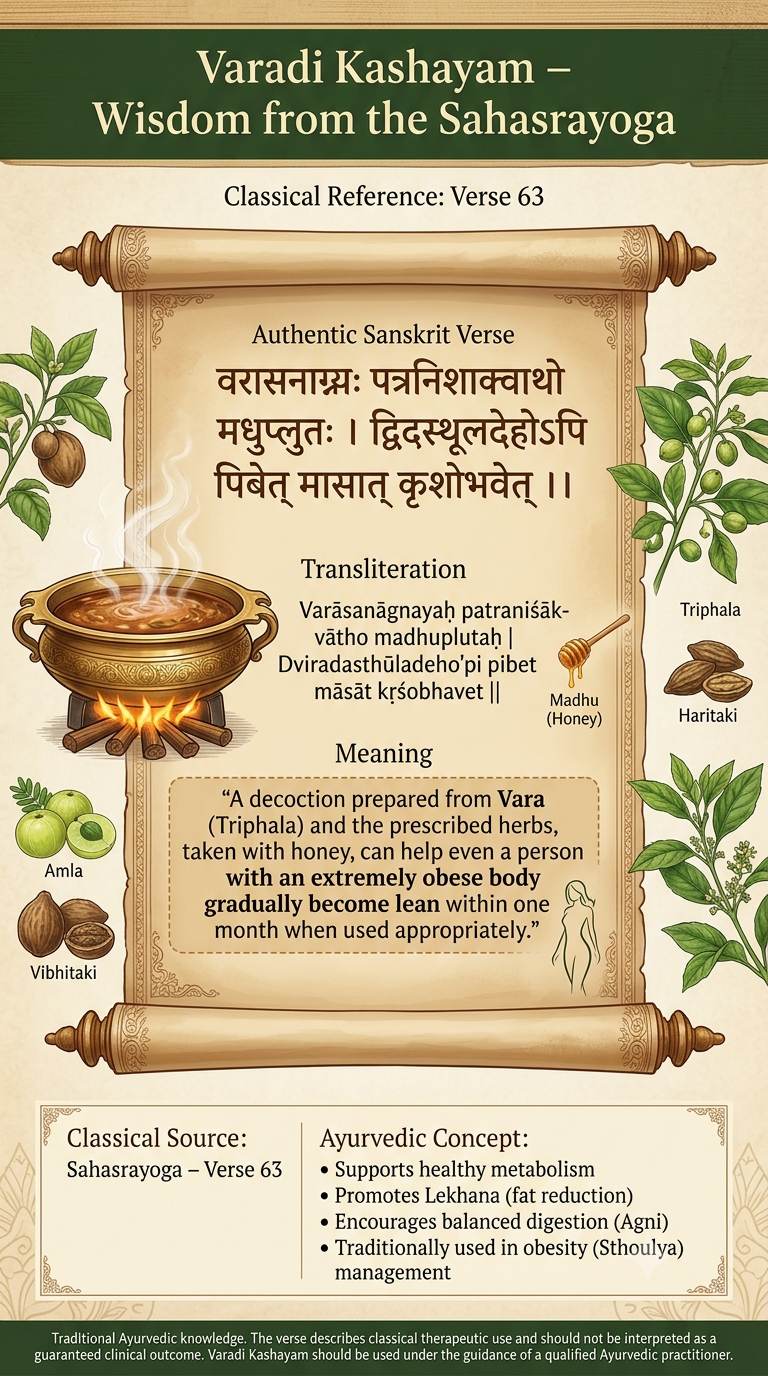
Word-by-Word Meaning:
- Vara = Triphala
- Asana = Pterocarpus marsupium
- Agnayah = Chitraka (Plumbago zeylanica)
- Patrani = Loha patra (Iron foils)
- Sākvātho = Prepared as a decoction (Kashaya)
- Madhupluta: = Mixed with honey (Madhu)
- Dvira = Two times
- Asta = Taken
- Sthūla deha: = Even an obese person
- Api = Also
- Pibet = Should drink
- Māsāt = Within a month
- Kṛśa: = Lean, slim
- Bhavet = Becomes
Translation: “The decoction (Kashayam) prepared from Triphala (Vara), Asana, Chitraka (Agni), and Iron foils (Patrani), when mixed with honey and consumed twice a day, will make even a highly obese person become slim within a month.”
Note on the timeline: While the classical text mentions results within a month (“Māsāt Kṛśo Bhavet”), modern Ayurvedic practitioners usually advise a more realistic and safe timeline of 3 to 4 months.
Rapid, extreme weight loss can be detrimental to the body, leading to loose skin, gallstones, and muscle loss. Ayurveda ultimately aims for sustainable, healthy weight management.
Dosage and Method of Administration
To achieve the best results, the method of taking Varadi Kashayam is just as important as the medicine itself.
If you purchase Varadi Kashayam from a standard Ayurvedic store, it will typically be in a concentrated liquid form. Because it is concentrated, it should never be consumed neat.
Standard Dosage:
- Measure 5 ml of the concentrated Kashayam.
- Mix it with 5 ml (or equal parts) of lukewarm water. Using lukewarm water is crucial because cold water can further dampen the digestive fire, counteracting the effects of Chitraka and Triphala.
- Add half a spoon of pure, raw honey to this mixture. (As per the strict traditional textual reference, honey is an absolute requirement, which we will explain below).
Timing: This formulation is most effective when taken on an empty stomach. The ideal times are:
- Early morning, shortly after waking up.
- Early evening, before dinner.
Taking it before food allows the herbs to prime the digestive tract, scrape away accumulated mucus and fat from the gastric lining, and prepare the body to metabolize the incoming meal efficiently.
Disclaimer: Your Ayurvedic doctor will always be the best judge of your specific dosage and time of intake based on your unique constitution (Prakriti) and the severity of your condition (Vikriti).
The Crucial Role of Honey (Madhu)
You might wonder why honey is specifically mandated for this Kashayam. In Ayurveda, honey is not just a sweetener; it is a powerful therapeutic substance (Anupana—a vehicle for medicine).
Honey possesses a unique quality called Lekhana—the ability to scrape away excess fat and moisture from the body.
It has a drying (Ruksha) and light (Laghu) nature, which directly counteracts the heavy (Guru) and oily (Snigdha) qualities of fat tissue (Meda Dhatu).
When combined with the Kashayam, honey acts as a targeted fat-lipolytic agent, carrying the herbal extracts deep into the adipose tissues.
Crucial Safety Rule: According to Ayurveda, honey should never be heated, boiled, or mixed with boiling hot liquids.
Heating honey alters its molecular structure, turning it into a sticky toxin (Ama) that can clog the body’s channels.
Therefore, you must mix the honey into the lukewarm (not hot) diluted Kashayam just before consumption.
Potential Side Effects and Precautions
Because Varadi Kashayam contains potent herbs like Chitraka and iron, it is a powerful medicine and must be respected as such. While it is generally safe when taken under guidance, a few individuals may experience side effects:
- Stomach Uneasiness or Burning Sensation: Chitraka is a very “hot” (Ushna) herb. If a person has high Pitta dosha (a tendency towards acidity, inflammation, or heartburn), Chitraka can aggravate it, causing a burning sensation in the stomach.
- Loose Stools: The detoxifying and scraping nature of Triphala and Chitraka can increase bowel movements. In some cases, this may lead to loose stools or mild diarrhea, especially in the first few days as the body clears out accumulated waste.
How to Mitigate Side Effects: If you experience a burning sensation or stomach upset, do not discontinue the medicine abruptly without consulting your doctor.
Often, the practitioner will simply advise you to start taking the Kashayam after food rather than on an empty stomach.
Taking it after a meal provides a buffering effect, protecting the stomach lining from the heating herbs while still allowing the medicine to work.
Varadi Kashayam vs. Varanadi Kashayam: A Detailed Comparison
A common question in Ayurvedic circles is whether Varadi Kashayam and Varanadi Kashayam can be used together, or how one should choose between them.
Both are highly efficient in the treatment of obesity, but they have distinct personalities and applications.
Understanding Varanadi Kashayam: Varanadi is a more complex herbal tea consisting of 16 ingredients. This specific group of herbs is famously explained by Acharya Vagbhata in the classical texts.
Usually, when a group of herbs is explained as a syndrome, it can be designed into various medicinal forms (herbal tea, ghee, powder, etc.).
Its primary ingredients include:
- Varuna (Crataeva nurvala): Highly effective in reducing water retention, breaking down kidney stones, and burning fat.
- Chitraka and Bhallataka (Marking Nut): Both are extremely potent, hot herbs used to aggressively burn fat and open up blocked body channels. Bhallataka, in particular, is very powerful and requires careful administration.
- Haritaki, Bilva, Brihati, Agnimantha: These herbs are excellent for reducing systemic inflammation and healing associated wounds, aches, and pains that often plague obese individuals.
- Moringa (Shigru): A powerhouse of nutrition and a very strong antioxidant.
The classical text states: “vāraṇādi kaphaṃ medo mandagnitvaṃ niyacchati”, meaning Varanadi Kashayam is useful in curing Kapha disorders, fat tissue (Medo) disorders, and low digestion strength (Mandagni).
Can They Be Used Together?
While both medicines can be used for weight management, combining them is generally not recommended without strict medical supervision.
Varadi contains Chitraka, and Varanadi contains both Chitraka and purified marking nut (Bhallataka). If combined, the sheer “hotness” (Ushna Veerya) of this combination can skyrocket, potentially causing severe burning sensations, fatigue, gastritis, and heartburn.
Furthermore, if two medicines have very similar ingredients, there is no special benefit in using both together, as their mode of action will overlap.
In this case, apart from Haritaki and Chitraka, Varadi and Varanadi contain very different sets of ingredients.
Because their ingredient profiles are diverse, an expert Ayurvedic doctor might prescribe them together in highly specific, stubborn cases of obesity, but the dosage must be carefully calibrated.
How to Choose Between the Two:
- Choose Varadi if: The patient has simple obesity without other major complications. Varadi is also the clear winner if the patient has anemia associated with obesity. The natural iron in Varadi (Loha patra/bhasma), combined with the Vitamin C-rich Amla in Triphala, ensures maximum iron absorption, addressing the root fatigue that prevents weight loss.
- Choose Varanadi if: The patient’s obesity is complicated by other systemic issues. Varanadi is vastly superior when obesity is accompanied by PCOS (Polycystic Ovary Syndrome), hypothyroidism, goiter, varicose veins, migraines, frequent headaches, abscesses, fistulas, anal fissures, significant water retention, or depleted urine output. Its broader spectrum of 16 herbs allows it to treat the underlying pathology of these conditions while addressing the weight gain.
Special Focus: Using Varadi for Hypothyroidism
Hypothyroidism is a notorious contributor to unexplained weight gain, fatigue, and water retention. Choosing the right Kashayam for a hypothyroid patient requires nuance:
- For Water Retention: If a hypothyroid patient is holding onto a lot of excess fluid (myxedema), Varanadi Kashayam is generally better, as ingredients like Varuna act as a natural diuretic to relieve excess fluid collection.
- For Diabetes and Frequent Urination: If the patient is diabetic and already suffers from frequent urination (a common diabetic symptom), Varadi Kashayam is better. Because Varanadi increases urine volume and frequency, it could distress a diabetic patient further.
- For Anemia with Hypothyroid: It is a well-documented medical fact that hypothyroidism often leads to or co-exists with anemia. In this specific scenario, Varadi Kashayam is undoubtedly the better choice. Its iron content directly addresses the anemia, while Triphala ensures the iron is actually absorbed and utilized by the body, giving the patient the energy needed to combat thyroid-related fatigue.
Easy Diet and Lifestyle Changes for Enhanced Weight Loss
While Varadi Kashayam is a powerful remedy, Ayurveda firmly believes that no medicine can outwork a poor diet and lifestyle.
To maximize the fat-burning potential of Varadi Kashayam, it must be supported by specific, easy-to-implement dietary and lifestyle adjustments.
1. The Golden Rule of Water (Ushnodaka)
Drinking plain cold water with meals is strictly discouraged in Ayurveda, especially for weight loss. Instead, practice drinking Ushnodaka—water that has been boiled and then cooled to a warm, drinkable temperature.
Boiling water changes its molecular structure, making it lighter and more easily absorbable.
Warm water acts as a gentle internal solvent, helping to dissolve hardened fat deposits and flush out Ama (toxins) from the digestive tract. Sip warm water continuously throughout the day.
2. The Magic of Haridra (Curcuma longa / Turmeric)
The brief reference to Haridra in the context of this Kashayam points to the profound importance of Turmeric in weight management.
Curcumin, the active compound in turmeric, is one of the most potent anti-inflammatory and fat-metabolizing agents known to science.
How to use it: Drink a glass of warm water with a pinch of turmeric and a dash of black pepper (to enhance absorption) first thing in the morning.
Alternatively, use generous amounts of turmeric in your daily cooking. Turmeric helps prevent the formation of new blood vessels in fat tissue (angiogenesis) and actively suppresses fat cell growth.
3. Kapha-Pacifying Diet Adjustments
Since obesity is a Kapha disorder, you must reduce foods that increase Kapha.
- Avoid: Heavy, oily, fried foods, excessive sweets, cold beverages, ice cream, refined flour (maida), and white bread.
- Embrace: Light, warm, and easily digestible foods. Favor whole grains like barley (Yava) and millets, which are traditionally used in Ayurveda to scrape away fat.
- Cook with Spices: Use a robust combination of warming spices in your food—ginger, black pepper, cumin, cinnamon, and mustard seeds. These spices act as secondary metabolic boosters, working synergistically with the Chitraka in the Varadi Kashayam.
- Lunch should be the heaviest meal when your digestive fire is at its peak. Dinner should be light—preferably a bowl of warm soup or steamed vegetables—and consumed at least 2 to 3 hours before bedtime.
4. Vyayama (Exercise)
The classical Ayurvedic texts state that physical exercise brings lightness to the body, improves stamina, and digests Ama.
You do not need to run a marathon. Regular, moderate exercise is key. Brisk walking for 45 minutes, yoga (especially dynamic forms like Sun Salutations or Vinyasa), or swimming are excellent choices.
Exercise should be done until you break a light sweat on your forehead and under the arms—pushing yourself to the point of utter exhaustion is discouraged, as it will further deplete your energy and increase Vata dosha.
5. Sleep Hygiene
Poor sleep disrupts the hormonal balance that governs appetite (Leptin and Ghrelin), leading to increased cravings for sugary, heavy foods. Aim to be in bed by 10:00 PM and wake up by 6:00 AM.
The hours before midnight are considered deeply restorative in Ayurveda and are crucial for resetting the body’s metabolic pathways.
Varadi Kashayam stands as a brilliant testament to the diagnostic and therapeutic genius of ancient Ayurvedic physicians, particularly those of the Kerala tradition. By combining the gentle detoxification of Triphala, the metabolic ignition of Chitraka, the blood-sugar-stabilizing properties of Asana, and the restorative power of purified iron, it offers a multi-pronged attack on obesity.