Mukha Durgandha: Natural Ayurvedic Cure for Bad Breath

In the ancient healing tradition of Ayurveda, the mouth is not merely the gateway to the digestive system—it is a mirror reflecting the health of the entire body. Persistent mouth odor, or Mukha Durgandha, is rarely treated as an isolated condition. Instead, it is understood as a symptom of deeper imbalances within the Doshas (bio-energies) and, most importantly, a sign of Ama—the toxic, undigested residue that forms when Agni (digestive fire) is weakened.
According to Ayurvedic texts like the Charaka Samhita and Sushruta Samhita, fresh breath is a sign of balanced Kapha Dosha (which governs moisture and stability) and strong Jatharagni (central digestive fire). Conversely, halitosis arises when:
- Kapha becomes stagnant and thick, coating the tongue and creating a breeding ground for bacteria.
- Pitta overheats and ferments food prematurely, producing sour or putrid odors.
- Vata dries the oral tissues, reducing saliva and allowing odor-causing bacteria to concentrate.
Ayurveda does not simply mask odors. It seeks to eliminate the root cause—Ama—through natural, kitchen-based remedies, daily cleansing rituals (Dincharya), and dietary adjustments.
This article explores powerful Ayurvedic home remedies that not only remove mouth odor but also restore balance to the entire system, from the tongue to the digestive tract.
Hydration-Based Remedies (Ayurvedic Dincharya for the Mouth)
Below are some hydration-based remedies inspired by Ayurvedic Dincharya for oral care, helping maintain mouth moisture, freshness, comfort, and overall oral health naturally every day.
1. Warm Water: The First Morning Ritual
In Ayurveda, the first action upon waking is not brushing, but drinking a glass of warm water. Cold water shocks the digestive fire and increases Kapha, leading to stagnation.
Warm water, however, stimulates Agni, liquefies accumulated Kapha from the night, and initiates a gentle internal cleanse. It also flushes away the overnight buildup of bacteria on the tongue.
Ayurvedic perspective: Ushna Jala (warm water) is said to open the Srotas (body channels), including those of the mouth and throat. It directly counteracts the heavy, sticky quality of Ama.
How to use it: Upon waking, slowly drink one to two cups of freshly boiled water that has cooled to a warm (not scalding) temperature. Sip rather than gulp to allow the body to absorb it gradually.
2. Triphala Water: The Three-Fruit Rinse
Triphala—a blend of Amalaki (Indian gooseberry), Bibhitaki, and Haritaki—is Ayurveda’s most revered rejuvenative formula. Its astringent, cleansing properties make it an exceptional mouth rinse.
Triphala reduces Kapha coating on the tongue, kills oral bacteria through its natural antimicrobial action (especially Haritaki), and improves digestion when swallowed.
How to use it: Steep one teaspoon of Triphala powder in one cup of hot water for 10 minutes. Strain and cool to room temperature.
Use half the liquid as a mouth rinse (swish for 30 seconds, then spit) and drink the remaining half to support digestive Agni. Perform this after breakfast.
3. Herbal Infusions for Dry Mouth (Vata Pacification)
According to Ayurveda, a dry mouth—common in Vata-dominant individuals—is a direct cause of odor because the protective, cleansing flow of saliva is reduced. To balance Vata, Ayurveda recommends warm, slightly oily, and sweet infusions.
Licorice root tea (Yashtimadhu): Licorice is demulcent, meaning it coats and moistens dry mucous membranes. Its natural sweetness (Madhura Rasa) also calms Vata and Pitta.
How to use it: Boil one teaspoon of dried licorice root in one cup of water for five minutes. Strain, cool slightly, and sip throughout the morning. (Caution: avoid large amounts if you have high blood pressure.)
Herbal & Spice Remedies (Ayurvedic Kshara & Rasa)
Below are some herbal and spice remedies inspired by Ayurvedic Kshara and Rasa principles, supporting oral health, fresh breath, balanced saliva, and overall mouth wellness naturally.
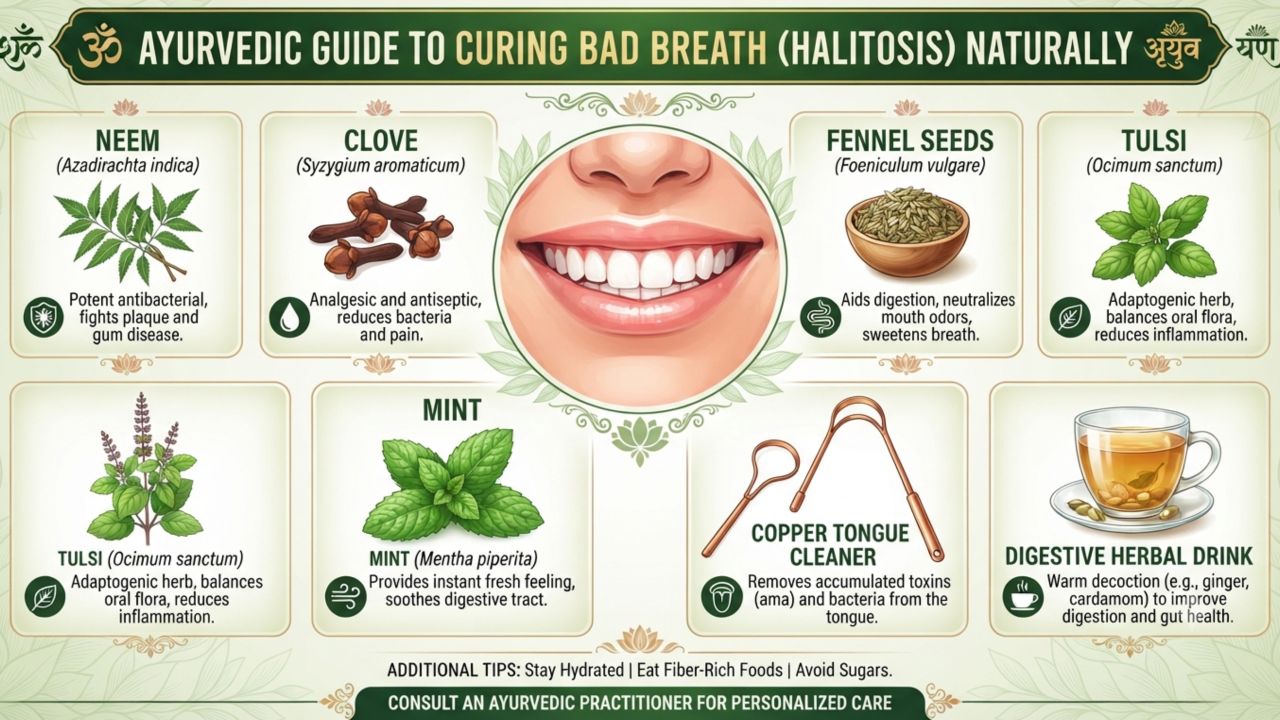
1. Cloves (Lavanga): The Kapha-Kaphna
In Ayurveda, cloves are classified as Kaphahara (Kapha-reducing) and Vatanulomana (directing Vata downward). The essential oil eugenol is recognized as a potent Krimighna (anti-microbial and anti-parasitic).
Cloves specifically target the sticky, heavy Kapha that forms the white coating on the tongue—the primary seat of mouth odor.
How to use it: Chew one or two whole cloves slowly after meals. For a more intensive remedy, make Lavanga Churna: grind five cloves with a pinch of rock salt and gently rub the powder on your gums and tongue. Spit, then rinse with warm water.
2. Fennel Seeds (Saunf): The Post-Prandial Purifier
Fennel seeds are a cornerstone of Ayurvedic post-meal rituals. They are Tridoshic (balancing for all three Doshas) with a slight emphasis on reducing Kapha and Vata.
Their Madhura (sweet) and Kashaya (astringent) tastes stimulate Agni while cleansing the oral cavity.
How to use it: After lunch and dinner, take one teaspoon of fennel seeds. Chew them thoroughly for two minutes.
For enhanced effect, dry-roast the seeds with a pinch of Hing (asafoetida)—a classical Ayurvedic remedy for digestive gas and breath odor.
3. Cardamom (Ela): The Heart-Friendly Refresher
Cardamom is revered in Ayurveda not only for its fragrance but for its ability to strengthen the heart (Hridaya) and awaken the mind. On a local level, Ela reduces Kapha and Pitta stagnation. Its essential oils are Shodhana (purifying) to the oral mucosa.
How to use it: Crack two green cardamom pods, crush the black seeds lightly, and steep them in a cup of warm water for 10 minutes.
Strain and drink as tea. Alternatively, simply chew the seeds after any meal containing onion or garlic—cardamom is considered the specific antidote (Pratipaksha) to their pungent odor.
4. Holy Basil (Tulasi): The Sacred Antibacterial
Tulasi (Ocimum sanctum) holds a unique place in Ayurveda as a Rasayana (rejuvenative) with powerful Krimighna (anti-microbial) properties. The leaves are particularly effective against the anaerobic bacteria that produce volatile sulfur compounds.
How to use it: Chew five to six fresh Tulasi leaves each morning, holding the juice on your tongue for 10 seconds before swallowing. If fresh leaves are unavailable, steep dried Tulasi in hot water to make a tea and use as a mouth rinse.
5. Neem (Nimba): The Dental Guardian
No Ayurvedic article on mouth odor is complete without Neem. Known as the “village pharmacy,” neem is intensely bitter (Tikta Rasa), which makes it powerfully Kapha-reducing and antimicrobial. Chewing neem twigs (Dantadhavana) was the original Ayurvedic toothbrush.
How to use it: Take a fresh neem twig (or use neem powder). If using a twig, chew one end until it becomes fibrous like a brush, then gently scrub your teeth and tongue. For a milder version, boil a handful of neem leaves in water, cool, and use as a daily mouth rinse.
Oil-Based Remedies (Gandusha & Kavala Graha)
Below are some oil-based remedies inspired by Ayurvedic Gandusha and Kavala Graha practices, promoting oral hygiene, nourishment, freshness, and overall mouth wellness naturally.
1. Sesame Oil Pulling: The Classical Gandusha
Oil pulling is not a new wellness trend—it is a classical Ayurvedic procedure called Gandusha (holding oil in the mouth) or Kavala Graha (swishing oil).
The classical texts specify cold-pressed sesame oil as the first choice, not coconut oil. Sesame oil is uniquely Tridoshic, with a slight affinity for pacifying Vata.
It is heavy, oily, and penetrating—qualities that draw out fat-soluble toxins (Ama) from the oral mucosa and gingival crevices.
Ayurvedic rationale: Sesame oil acts as a Snigdha (unctuous) vehicle that binds to Ama and is then expelled.
The 10- to 15-minute swishing time allows the oil to undergo lipolysis, releasing free fatty acids that disrupt bacterial cell walls.
How to perform: Take one tablespoon of organic, cold-pressed sesame oil (warm it slightly if solid). Swish it slowly, without gargling, pulling it between teeth and across the tongue.
After 10–15 minutes, the oil will become thin, white, and milky—signifying it has absorbed toxins. Spit into a disposable cup (not the sink), then rinse with warm salt water. Perform daily upon waking, before eating or drinking.
2. Coconut Oil with Turmeric: A Pitta-Kapha Variation
For individuals with dominant Pitta (prone to inflammation, bleeding gums, or sour breath) or Kapha (thick tongue coating, mucus), coconut oil with turmeric is an excellent variation.
Coconut oil is cooling (Sheeta) and Kapha-aggravating if used alone, but when combined with turmeric (Haridra), a potent anti-inflammatory and antimicrobial, the blend becomes balanced.
How to use it: Warm two tablespoons of coconut oil and mix in ½ teaspoon of turmeric powder. Allow to cool to lukewarm. Use 1 tablespoon for Gandusha as described above.
Tongue Scraping (Jihva Nirlekhanam) – The Most Critical Ayurvedic Practice
Of all the remedies described in the Charaka Samhita for mouth odor, tongue scraping (Jihva Nirlekhanam) is singled out as the single most important daily practice (Dincharya).
The coating on the tongue—often white (Sama Kapha), yellow (Pitta), or brownish (Vata)—is considered the most visible manifestation of Ama. Leaving it in place allows toxins to be reabsorbed throughout the day.
Why a spoon is not ideal: While a household spoon can work, classical Ayurveda recommends a copper tongue scraper. Copper has natural Krimighna (antimicrobial) properties and, according to Ayurveda, imparts a subtle Rasayana (rejuvenative) energy to the tissues.
How to perform Jihva Nirlekhanam:
- Stand in front of a mirror. Extend your tongue.
- Hold the copper scraper (or rounded spoon) gently but firmly.
- Starting from the back of the tongue (as far as comfortable without gagging), draw the scraper forward to the tip in one smooth motion.
- Rinse the scraper under warm water. Repeat 5–7 times until no coating remains.
- Do this every morning before brushing, drinking, or eating.
Expected result: Within three days of consistent tongue scraping, most people notice a dramatic reduction in morning breath and a cleaner taste throughout the day.
Herbal Gargles & Powders (Kavala & Dantadhavana Churna)
Below are some herbal gargles and powders inspired by Ayurvedic Kavala and Dantadhavana Churna practices, supporting oral cleansing, freshness, gum care, and overall mouth wellness naturally.
1. Salt Water with Trikatu: The Warming Gargle
While simple salt water is effective, Ayurveda enhances it with Trikatu (“three pungents”): equal parts dried ginger (Shunthi), black pepper (Maricha), and long pepper (Pippali).
This combination stokes Agni and scrapes Kapha from the throat and oral cavity.
How to use it: Dissolve ½ teaspoon of rock salt (Sendha Namak) and ¼ teaspoon of Trikatu powder in one cup of warm water.
Gargle vigorously for 30 seconds, ensuring the solution reaches the back of the throat. Perform after tongue scraping but before brushing.
2. Herbal Tooth Powder (Danta Dhavana Churna)
Modern toothpaste is a recent invention. For thousands of years, Ayurveda used powdered mixtures of astringent, bitter, and pungent herbs to clean teeth and eliminate odor. A simple home-made Danta Dhavana Churna includes:
- 2 parts Neem powder (antimicrobial)
- 2 parts Babul bark (astringent, gum health)
- 1 part Clove powder (analgesic, deodorizing)
- 1 part Peppercorn (stimulates salivation)
- ½ part Rock salt (mild abrasive, balances Vata)
How to use it: Mix the powders thoroughly. Dip a moistened toothbrush into the mixture or use your finger to rub it onto teeth and gums. Brush gently for two minutes, then rinse. Do this twice daily.
Yogurt & Probiotics through the Ayurvedic Lens (Takra & Lassi)
Below are some yogurt and probiotic approaches viewed through the Ayurvedic lens of Takra and Lassi, supporting digestion, balance, nourishment, and overall wellness naturally.
1. Buttermilk (Takra): The Digestive Fire Tonic
Ayurveda distinguishes between commercial yogurt and traditional Takra (spiced buttermilk). Takra is created by churning plain yogurt with water and specific digestive spices.
It is considered one of the most powerful remedies for Ama throughout the digestive tract, including Ama that rises to the mouth.
How to make Takra: Blend ¼ cup plain yogurt with ¾ cup water, a pinch of roasted cumin powder, a pinch of rock salt, and a few fresh curry leaves. Drink this after lunch.
The probiotics are delivered alongside spices that enhance Agni, ensuring the beneficial bacteria reach the lower gut while the mouth is cleansed.
2. Ayurvedic Warning on Cold Yogurt
Never consume cold, straight yogurt from the refrigerator. According to Ayurveda, cold yogurt increases Kapha, leading to more coating on the tongue and worsening mouth odor.
Always bring yogurt to room temperature, blend it with water to make Takra, or add a pinch of black pepper and ginger to neutralize its Kapha-increasing qualities.
Lifestyle & Hygiene (Dincharya & Ritucharya)
Ayurveda emphasizes that remedies work only within a supportive daily routine. To maintain fresh breath:
- Brush and scrape before sunrise (Brahma Muhurta), not after breakfast. Cleaning before eating allows the digestive fire to rise without obstruction.
- Eat your largest meal at midday, when Agni is strongest. A weak digestive fire at night leads to Ama formation and morning breath.
- Avoid incompatible food combinations (Viruddha Ahara). Specifically, never combine dairy with fish, fruit with dairy, or honey with hot water. These combinations produce toxins (Ama) that manifest as mouth odor.
- Chew one teaspoon of fennel seeds mixed with a pinch of jaggery after every meal. This is a classical Mukha Shodhana (oral purification) practice.
When to See a Doctor (Ayurvedic Triage)
If home remedies, tongue scraping, and dietary adjustments fail to resolve mouth odor after four weeks, Ayurveda recommends consulting a practitioner to identify deeper Dosha imbalances:
- Fruity, acetone-like odor → Severe Pitta derangement; possible diabetic condition (Madhumeha). Requires medical evaluation.
- Ammonia-like odor → Vata and Kapha imbalance affecting the kidneys (Mutravaha Srotas). Consult a physician.
- Foul, putrid odor with bleeding gums → Advanced Pitta and Rakta Dhatu (blood tissue) vitiation; likely periodontitis. See a dentist.
Fresh breath, in the Ayurvedic view, is not a cosmetic luxury. It is a sign of Ojas—vitality, clarity, and balanced health. And the path to that state is already in your kitchen, your spice box, and your daily routine. Begin tomorrow morning with a glass of warm water and a copper scraper. Your mouth—and your entire body—will thank you.