Herbs & Spices That You Should Try For Hair Growth At Home

In the search for lush and vibrant hair, the answer might just be found in the heart of your kitchen. For thousands of years, Ayurveda—the ancient Indian system of medicine and wellness—has taught us that true beauty is a reflection of our internal health and balance.  Long before the invention of synthetic serums and chemical-laden treatments, Ayurvedic practitioners relied on the earth’s botanical bounty to maintain the body, mind, and crowning glory.
Today, as we become increasingly aware of the harsh side effects of modern hair care—dryness from sulfates, scalp irritation from parabens, and long-term follicle damage from synthetic dyes—there is a massive resurgence in returning to our roots.
The kitchen pantry and the traditional home garden have once again become the primary apothecaries for beauty enthusiasts worldwide. In Ayurveda, hair is considered a byproduct of bone tissue (Asthi dhatu) and is deeply connected to the nervous system and the body’s vital essence (Ojas).
Therefore, healthy hair cannot be achieved through topical treatments alone; it requires nurturing the body from the inside out. The rejuvenating power of herbs and spices extends far beyond their culinary uses, offering a natural, accessible, and potent solution for promoting hair growth.
Beyond the shelves of expensive hair products, these remarkable ingredients possess the potential to invigorate your hair care routine, pacify imbalanced energies, and foster a healthier, more vibrant mane.
In this comprehensive guide, we’ll delve into the realm of herbs and spices through an Ayurvedic lens, uncovering their secrets for nurturing hair growth from the comfort of your own home.
Understanding Hair Growth Through the Ayurvedic Lens
Before we dive into the specific herbs and spices, it is essential to understand how Ayurveda views hair growth.
Ayurveda does not treat the hair as dead tissue; it views it as a vital byproduct of the metabolic process. Ayurveda categorizes the body’s energies into three doshas: Vata (air and ether), Pitta (fire and water), and Kapha (earth and water).
Every individual has a unique constitution (Prakriti), and their hair type reflects this.
- Vata Hair: Vata-dominant hair tends to be thin, dry, frizzy, and prone to split ends and breakage. It grows quickly but breaks easily due to a lack of natural moisture and lubrication.
- Pitta Hair: Pitta hair is generally straight and fine. When in balance, it is luscious and warm-toned. However, when out of balance, it is highly susceptible to premature graying and thinning due to excess heat burning away the follicle’s vitality.
- Kapha Hair: Kapha hair is naturally thick, oily, and luscious. Imbalances in Kapha lead to an overly greasy scalp, clogged follicles, sticky dandruff, and a heavy feeling on the head.
Furthermore, Ayurveda speaks of Agni (digestive fire) and Ama (toxins). If your digestion is weak, food is not properly broken down.
This creates Ama, a toxic, sticky residue that builds up in the body and blocks the channels (srotas) that supply nutrients to the hair follicles.
The herbs and spices listed below work primarily by kindling Agni, clearing Ama, increasing blood microcirculation, reducing inflammation, and balancing the doshas, thereby creating the perfect internal and external environment for hair to thrive.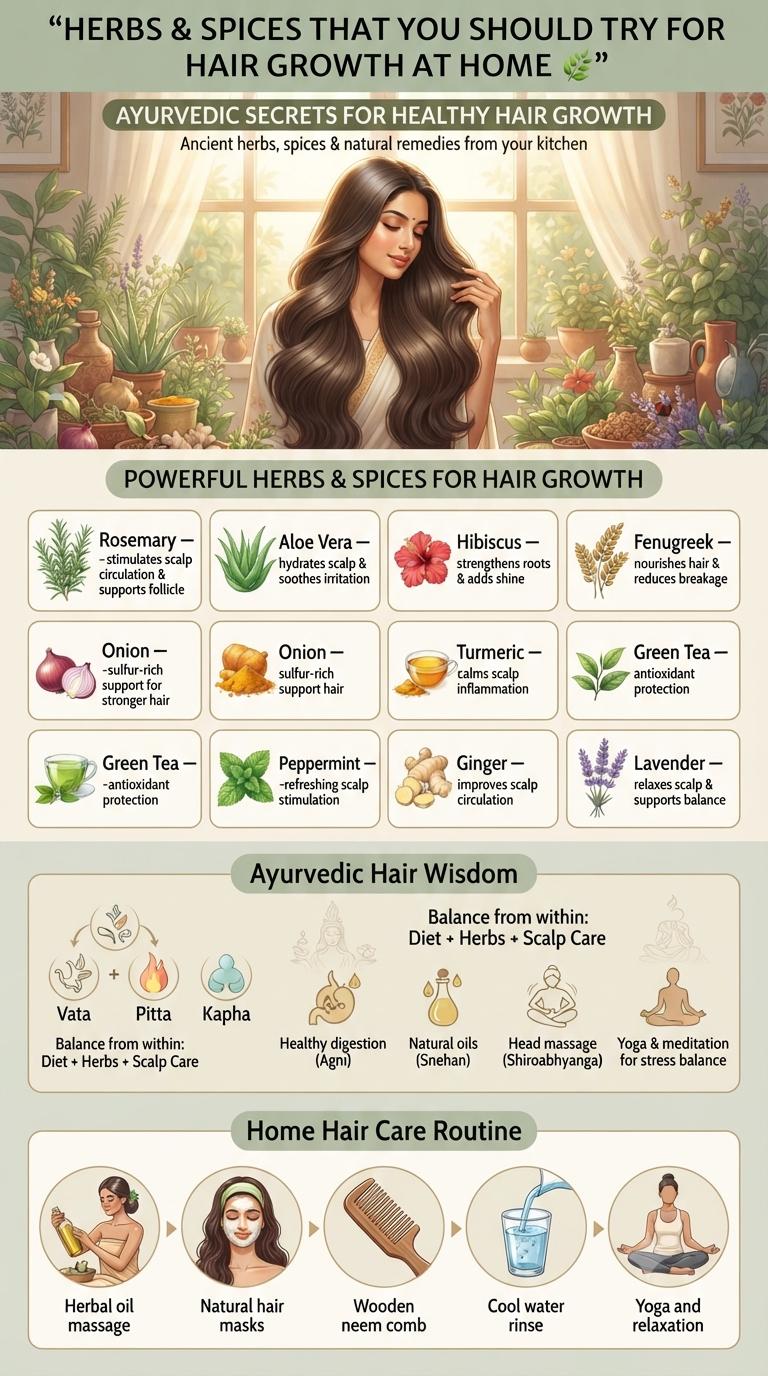
Herbs and Spices That Promote Hair Growth
While it is true that there is no miracle product to grow hair overnight, Ayurveda offers a wide variety of alternatives that can help stimulate healthy growth by treating the root cause of hair fall.
Consistency is key; natural remedies require regular application to yield visible results. Among these options, we find powerful medicinal plants that revitalize the mane when environmental stressors or internal imbalances have damaged it.
Do you dare to try them? Discover them below.
1. Rosemary
While native to the Mediterranean, Rosemary (Rosmarinus officinalis) has been warmly embraced by modern Ayurvedic practitioners for its Ushna (warming) and Tikta (bitter) qualities.
It is an excellent remedy for Kapha and Vata imbalances in the scalp. In recent years, rosemary has gained massive scientific backing for its ability to perform similarly to conventional hair growth treatments, but without the side effects.
Way to Use:
- Create a rosemary-infused oil by steeping a handful of dried rosemary leaves in a carrier oil (like coconut or jojoba) in a glass jar.
- Place the jar in a sunny window for two to four weeks to allow the solar energy and herb qualities to merge. Strain the leaves.
- Massage the oil onto your scalp using circular motions—a practice known as Shiroabhyanga (Ayurvedic head massage)—and leave it on for a few hours or overnight before washing.
Benefits:
- Rosemary works by stimulating cellular generation and blood circulation to the scalp, effectively clearing blocked srotas (channels).
- This rush of oxygen and nutrients wakes up dormant hair follicles. Its antioxidants fight off free radicals, which can cause premature aging and hair thinning.
- Furthermore, its warming properties soothe an itchy, Vata-aggravated scalp and help keep the scalp microbiome balanced.
2. Aloe Vera
Known as Kumari (meaning young maiden) in Sanskrit, Aloe Vera is a revered Ayurvedic rasayana (rejuvenative) succulent that perfectly balances Pitta dosha due to its Sheeta (cooling) nature.
It is highly revered for its ability to restore youthfulness to damaged tissues.
Way to Use:
- Extract fresh aloe vera gel directly from the plant’s leaves.
- Slice a leaf open, scoop out the clear gel, and blend it slightly to remove lumps.
- Apply it directly to your scalp and lengths.
- Leave it on for about 30 to 45 minutes before rinsing with lukewarm or cool water to maintain its cooling benefits.
Benefits:
- Kumari is packed with proteolytic enzymes that actively break down dead skin cells and excess sebum (Kapha) on the scalp, unclogging hair follicles.
- It naturally maintains the scalp’s pH balance, creating an optimal environment for hair growth.
- It acts as a deep conditioner, adding incredible shine, reducing Pitta-related frizz, and alleviating inflammatory scalp conditions like sunburn or dermatitis.
3. Ginseng
In Ayurveda, adaptogenic roots like Ginseng are often compared to Ashwagandha for their ability to restore balance and vitality to the body.
They are considered Balya (strength-giving) and Vata pacifying. Adaptogens help the body resist physiological and psychological stress.
Way to Use:
- Brew a strong cup of ginseng tea using root slices.
- Allow the tea to cool completely. After shampooing and conditioning, pour the cooled ginseng tea over your scalp and hair as a final rinse.
- Massage it in gently and do not rinse it out.
Benefits:
- Ginseng’s stimulating properties encourage hair growth by increasing dermal papilla cell proliferation. More importantly, adaptogens help the body manage stress.
- High stress elevates Vata and cortisol, a leading cause of telogen effluvium (stress-induced hair loss).
- By calming the nervous system (Manas vaha srotas), ginseng indirectly protects your hair from stress-induced shedding.
4. Peppermint
Known as Pudina in Ayurveda, peppermint is a potent Ushna (warming) and Laghu (light) herb that excels at pacifying Kapha dosha and clearing stagnation from the scalp.
It provides an immediate sensory awakening that translates to cellular awakening.
Way to Use:
- Mix 3 to 5 drops of peppermint essential oil with a tablespoon of a carrier oil (like sweet almond).
- Massage this mixture deeply into your scalp.
- Leave it on for 15 to 20 minutes before washing it out.
Benefits:
- The menthol in peppermint oil causes a rapid increase in local blood circulation, leading to increased hair follicle depth and overall follicle activity.
- In Ayurvedic terms, it clears Ama (toxins) from the scalp pores.
- Its cooling yet stimulating effect provides immense relief from scalp itchiness and Kapha-related dandruff.
5. Cinnamon
Known as Twak, cinnamon is a warming spice that brings a fiery, invigorating energy to the scalp.
It is highly effective at pacifying stagnant Kapha and stimulating sluggish Vata. It is one of the most powerful spices for microcirculation.
Way to Use:
- Mix one to two tablespoons of ground cinnamon with enough raw honey to form a thick paste. (Honey—Madhu—acts as a Yogavahi, meaning it carries the properties of the cinnamon deep into the tissues while buffering the heat).
- Apply to the scalp, leaving it on for 15 to 20 minutes before rinsing.
Note: You will feel a warming sensation; this is the Ushna virya (hot potency) at work. If it burns uncomfortably, wash it off immediately.
Benefits:
- Cinnamon kindles Agni (metabolic fire) in the scalp tissues, boosting blood circulation and providing hair follicles with essential nutrients.
- Its antimicrobial properties help prevent scalp infections and fungal dandruff caused by Kapha imbalance.
6. Ginger
Known as Ardraka (fresh) or Shunthi (dry), ginger is a universal medicine in Ayurveda (Vishwabheshaja).
It is Tikshna (sharp) and Ushna (hot), making it perfect for clearing Ama and stimulating hair growth from the root.
Way to Use:
Peel and chop a thumb-sized piece of fresh ginger. Blend it with a quarter cup of coconut oil. Apply the mixture to your scalp, leave it on for 30 minutes, and wash it out.
Benefits: Ginger contains gingerol, which stimulates hair follicles and promotes blood flow. Its Tikshna (penetrating) nature allows it to deeply cleanse the scalp of accumulated toxins and excess oil. It is highly effective against dandruff and scalp inflammation, removing the physical barriers that prevent hair from growing.
7. Turmeric
Known as Haridra, turmeric is one of the most sacred herbs in Ayurveda. It is Rakta shodhaka (blood purifier) and incredibly Sheeta (cooling), making it the ultimate remedy for Pitta-aggravated scalp issues like redness, itching, and inflammation.
Way to Use:
- Mix one tablespoon of turmeric powder with three tablespoons of plain yogurt.
- Yogurt is cooling and contains lactic acid, which synergizes beautifully with turmeric.
- Apply it to your scalp and hair, leaving it on for 20 to 30 minutes before rinsing. (Be cautious, as turmeric can stain light-colored towels).
Benefits:
- Turmeric’s active compound, curcumin, significantly reduces scalp inflammation—a hidden culprit behind Pitta-related hair loss.
- By purifying the blood and providing potent antioxidants, Haridra supports a healthy scalp ecosystem.
- It is particularly helpful for treating inflammatory dandruff and soothing irritated skin.
8. Fenugreek
Known as Methika, fenugreek is a legendary Ayurvedic herb specifically classified as Keshya (that which promotes hair health).
It balances both Vata and Kapha doshas and is a staple in Indian grandmother’s hair care recipes.
Way to Use:
- Soak two tablespoons of fenugreek seeds in water overnight.
- The next morning, blend the swollen seeds into a thick paste.
- Apply the paste to your scalp and hair, leaving it on for 30 minutes before washing.
Benefits:
- Methika is incredibly rich in proteins and nicotinic acid (Vitamin B3), which directly nourish Asthi dhatu (bone tissue, the parent tissue of hair).
- It contains lecithin, which strengthens the hair shaft and prevents breakage.
- Regular use adds a natural shine and effectively reduces Kapha-type oily dandruff.
9. Lavender
While not traditionally Indian, lavender’s Ayurvedic profile shows it to be Sheeta (cooling) and Snigdha (unctuous), making it a wonderful pacifier of Pitta and Vata doshas in the mind and scalp.
It bridges the gap between aromatherapy and topical treatment.
Way to Use:
- Mix 3 to 5 drops of lavender essential oil with a tablespoon of a carrier oil.
- Massage it into your scalp and leave it on overnight, wrapping your head in a silk scarf.
Benefits:
- Lavender promotes deep relaxation, pacifying an aggravated nervous system.
- By reducing stress and Vata imbalance, it indirectly supports hair growth.
- It also possesses potent antimicrobial properties that keep the scalp’s Kapha in check, preventing folliculitis and bacterial imbalances.
10. Thyme
Thyme shares similarities with Ayurvedic herbs like Ajwain (carom seeds). It is Ushna (hot) and Katu (pungent), highly effective at drying up excess Kapha moisture and fighting stubborn fungal infections.
Way to Use:
- Steep dried thyme leaves in a carrier oil using low heat or the sun-infusion method.
- Massage the infused oil into your scalp and let it sit for at least 30 minutes before washing.
Benefits:
- Thyme stimulates blood flow, nourishing starved hair follicles. Its active compound, thymol, gives it exceptional antifungal properties.
- If your hair loss is accompanied by Kapha-aggravated scalp issues like seborrheic dermatitis or fungal acne, thyme clears the path for uninterrupted hair growth.
11. Hibiscus
Known as Japa or Gudhal, hibiscus is the quintessential Ayurvedic flower for hair care.
It is a powerful Rasayana (rejuvenator) that balances Pitta and Vata. It is often called the “flower of hair care” in ancient texts.
Way to Use:
- Boil fresh hibiscus flowers and leaves in water until the water reduces by half.
- Let it cool, strain, and use it as a final hair rinse.
- Alternatively, crush the flowers into a paste with a little water or yogurt and apply directly to the scalp.
Benefits:
- Japa is naturally rich in amino acids and Vitamin C, which nourish the hair follicles and strengthen the Majja dhatu (nervous system/tissues connected to hair root).
- It is renowned in Ayurveda for its ability to prevent premature graying (a classic Pitta imbalance) by naturally boosting melanin production.
- It adds volume, treats dry scalp conditions, and adds a beautiful natural bounce.
12. Nettle
Known in Ayurvedic texts as Vrishchikali, stinging nettle is a nutrient-dense plant that excels at pacifying Kapha and purifying Rakta (blood). It acts as a powerful tonic for the hair.
Way to Use:
- Create a strong tea by steeping two tablespoons of dried nettle leaves in boiling water for 15 minutes.
- Let it cool, then use it as a hair rinse, massaging it into the scalp.
- You can also consume nettle tea internally for double the benefits.
Benefits:
- Nettle provides bioavailable iron, magnesium, and zinc—minerals essential for hair growth.
- It acts as a natural DHT (dihydrotestosterone) blocker.
- In Ayurveda, excess DHT is often seen as a byproduct of impaired Meda dhatu (fat tissue) metabolism; nettle helps clear this stagnation, preventing hair follicles from shrinking and hair from thinning.
13. Onion
Known as Piyaz, onion is a powerful kitchen remedy with strong Ushna virya (hot potency) and Katu rasa (pungent taste). It is highly effective at penetrating deep into the tissues to evoke change.
Way to Use:
- Extract raw onion juice by grating and straining the onion.
- Apply the juice directly to your scalp using a cotton ball.
- Leave it on for 30 minutes before washing thoroughly.
- (To mitigate the strong smell, you can add a few drops of rosemary or lavender essential oil to the juice).
Benefits:
- Onion juice is incredibly rich in sulfur (Gandhak), a mineral that is a vital building block of keratin.
- Sulfur kindles the Agni of the hair follicles, improves blood circulation, and promotes collagen production.
- It acts as a Shodhana (purifying) agent, ridding the scalp of bacterial infections and stimulating dormant follicles to enter the growth phase.
14. Green Tea
Green tea shares a similar Ayurvedic profile to standard black tea but is lighter and richer in antioxidants. It is Kashaya (astringent) and Tikta (bitter), making it excellent for pacifying Pitta and Kapha.
Way to Use:
- Brew two to three bags of organic green tea, let it cool completely, and pour it over your scalp and hair as a final rinse after washing.
Benefits:
- Green tea’s EGCG (Epigallocatechin gallate) prevents hair follicles from prematurely entering the resting (telogen) phase.
- Its astringent nature helps tighten the scalp tissues and control excess oil production (Kapha).
- It soothes Pitta-related scalp inflammation and gently stimulates growth without aggravating sensitive skin.
Ayurvedic Hair Care Tips at Home
Using herbs and spices is a fantastic Bahya (external) treatment, but Ayurveda teaches that true hair health requires Abhyantara (internal) balance as well.
Topical treatments cannot compensate for poor daily habits. Here are essential Ayurvedic tips to maximize your hair growth efforts:
1. Maintain a Dosha-Balancing Diet & Nourish Agni
In Ayurveda, you are not just what you eat, but what you digest. Making sure that your Agni (digestive fire) is strong is the absolute key to healthy hair.
If Agni is weak, food turns into Ama (toxins) instead of nutrients, which travels through the blood and deposits in the hair follicles, causing hair fall.
- Eat warm, cooked foods that are easy to digest. Avoid drinking ice-cold water with meals, as it extinguishes Agni.
- Include healthy fats like Ghee (clarified butter), which nourishes Asthi dhatu and Majja dhatu.
- Ensure you are getting adequate protein (mung beans, lentils, eggs, or tofu depending on your diet) to build keratin.
- Add digestive spices like cumin, coriander, and fennel to your cooking to stoke the digestive fire.
- Avoid excessive intake of spicy, oily, and processed foods, which aggravate Pitta and lead to premature thinning and graying.
2. Choose the Right Ayurvedic Products
Commercial shampoos strip the hair of its natural protective barrier (the acid mantle). Switching to natural cleansers is a non-negotiable step in Ayurvedic hair care.
- Hair Cleansers: Instead of harsh sulfate shampoos, turn to traditional Ayurvedic hair cleansers like Shikakai (fruit for hair), Reetha (soapnut), and Amla (Indian Gooseberry). These herbs naturally create a mild lather while balancing the scalp’s pH and nourishing the roots. Boiling these three together creates the famous “Ayurvedic shampoo.”
- Hair Conditioner: Avoid silicones. Instead, use natural botanical oils like Bhringraj oil, Brahmi oil, or Coconut oil to condition. These oils penetrate the hair shaft, unlike silicones, which merely coat it and cause long-term buildup.
3. Use a Neem Wood Comb & Boar Bristle Brush
Ayurveda places great importance on the materials that touch the body, as they can either pacify or aggravate the doshas.
- Neem or Sandalwood Comb: A wide-tooth wooden comb made of Neem is highly recommended. Neem is naturally antifungal and antibacterial. Unlike plastic, wood does not create static electricity (which aggravates Vata), and it gently massages the scalp, promoting blood flow every time you comb.
- Boar Bristle Brush: Once detangled, a boar bristle brush helps distribute the scalp’s natural sebum (Kapha) down the hair shafts, providing natural, deep conditioning from root to tip.
- Never Comb Wet Hair: Wet hair is in a weakened, swollen state. Combing it causes Vata-type breakage. Always allow hair to dry naturally before styling.
4. How to Do Deep Conditioning (Snehan) of Hair at Home
In Ayurveda, oiling the hair is known as Snehan (oleation), and it is considered a sacred weekly ritual to nourish the mind, nervous system, and hair.
Conditioner is extremely important, but deeply nourishing your hair at least once a week with an Ayurvedic hair mask or warm oil treatment is transformative.
Always warm the oil slightly using a water bath (never a microwave, as it destroys the oil’s medicinal properties) before applying it to enhance penetration.
5. Always Wash with Cool or Lukewarm Water
Hot water aggravates Pitta dosha and strips the hair of its natural oils (Sneha).
Cold or lukewarm water helps seal the hair cuticles flat, ensuring the hair is soft, silky, and retains the moisture from your herbal treatments. It traps the Ojas (vitality) within the hair shaft.
6. Trim Regularly to Remove Dead Ends
Ayurveda recommends trimming your hair every 6 to 8 weeks. Split ends represent dead Asthi dhatu (bone tissue).
If left untrimmed, the split travels upward, causing further breakage and wasting the energy the body is putting into growing the hair.
Trimming redirects the body’s energy (Prana) toward growing new, healthy hair rather than sustaining dead ends.
7. Stop Using Hot Styling Tools
Excessive heat directly aggravates Pitta and Vata doshas in the hair, literally “cooking” the moisture out of the strands and causing the internal protein structure to fracture.
Ayurveda advocates for embracing your natural hair texture. If you must style, use natural methods like braiding damp hair or pin-curling.
Protecting your hair from heat preserves its internal moisture and structural integrity.
8. Let Your Hair Air Dry and Practice Shiroabhyanga
Instead of a blow dryer, let your mane air dry. Gently squeeze excess water out with a soft cotton t-shirt (avoid rough terrycloth towels, which cause friction and Vata-aggravation).
Most importantly, incorporate Shiroabhyanga (head massage) into your routine. Massaging warm herbal oil into the scalp for 15-20 minutes before washing not only conditions the hair deeply but also calms the nervous system.
But also, induces better sleep and pacifies Vata—the dosha most responsible for dry, falling hair. Use your fingertips to make circular motions, starting from the crown and moving outward to the temples and the back of the neck.
The Role of Yoga and Pranayama in Hair Growth
Because hair is deeply tied to the nervous system and blood circulation, physical movement is a vital part of Ayurvedic hair care.
Stress constricts blood vessels, starving the follicles. Certain yoga asanas (postures) are specifically designed to reverse the flow of gravity and direct Prana (life force) and blood toward the scalp.
- Sarvangasana (Shoulder Stand): Known as the “Queen of Asanas,” this pose directly stimulates the thyroid gland (which governs metabolism) and floods the scalp with oxygenated blood.
- Viparita Karani (Legs Up the Wall): A gentle inversion that relieves stress, lowers cortisol, and promotes relaxation in the neck and head.
- Pranayama (Breathwork): Practices like Nadi Shodhana (Alternate Nostril Breathing) and Bhramari (Bee Breath) are incredibly effective at pacifying Vata and calming the mind, directly addressing stress-related hair fall.
FAQ’s
1. Which herbs are best for hair growth at home?
Herbs like rosemary, aloe vera, amla, fenugreek, hibiscus, and bhringraj are commonly used in natural hair care routines to support healthy hair and scalp care.
2. Can spices help with hair growth?
Yes, some spices such as cinnamon, turmeric, and black pepper are used in traditional hair care practices. They may help support scalp health when used properly.
3. How can I use rosemary for hair growth?
Rosemary can be used as a diluted essential oil mixed with a carrier oil or as rosemary-infused water for scalp care. Avoid applying concentrated essential oil directly to the scalp.
4. Is fenugreek good for reducing hair fall?
Fenugreek seeds are traditionally used in hair masks because they contain nutrients that may help improve hair strength and scalp condition.
5. How often should I use herbal remedies for hair growth?
Most homemade hair treatments can be used once or twice a week. Consistency and a healthy hair care routine are important for maintaining scalp health.
6. Can natural herbs regrow lost hair?
Herbs may support healthier hair growth and reduce breakage, but results vary depending on the cause of hair loss, genetics, diet, and overall health.
7. Which spice is commonly used for a healthy scalp?
Turmeric and cinnamon are commonly used in traditional remedies for their soothing properties, but they should be used carefully and diluted to avoid irritation.
8. Are homemade herbal hair remedies safe for everyone?
Natural ingredients can still cause allergies or irritation. Perform a patch test before applying any new herb, oil, or spice to your scalp.
9. What are the best herbs for thicker and stronger hair?
Amla, bhringraj, hibiscus, rosemary, and fenugreek are popular choices in natural hair care routines for supporting stronger-looking hair.
10. How long does it take to see results from herbal hair treatments?
Hair growth is a slow process. Many people need several weeks or months of consistent care before noticing visible changes. Results depend on individual hair and scalp conditions.
Achieving lush, vibrant hair is not a quick fix; it is a beautiful, ongoing dialogue between you and your body. By integrating these herbs and spices into your routine—alongside mindful dietary habits, proper sleep, and the ancient wisdom of Ayurveda—you address the root causes of hair fall rather than just the symptoms.